Key Highlights
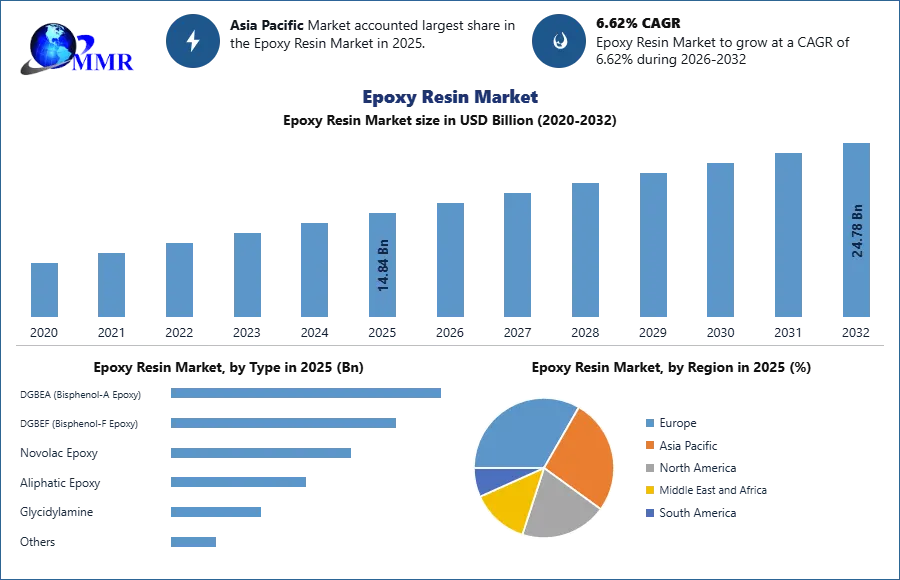
- Epoxy Resin Market valued at USD 14.84 Billion in 2025
- Expected to reach USD 24.78 Billion by 2032
- Forecast CAGR of 6.62% during 2025–2032
- Rising demand from wind energy, aerospace, automotive, electronics, and construction
- Bio-based epoxy resin development creates new commercial opportunities
- Asia Pacific remains the industry’s manufacturing and consumption powerhouse
- Innovation increasingly focused on performance, sustainability, and advanced composite applications
Why This Matters Now
Chemical manufacturers are facing a decisive shift in customer demand. Industrial buyers no longer seek only high-performance materials; they increasingly require products that combine durability, lightweight performance, and sustainability. That transition is changing procurement strategies across transportation, renewable energy, infrastructure, and electronics.
The Epoxy Resin Market, valued at USD 14.84 Billion in 2025, is projected to reach USD 24.78 Billion by 2032, growing at a 6.62% CAGR. That trajectory signals expanding opportunities for producers capable of securing raw materials, investing in specialty formulations, and developing bio-based alternatives before competitive pressures intensify.
Market Overview
The Epoxy Resin Market has evolved beyond its traditional role as an industrial adhesive. Today it is an essential material across protective coatings, structural composites, electrical insulation, construction systems, marine applications, and advanced manufacturing because of its exceptional chemical resistance, mechanical strength, and thermal performance.
Demand is increasingly being shaped by industries seeking materials that improve durability while reducing weight. Automotive manufacturers are pursuing lighter vehicle platforms. Wind turbine manufacturers require stronger composite blades. Aerospace companies continue replacing heavier materials with advanced composites. Each of these shifts expands downstream demand for epoxy resin while encouraging producers to develop higher-value specialty products instead of competing solely on commodity volumes.
Supply chains are also adapting. Manufacturers are investing more heavily in product development, feedstock flexibility, and operational efficiency to improve resilience against raw material volatility and changing customer specifications. These investments position leading suppliers to capture premium applications where performance outweighs price sensitivity.
Key Trends Driving Growth
One of the strongest growth catalysts is the rapid expansion of lightweight composite materials. Wind energy projects increasingly require longer turbine blades capable of operating under greater mechanical stress. Epoxy resins provide the tensile strength and structural stability necessary for these applications, making renewable energy a strategic growth engine for resin producers.
Automotive manufacturers are also accelerating material substitution strategies. Lighter composite components improve fuel efficiency and support vehicle electrification objectives. As manufacturers prioritize weight reduction without sacrificing structural integrity, epoxy-based composites become increasingly attractive across multiple vehicle platforms.
Another notable trend is the emergence of bio-based epoxy resins. Research into renewable feedstocks including sorbitol, natural sugars, isosorbides, and bio-sourced glycerol is creating opportunities to reduce dependence on conventional petrochemical inputs. These developments align with global sustainability priorities while opening premium product categories for specialty chemical manufacturers.
Technology remains another competitive differentiator. Continuous research and development is producing improved resin formulations with enhanced mechanical properties, broader application compatibility, and better environmental performance. Companies investing consistently in innovation are strengthening pricing power while expanding into higher-margin industrial applications.
Segment Insights
- Dominant Segment: The supplied report identifies growing demand from end-use industries, particularly applications involving adhesives, coatings, composites, construction, electronics, aerospace, automotive, and wind energy, but does not explicitly identify the dominant segment.
- Fastest-Growing Segment: The report highlights lightweight composites used in wind turbines and aerospace as major growth drivers, indicating these advanced composite applications are among the fastest-expanding opportunities.
- Rising downstream consumption is being driven by industrialization, urbanization, and expanding technology-intensive industries worldwide.
- Bio-based epoxy resin development represents one of the industry’s most significant long-term opportunity areas through renewable feedstock adoption and sustainable chemistry innovation.
Regional Growth Story
Asia Pacific continues to anchor global epoxy resin production and consumption because of its extensive manufacturing ecosystem, expanding construction activity, and strong industrial base. The region benefits from large-scale downstream industries including electronics, automotive manufacturing, and infrastructure development, making it the primary engine of market expansion.
China remains central to global manufacturing capacity, while India continues benefiting from industrialization and infrastructure investment that increase demand for coatings, adhesives, and construction materials. Japan and South Korea contribute through advanced electronics, automotive innovation, and high-performance manufacturing where specialty epoxy formulations command premium value.
In North America, the United States continues investing in aerospace manufacturing, renewable energy, and advanced industrial production. Germany maintains its position as Europe’s manufacturing leader, supported by automotive engineering, industrial machinery, and specialty chemical expertise. Across these mature markets, investment increasingly targets high-performance applications rather than commodity production, supporting stronger margins for technology-focused suppliers.
Competitive Landscape
Competition is moving beyond production scale toward technological differentiation. Manufacturers expanding research capabilities are improving product performance while addressing customer demand for sustainable alternatives. That strategy strengthens customer retention and reduces exposure to commodity pricing cycles.
Innovation in bio-based feedstocks also signals a broader competitive transition. Companies investing early in renewable raw materials could gain regulatory advantages, improve sustainability credentials, and capture customers seeking lower-carbon procurement strategies. Rather than competing solely through capacity additions, producers are increasingly building competitive advantage through intellectual property, application expertise, and specialized formulations.
Recent Developments
- Increased investment in bio-based epoxy resin research using renewable raw materials including sorbitol, natural sugars, isosorbides, and bio-sourced glycerol.
- Growing adoption of epoxy resin in lightweight composites supporting wind turbine manufacturing.
- Continued research focused on developing improved epoxy resin formulations with enhanced performance characteristics.
- Expanding industrial demand driven by urbanization, economic development, and technology-intensive manufacturing sectors.
Strategic Implications
Procurement leaders should prepare for stronger competition in specialty epoxy applications as renewable energy, aerospace, and advanced manufacturing continue expanding. Long-term supplier partnerships will become increasingly valuable where consistent quality and technical support matter more than lowest-cost sourcing.
Chemical manufacturers should prioritize investments in sustainable feedstocks, advanced formulations, and resilient supply chains. Companies capable of combining innovation with manufacturing scale will be better positioned to protect margins as customer expectations shift toward higher-performance and lower-carbon materials.
Investors should monitor companies building differentiated technology portfolios rather than simply expanding production capacity. Specialty products supported by intellectual property generally provide stronger pricing discipline and greater resilience during raw material volatility.
Future Outlook
The next phase of the Epoxy Resin Market will be defined less by volume expansion than by the industry’s ability to commercialize sustainable feedstocks, capture advanced composite demand, and deliver differentiated performance—placing technology leaders in the strongest competitive position while commodity-focused producers face increasing margin pressure.
Analyst Perspective
“The epoxy resin industry is entering a phase where innovation and sustainability will increasingly determine competitive success. Manufacturers investing in bio-based technologies and advanced application development are positioned to capture the strongest long-term value creation opportunities.” — Ankita Kagawade, Analyst
About Maximize Market Research
Maximize Market Research Pvt. Ltd. (MMR) is a global market research and consulting company that provides reliable, data-focused, and practical business insights. The firm serves a wide range of industries, including healthcare, pharmaceuticals, technology, automotive, electronics, chemicals, personal care, and consumer goods. Through market forecasts, competitive analysis, strategic consulting, and industry impact assessments, MMR helps organizations understand changing market conditions, identify growth opportunities, and make informed business decisions for long-term success.
2nd Floor, Navale IT Park Phase 3
Pune Banglore Highway, Narhe
Pune, Maharashtra 411041, India
+91 9607365656
sales@maximizemarketresearch.com
