Key Highlights
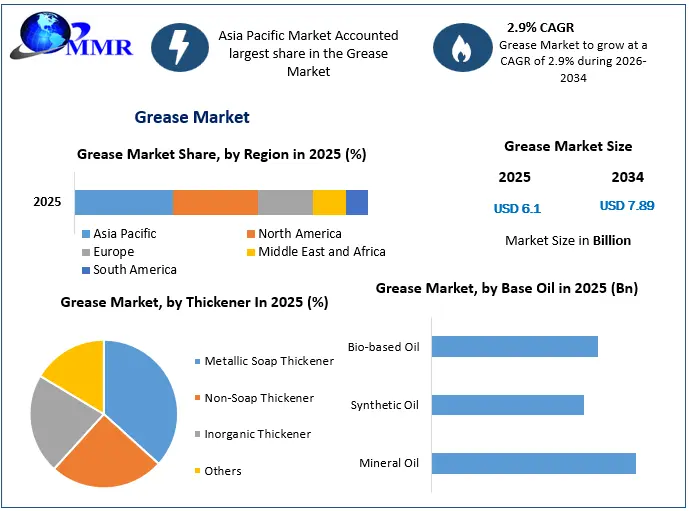
- Grease Market valued at USD 6.1 billion in 2025.
- Expected to reach USD 7.89 billion by 2034.
- Forecast CAGR of 2.9% from 2026 to 2034.
- Automotive manufacturing and shipbuilding remain primary demand generators.
- Asia-Pacific continues to lead global consumption and production.
- Industrial automation is increasing demand for premium-performance greases.
- Sustainability initiatives are accelerating interest in advanced lubricant formulations.
Why This Matters Now
Lubricants rarely dominate headlines, yet they determine equipment reliability, maintenance costs, and manufacturing productivity across global industry. As vehicle production expands and marine transportation investments accelerate, procurement teams are reassessing lubricant sourcing to reduce downtime while protecting operating margins.
The Grease Market, valued at USD 6.1 billion in 2025 and projected to reach nearly USD 7.89 billion by 2034 at a CAGR of 2.9%, signals a stable but strategically important opportunity. For manufacturers, this means consistent long-term demand rather than cyclical spikes. For suppliers, it reinforces the importance of product differentiation, supply reliability, and application-specific performance.
Market Overview
The Grease Market combines base oils, thickeners, and additives into a semi-solid lubricant designed to reduce friction, resist water, and protect equipment operating under demanding conditions. Unlike liquid lubricants, grease remains in place for extended periods, making it indispensable for bearings, heavy machinery, automotive assemblies, marine equipment, mining systems, and industrial production lines.
Growth remains closely linked to industrial activity. Automotive manufacturing continues to consume significant lubricant volumes through original equipment manufacturing and aftermarket servicing. Shipbuilding adds another layer of demand because marine environments require specialized products capable of resisting corrosion, water contamination, and extreme operating conditions. Every increase in vehicle production or marine construction therefore translates into recurring lubricant consumption rather than one-time purchases.
Demand is also becoming increasingly quality-driven. Manufacturers are seeking greases that extend maintenance intervals, reduce equipment failures, and improve energy efficiency. This shifts competition away from price alone toward technical performance and lifecycle value.
Key Trends Driving Growth
Automotive production remains the market’s largest catalyst. Every passenger vehicle, commercial truck, agricultural machine, and construction vehicle requires multiple grease applications throughout manufacturing and operational life. Higher vehicle ownership expands both OEM demand and aftermarket replacement cycles.
Industrial automation is changing lubricant specifications. Automated manufacturing systems operate continuously and require longer-lasting lubrication to minimize shutdowns. Suppliers capable of delivering extended-service formulations gain stronger customer retention.
Marine transportation continues to support specialized lubricant demand. Expansion of global shipping fleets and shipbuilding activity increases consumption of corrosion-resistant and water-resistant greases, creating opportunities for higher-value specialty products.
Technology development is also reshaping competition. Manufacturers continue investing in formulations that improve oxidation stability, thermal resistance, mechanical durability, and equipment protection. Product innovation increasingly becomes a pricing advantage rather than simply a compliance requirement.
Environmental expectations are influencing purchasing decisions as well. Industrial customers increasingly evaluate lubricant efficiency alongside sustainability objectives, encouraging suppliers to develop cleaner formulations while maintaining equipment protection.
Segment Insights
- Dominant Segment: Not specified in the supplied report.
- Fastest-Growing Segment: Not specified in the supplied report.
- Automotive applications continue to represent one of the strongest sources of lubricant demand due to sustained vehicle production.
- Marine and heavy industrial applications continue generating demand for high-performance specialty greases.
- Industrial maintenance requirements support recurring replacement demand across manufacturing sectors.
Regional Growth Story
Asia-Pacific remains the center of gravity for grease production and consumption because it combines expanding manufacturing capacity, strong automotive output, infrastructure investment, and growing industrial equipment installations. China and India continue benefiting from expanding manufacturing ecosystems, while Japan and South Korea sustain demand through advanced automotive and industrial production.
The United States continues to generate stable demand through automotive manufacturing, aerospace, heavy machinery, agriculture, and industrial maintenance. Modernization of manufacturing facilities supports demand for premium lubricant technologies designed for higher productivity.
Germany remains Europe’s industrial benchmark. Advanced engineering, precision manufacturing, and automotive production require consistent use of specialty greases capable of supporting sophisticated machinery with minimal maintenance interruptions.
Growing industrialization across emerging economies also creates incremental opportunities. As manufacturing investment expands, grease consumption follows equipment installations, creating recurring aftermarket demand that often exceeds original equipment lubricant volumes over time.
Competitive Landscape
Competition increasingly centers on formulation expertise rather than production volume alone. Manufacturers able to supply application-specific products gain stronger customer relationships because industrial buyers prioritize equipment reliability over marginal price differences.
Research investments indicate a gradual transition toward premium lubricant portfolios capable of serving electric mobility, automated manufacturing, and advanced industrial machinery. These developments improve pricing resilience while reducing exposure to commoditized product categories.
Capacity investments also reflect confidence in long-term industrial demand. Expansion decisions typically signal expectations of sustained utilization rather than speculative growth, helping stabilize supply availability across major manufacturing regions.
Competitive positioning therefore depends on three capabilities: dependable raw-material sourcing, technical product development, and extensive industrial distribution networks capable of supporting global customers.
Recent Developments
- Automotive manufacturing expansion continues supporting lubricant demand.
- Shipbuilding activity strengthens requirements for specialized marine greases.
- Product innovation focuses on improved equipment protection and longer maintenance intervals.
- Industrial customers increasingly prioritize high-performance lubricant solutions that reduce operational downtime.
Strategic Implications
Procurement leaders should view grease as a strategic maintenance input rather than a commodity purchase. Lower-quality lubricants may reduce acquisition costs but often increase equipment wear, maintenance frequency, and operational interruptions.
Chemical manufacturers face opportunities to differentiate through specialty formulations instead of competing solely on volume. Investments in research, application engineering, and technical customer support can strengthen pricing power even in a moderate-growth environment.
Industrial buyers also benefit from supplier partnerships capable of ensuring consistent product availability. Supply continuity becomes increasingly valuable as manufacturers seek greater resilience across maintenance operations and production planning.
Future Outlook
The Grease Market is expected to maintain steady expansion as automotive manufacturing, industrial automation, and marine transportation sustain lubricant demand. Growth is unlikely to be explosive, but recurring replacement cycles provide resilience against economic volatility. Companies investing in premium formulations, reliable supply chains, and application-specific innovation will be best positioned to capture long-term value while commodity suppliers face increasing competitive pressure.
Analyst Perspective
“The grease industry is evolving beyond traditional lubrication. Automotive manufacturing, marine expansion, and industrial modernization are creating sustained demand for higher-performance products, making innovation and application expertise increasingly important competitive advantages.” — Ankita Kagawade
About Maximize Market Research
Maximize Market Research Pvt. Ltd. (MMR) is a global market research and consulting company that provides reliable, data-focused, and practical business insights. The firm serves a wide range of industries, including healthcare, pharmaceuticals, technology, automotive, electronics, chemicals, personal care, and consumer goods. Through market forecasts, competitive analysis, strategic consulting, and industry impact assessments, MMR helps organizations understand changing market conditions, identify growth opportunities, and make informed business decisions for long-term success.
2nd Floor, Navale IT Park Phase 3
Pune Banglore Highway, Narhe
Pune, Maharashtra 411041, India
+91 9607365656
sales@maximizemarketresearch.com
