Key Highlights
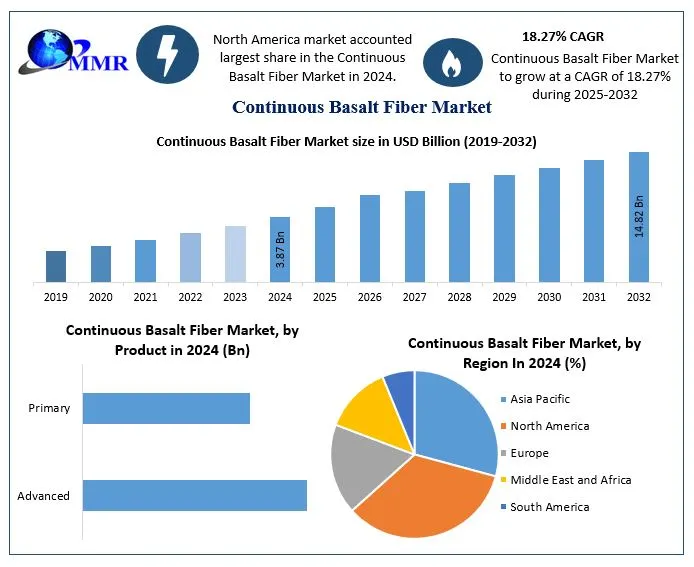
The market value scales from USD 3.87 Billion in 2024 to USD 14.82 Billion by 2032 under an aggressive 18.27% growth trajectory.
Single-phase manufacturing technology drives down production costs to match standard E-glass fibers, altering procurement economics.
High technological entry barriers and technical asset costs restrict raw asset deployment and localized market consolidation.
The building and construction application sector claims market dominance through structural requirements for low bulk density and high thermal tolerance.
Process machinery innovations introduce the BCF-G and BCF-GM series, decreasing gas consumption while lifting manufacturing yields.
Why This Matters Now
Volatile raw material costs and stringent decarbonization mandates are disrupting the global technical textiles and composites sectors, leaving chemical asset managers with a narrow window to secure structural material alternatives. Traditional steel and glass reinforcement materials face intense regulatory pressures due to high production emissions and weight limitations. Decision-makers must immediately pivot to volcanic mineral processing to insulate supply chains against carbon taxes and steel procurement constraints.
Industrial buyers are actively accelerating qualification cycles for continuous basalt fiber to exploit its chemical stability and structural longevity. Procuring this material provides a strategic hedge against the high energy costs associated with synthetic fiber production. Industrial infrastructure programs and clean energy installations require high volumes of lightweight materials, ensuring that capital deployment into basalt production assets yields substantial returns.
Market Overview
The global Continuous Basalt Fiber Market represents a critical shift toward mineral-derived high-performance reinforcements. Valuation metrics registered the sector at USD 3.87 Billion in 2024, with long-term capital deployment expected to drive total revenue to USD 14.82 Billion by 2032. This expansion reflects an 18.27% CAGR across the forecast period, signaling rapid structural substitution across heavy industries.
The structural foundation of this market rests on single-phase melting technology, which transforms crushed volcanic rock directly into continuous filaments without chemical additives. This lean manufacturing footprint minimizes upstream chemical synthesis risks and reduces plant emissions. However, structural constraints persist; short-term market expansion faces localized headwinds from technical cost constraints and raw material extraction limits. As industrial supply chains seek higher resilience, continuous basalt fiber offers an alternative to conventional glass fibers and structural steel alloys.
Key Trends Driving Growth
Surging demand for renewable energy infrastructure acts as the primary tailwind for continuous basalt fiber adoption. Wind turbine manufacturers utilize the material in heavy-duty blade assemblies to mitigate structural fatigue and withstand extreme environmental exposure. This transition aligns directly with state-level mandates favoring zero-emission power generation, opening up high-volume supply contracts for compounders.
Concurrently, a major shift in processing efficiency is altering the competitive baseline for global fiber manufacturers. The commercialization of BCF-G and BCF-GM series process machinery lowers operational expenditure by cutting natural gas and electricity usage during melting cycles. These technological advancements drop net operational costs to parity with E-glass fiber, removing the historical premium barrier that previously restricted basalt to niche applications.
Segment Insights
Dominant Segment: Building and Construction. This application sector captures the largest financial footprint due to urgent demand for modern building materials featuring low bulk density, extreme thermal load resistance, and high structural filtering capabilities.
Fastest-Growing Segment: Advanced Product Manufacturing. Industrial demand for specialized composite components, including reinforced mesh, non-woven geotextiles, industrial fabrics, and heavy-duty structural tapes, drives the fastest rate of market consumption.
Regional Growth Story
North America maintains the dominant market share and continues to display the fastest regional growth rate through 2032. Rapid industrialization and heavy spending on defense systems and high-performance sports equipment sustain high consumption volumes across domestic supply chains. The region also benefits from growing applications in advanced multi-layer blown film manufacturing within the pharmaceutical and food packaging sectors.
In parallel, Asia-Pacific remains the primary manufacturing and technology hub, led by heavy industrial concentration in China, India, Japan, and South Korea. Chinese entities leverage state-backed research infrastructure to optimize single-phase production lines, driving down global commodity prices. European hubs, anchored by Germany, focus heavily on automotive lightweighting and environmental filtration compliance, sustaining a steady import flow of raw basalt filaments.
Competitive Landscape
The global structural matrix of the continuous basalt fiber market features a mix of regional technology pioneers and diversified chemical material conglomerates. China-based companies, such as Shanxi Basalt Fiber Technology Co., Ltd and JiangSu TianLong Continuous Basalt Fiber High-tech Co., Ltd, utilize direct access to domestic mineral reserves to drive high-capacity utilization. Similarly, specialized players like Zhejiang GBF Basalt Fiber Co., Ltd focus on expanding output for advanced product applications.
Western and Eastern European market participants, including Kamenny Vek, Basaltex NV, and Technobasalt Invest LLC, maintain pricing power by focusing on specialized composite formulations and proprietary sizing technologies. Other critical entities, such as Sudaglass Fiber Technology Inc, Mafic SA, Mineral 7 CJSC, and Zaomineral, compete on supply chain resilience and localized distribution networks. The market shows an increasing concentration of capital, with top-tier producers investing heavily in automated machinery to protect their market share from lower-cost glass fiber alternatives.
Recent Developments
Engineering teams rolled out the next-generation BCF-1G, BCF-1GM, BCF-2G, and BCF-2GM processing installations to scale up manufacturing output.
Production lines integrated advanced thermal recovery systems to lower natural gas inputs during basalt rock melting operations.
Regional compounders expanded their product portfolios to include specialized chopped strand roving designed explicitly for heavy transport body applications.
Aerospace and defense suppliers executed long-term supply agreements to secure continuous filament yarns for high-temperature insulation barriers.
Chemical technology firms optimized one-phase basalt extraction systems to achieve direct manufacturing cost parity with commercial E-fiberglass.
Strategic Implication
The convergence of cost parity with E-glass and superior structural performance will alter procurement strategies across the automotive, construction, and energy sectors. Companies relying on legacy glass fiber reinforcements face the risk of margin erosion as competitors transition to basalt-reinforced systems to achieve higher strength-to-weight ratios. Procurement managers must act now to secure multi-year supply contracts with primary mineral processors before surging wind energy demand consumes available capacity.
Furthermore, capital investment strategies must adapt to the unique raw material dynamics of the volcanic rock supply chain. Because basalt fiber production requires specific mineral compositions, manufacturers who acquire sites near high-grade basalt deposits will gain long-term pricing power. Conversely, companies that fail to invest in efficient processing machinery risk being squeezed out by rising industrial energy costs.
Future Outlook
Market consolidation will favor high-capacity producers that integrate low-emission BCF-G series machinery into their primary production lines, leaving undercapitalized operations exposed to rising technical cost pressures.
Analyst Perspectiv
“The continuous basalt fiber sector has moved past its pilot-scale origins into a high-growth industrial phase,” stated Ankita Kagwade, Lead Analyst at Maximize Market Research. “By achieving production cost parity with standard E-glass while providing superior chemical stability, this mineral asset offers an excellent opportunity for chemical and materials manufacturers to de-risk their portfolios.”
About Maximize Market Research
Maximize Market Research Pvt. Ltd. (MMR) is a global market research and consulting company that provides reliable, data-focused, and practical business insights. The firm serves a wide range of industries, including healthcare, pharmaceuticals, technology, automotive, electronics, chemicals, personal care, and consumer goods. Through market forecasts, competitive analysis, strategic consulting, and industry impact assessments, MMR helps organizations understand changing market conditions, identify growth opportunities, and make informed business decisions for long-term success.
2nd Floor, Navale IT Park Phase 3
Pune Banglore Highway, Narhe
Pune, Maharashtra 411041, India
+91 9607365656
sales@maximizemarketresearch.com
