Key Highlights
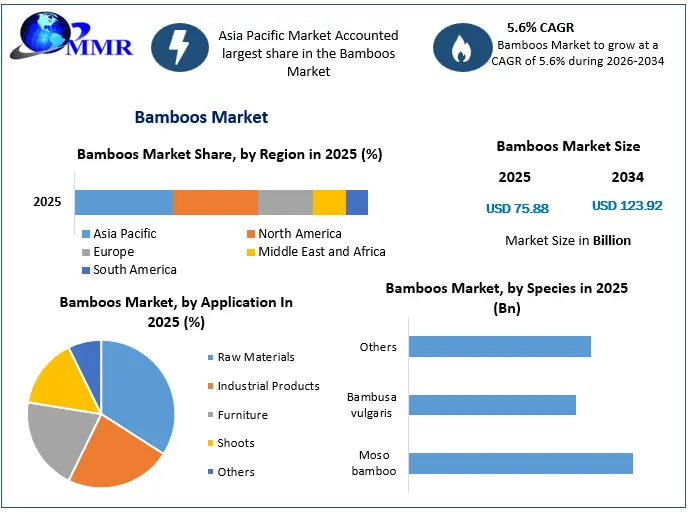
The global Bamboos Market achieved a valuation of USD 75.88 Billion in 2025 and is projected to scale to USD 123.92 Billion by 2034.
Industrial consumption is accelerating at a compound annual growth rate (CAGR) of 5.6% from 2026 to 2034.
The Asia-Pacific region commands the largest market share, driven by extensive natural reserves, mature cultivation infrastructure, and concentrated processing hubs in China and India.
Rising regulatory penalties on single-use plastics and carbon-intensive construction materials are forcing industrial buyers to shift procurement toward renewable bamboo alternatives.
Feedstock volatility remains a key supply chain risk, requiring strategic investments in structured commercial plantations to secure long-term industrial supply.
Why This Matters Now
Volatile timber supply chains and intensifying carbon emissions penalties are forcing industrial manufacturers to rapidly re-engineer their raw material baselines. The 2025 market valuation of USD 75.88 Billion proves that bamboo is no longer just a niche agricultural product; it has evolved into a critical industrial feedstock. Procurement leaders face a stark choice: secure long-term bio-based supply contracts now or risk exposure to escalating regulatory costs and synthetic material shortages.
What changed is the technical viability of processed bamboo. Recent advancements in processing technologies have converted raw bamboo into standardized, high-tensile structural components and chemical-grade cellulose. Why now? Global decarbonization mandates are penalizing traditional timber harvesting and petroleum-based plastics, creating an immediate demand vacuum that bamboo is uniquely positioned to fill. Industrial buyers benefit from an exceptionally short cultivation cycle compared to traditional softwoods, enabling faster supply chain adaptation to demand shocks. What happens next is a fundamental shift in material sourcing, where legacy chemical and construction firms must integrate agricultural supply chains directly into their operational planning.
Market Overview
The commercial trajectory of the Bamboos Market reflects an accelerating shift toward circular economy inputs across major manufacturing hubs. Generating USD 75.88 Billion in 2025, the global market is set to touch USD 123.92 Billion by 2034, expanding at a steady 5.6% CAGR. This growth pattern highlights the material’s transition from local craftsmanship applications to scaled industrial manufacturing inputs.
This structural expansion is anchored by the plant’s biological advantages, notably its rapid growth cycle and high carbon sequestration capabilities. Unlike traditional hardwood forests that require decades to mature, commercial bamboo can be harvested within three to five years without destroying the root system. This rapid regeneration capability ensures a highly resilient feedstock pipeline, shielding downstream industrial users from the chronic supply shocks common in the timber and forestry markets.
Furthermore, the geographical concentration of cultivation is expanding beyond its traditional Asian boundaries. While nations like China and India remain the bedrock of global volume, investment is surging across Latin America and Sub-Saharan Africa to establish parallel supply chains. This geographical diversification addresses logistics risks and satisfies the localized procurement mandates enforced by Western multi-national buyers.
Key Trends Driving Growth
Decarbonization mandates act as the primary catalyst transforming the global market landscape. Regulatory frameworks, particularly within the European Union and North America, are penalizing industrial sectors that rely on carbon-heavy manufacturing inputs. As chemical producers and construction conglomerates race to lower their scope 3 emissions, bamboo has emerged as a high-margin substitution candidate. The material’s natural capacity to capture carbon during growth adds substantial value for compliance-driven procurement strategies.
Technological breakthroughs in pulp extraction and composite manufacturing are also unlocking previously inaccessible downstream sectors. Historically, the irregular physical dimensions of natural bamboo limited its utility in high-precision manufacturing. Modern thermo-mechanical processing now allows producers to break down fibers into highly uniform structural engineered boards, bio-plastics, and specialized textiles. These innovations directly open up high-volume automotive and electronics packaging markets.
Consumer sentiment is simultaneously driving a shift in retail packaging and consumer goods manufacturing. Brands face intense pressure to eliminate single-use plastics, creating an immediate, high-volume demand for biodegradable bamboo pulp. This shift ensures consistent, non-cyclical demand that insulates bamboo cultivators from the macroeconomic downturns that typically depress structural construction markets.
Segment Insights
Dominant Segment: Industrial Applications command the largest volume and revenue share within the market. This dominance stems from massive downstream consumption in pulp, paper, and structural engineered boards, where manufacturers require steady, high-volume feedstock inputs to sustain continuous factory utilization.
Fastest-Growing Segment: Bamboo Composites and Bio-plastics represent the fastest-growing product category. This accelerating expansion is driven by automotive lightweighting initiatives and strict regulatory bans on petroleum-derived polymers in consumer packaging solutions.
Regional Growth Story
The Asia-Pacific region maintains absolute dominance over global production and consumption dynamics. China stands as the undisputed center for bamboo processing capacity, driven by decades of state-supported plantation development and highly integrated industrial clusters. India is executing aggressive national cultivation strategies to expand its domestic processing capabilities, aiming to reduce its reliance on imported paper pulp and structural timber.
In Western economies, the market is defined by rapidly rising import volumes. The United States and Germany represent massive consumption sinks, where demand is fueled by the construction, automotive, and consumer goods packaging sectors. Tightening environmental regulations in these regions prevent the expansion of local logging, forcing industrial buyers to look for imported bio-based substitutes.
Concurrently, South Korea and Japan are channeling significant research and development investments into high-performance bamboo-fiber composites. These advanced materials are designed for use in their domestic electronics and automotive manufacturing ecosystems. This targeted R&D activity is transforming bamboo from a simple commodity import into a highly specialized, engineered material input.
Competitive Landscape
The competitive structure of the market is rapidly consolidating as large industrial packaging and forestry corporations acquire local, specialized processors. Established players are forming strategic partnerships with agricultural cooperatives to secure exclusive access to certified plantation outputs. This vertical integration is crucial for ensuring uniform raw material quality and guaranteeing continuous factory operations.
Investment capital is increasingly flowing into automated, large-scale processing facilities designed to optimize fiber extraction yields. Smaller, fragmented processors are struggling to compete with these highly efficient operations, which can absorb fluctuations in raw feedstock prices. This dynamic is driving significant consolidation, with larger entities standardizing product grades across global supply chains.
Furthermore, leading market participants are heavily investing in chain-of-custody tracking technologies. Providing verifiable environmental data has become a critical competitive differentiator, as industrial buyers require auditable proof of sustainability to satisfy regulatory compliance. Companies that fail to provide transparent tracking are systematically being cut out of lucrative Western corporate supply contracts.
Recent Developments
Industrial forestry leaders have formed new joint ventures with local agricultural authorities in Southeast Asia to establish over 50,000 hectares of managed commercial bamboo plantations.
Advanced manufacturing facilities equipped with automated thermo-mechanical fiber extraction lines have been commissioned in China to produce high-purity industrial pulp.
Automotive component manufacturers have successfully integrated lightweight bamboo-fiber composites into mass-production interior panels for electric vehicles.
Major consumer packaging firms have secured long-term off-take agreements with bamboo processors to completely phase out single-use plastics from their global portfolio.
Strategic Implications
The evolution of the market fundamentally alters procurement risks for global manufacturing corporations. Relying solely on spot-market purchases for bio-based inputs is no longer a viable strategy as competition for high-quality fiber intensifies. Companies must actively pursue long-term off-take agreements or invest directly in upstream cultivation infrastructure to protect their production timelines from future raw material spikes.
Moreover, the shift toward bamboo composites changes the cost-benefit calculations for product design engineers. Bamboo’s high tensile strength allows for significant material reduction without sacrificing structural integrity, lowering total freight costs. Embracing these advanced bio-composites early provides a distinct cost and regulatory advantage over slower-moving competitors.
Future Outlook
Looking forward, the global market will experience sharp divisions based on processing sophistication and supply chain transparency. Standardized, high-grade bamboo fibers will increasingly compete directly with traditional glass fibers and engineered softwoods. Winners in this shifting landscape will be the vertically integrated enterprises that master automated processing and offer verified carbon tracking data to compliance-squeezed industrial buyers.
Analyst Perspective
“The global shift toward bio-based economies has transformed bamboo from a traditional agricultural resource into a critical industrial feedstock. As industrial buyers face tightening emissions regulations and volatile synthetic material markets, securing reliable, high-tensile, and sustainable bamboo supply chains has become a strategic priority for maintaining long-term manufacturing resilience.” — Ankita Kagawade, Analyst, Maximize Market Research
About Maximize Market Research
Maximize Market Research Pvt. Ltd. (MMR) is a global market research and consulting company that provides reliable, data-focused, and practical business insights. The firm serves a wide range of industries, including healthcare, pharmaceuticals, technology, automotive, electronics, chemicals, personal care, and consumer goods. Through market forecasts, competitive analysis, strategic consulting, and industry impact assessments, MMR helps organizations understand changing market conditions, identify growth opportunities, and make informed business decisions for long-term success.
2nd Floor, Navale IT Park Phase 3
Pune Banglore Highway, Narhe
Pune, Maharashtra 411041, India
+91 9607365656
sales@maximizemarketresearch.com
