Key Highlights
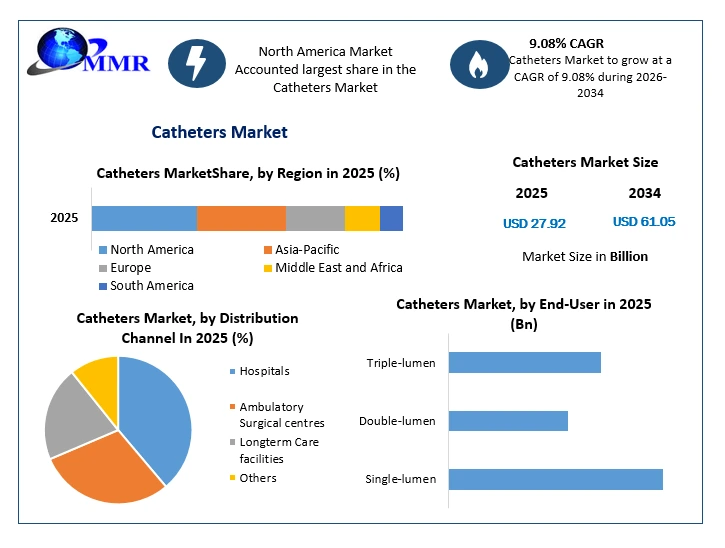
Market Growth: Valued at USD 23.47 billion in 2023, projected to reach USD 43.13 billion by 2030.
Expansion Rate: 9.08% CAGR during the 2024–2030 forecast period.
Dominant End-User: Hospitals account for over 43.36% of market revenue, driven by complex interventional surgeries.
Fastest-Growing Segment: Double-lumen catheters are expected to grow at the highest CAGR of 10.2% due to their utility in intravenous procedures and hemodialysis.
Technological Shift: High demand for antimicrobial catheters to combat catheter-associated infections (CAUTIs) and bloodstream infections (CLABSIs).
Regional Leader: North America holds the largest revenue share, while Asia-Pacific is the fastest-growing region.
Why This Matters Now
The clinical mandate is clear: reduce patient trauma and hospital-acquired infections. With chronic diseases—such as hypertension and diabetes—driving a massive rise in demand for renal and vascular support, the “last mile” of drug and fluid delivery is being revolutionized by catheter engineering. For hospital systems and procurement leaders, selecting the right technology—specifically antimicrobial and dual-access devices—is no longer just a supply chain decision; it is a critical strategy to improve patient throughput and reduce the total cost of care.
Market Overview
The global Catheters Market is scaling rapidly as medical interventions shift from the operating theater to the interventional suite. These devices, manufactured from advanced medical-grade silicone, nylon, and polyurethane, are fundamental to treating cardiovascular, neurovascular, and urological conditions. The market’s trajectory from USD 23.47 billion in 2023 to a projected USD 43.13 billion in 2030 underscores the increasing reliance on these devices to manage the modern world’s most burdensome chronic ailments.
Key Trends Driving Growth
The industry is responding to the dual pressures of an aging global population and the rise of lifestyle-related chronic diseases. In the United States alone, the prevalence of chronic kidney disease among adults highlights the urgent necessity for advanced dialysis and renal care infrastructure. As patients opt for minimally invasive procedures to manage these conditions, hospitals are prioritizing technology that enables simultaneous fluid administration and improved patient comfort.
Safety is the secondary, yet equally critical, driver. Catheter-associated infections remain a significant barrier to clinical efficiency. Consequently, market players are aggressive in their development of antimicrobial coatings and designs that prevent thrombosis. This focus on “zero-infection” pathways is changing how procurement teams vet new device portfolios, shifting preference toward products that provide quantifiable reductions in complication rates.
Segment Insights
Dominant Segment: Hospitals remain the primary end-user, accounting for over 43.36% of market share. This is attributed to the concentration of complex interventional surgeries and the availability of specialized personnel required to manage advanced catheterization procedures.
Fastest-Growing Segment: Double-lumen catheters are projected to achieve a 10.2% CAGR. Their unique capability to provide independent venous access—allowing for the simultaneous injection of different fluids or medications—has made them indispensable in critical care and hemodialysis.
Product Focus: The sector is shifting toward materials that offer the optimal combination of flexibility, durability, and biological inertness.
Regional Growth Story
North America currently dominates the market landscape, benefiting from an established infrastructure, supportive government policies, and high awareness of minimally invasive techniques. In the U.S., where one in seven adults faces chronic kidney disease, the demand for high-quality catheterization is constant. Europe is following a similar path, with a CAGR of 10.05% forecast for the 2024–2030 period as the region shifts its focus toward advanced, efficient outpatient care.
Asia-Pacific is the most rapid growth engine for the industry. China and India are experiencing a surge in infrastructure investment and an increase in the prevalence of cardiovascular and kidney-related diseases. While challenges remain regarding the availability of highly specialized surgeons, the rapid expansion of hospital networks in these nations is accelerating the adoption of international-grade catheterization standards, setting the stage for long-term regional dominance.
Competitive Landscape
The competitive environment in the catheters market is centered on technology leadership and the ability to scale specialized device portfolios. Industry players are moving beyond hardware production, increasingly focusing on integration with diagnostic imaging systems and smart patient-monitoring protocols. This competitive signaling indicates that the market is moving toward a “total solution” model.
Hospital purchasing behavior is increasingly shifting toward vendors who can provide a comprehensive ecosystem of support—training, specialized instrumentation, and integrated data. Investments in antimicrobial technology and the development of new catheter materials aren’t just incremental improvements; they are key differentiators used to secure long-term hospital contracts. Future market direction will favor those who successfully bridge the gap between material science and digital health integration, effectively reducing infection rates while simultaneously streamlining interventional workflows.
Recent Developments
Antimicrobial Innovation: Market leaders are significantly increasing R&D into silver-alloy and antibiotic-coated catheters to directly reduce the incidence of CLABSIs and CAUTIs.
Clinical Infrastructure: Growth in hospital-based interventional suites is driving demand for highly specialized catheters, particularly in the cardiovascular and neurovascular fields.
Shift in Care Delivery: European health systems are increasingly transitioning patients from inpatient to outpatient catheterization, necessitating the development of devices optimized for rapid, reliable, and lower-cost usage.
Strategic Implications
The transition toward antimicrobial and dual-access catheters represents a “quality floor” for modern medical facilities. Procurement leaders must view these devices as strategic assets that prevent costly post-operative complications rather than as standard consumables. For investors, the opportunity lies in manufacturers that can prove clinical efficacy—specifically, those that provide clear data on reduced hospital readmission rates and infection management.
Future Outlook
The next phase of growth in the catheters market will be defined by the seamless integration of smart-material engineering and digital patient-monitoring capabilities. The future market leaders will be those who successfully translate real-time procedural data into improved device design, creating a feedback loop that enhances clinical precision and safety. The divide between future winners and laggards will be marked by this transition: winners will deliver “intelligent” conduits that actively participate in clinical safety, while laggards will remain stuck in a commodity-driven cycle of competing only on price and basic functionality.
Analyst Perspective
“The catheter is evolving from a passive drainage tool to a high-precision, intelligent clinical asset,” says Komal Patil. “Success in this market now requires an integrated approach that prioritizes infection prevention through antimicrobial innovation while simultaneously enabling the faster, more efficient minimally invasive procedures that modern hospital systems demand.”
About Maximize Market Research
Maximize Market Research Pvt. Ltd. (MMR) is a global market research and consulting company that provides reliable, data-focused, and practical business insights. The firm serves a wide range of industries, including healthcare, pharmaceuticals, technology, automotive, electronics, chemicals, personal care, and consumer goods. Through market forecasts, competitive analysis, strategic consulting, and industry impact assessments, MMR helps organizations understand changing market conditions, identify growth opportunities, and make informed business decisions for long-term success.
2nd Floor, Navale IT Park Phase 3
Pune Banglore Highway, Narhe
Pune, Maharashtra 411041, India
+91 9607365656
sales@maximizemarketresearch.com
