Key Highlights
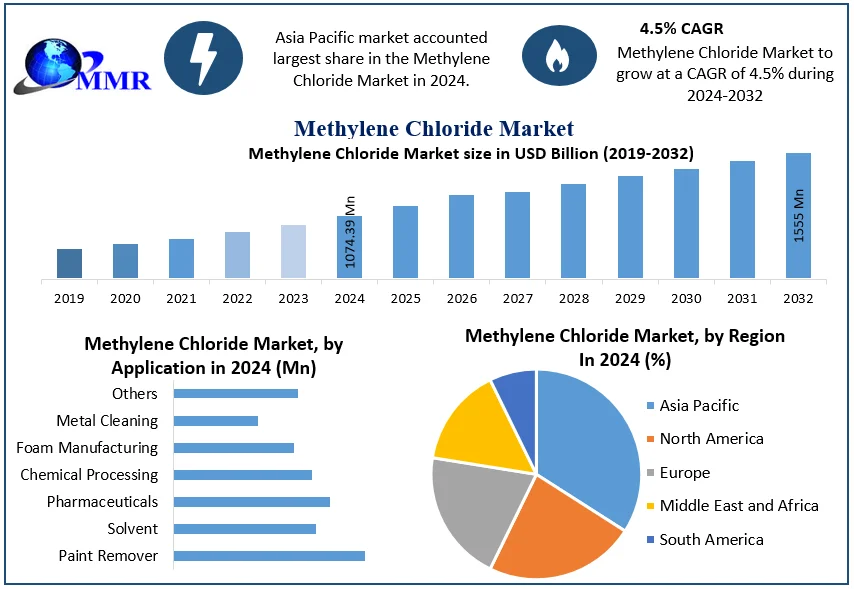
- Methylene Chloride Market was valued at USD 1,074.39 million in 2024 and is projected to reach USD 1,555 million by 2032, growing at a 4.73% CAGR. The expansion signals continued demand despite tightening regulatory oversight.
- Paint remover remains the dominant application segment, while pharmaceuticals are expected to register the fastest growth.
- Asia Pacific leads global consumption and production due to industrial expansion and feedstock availability.
- Environmental regulations continue to shift demand toward controlled industrial applications and safer operating practices.
- Chemical manufacturers are balancing compliance investments with opportunities in pharmaceutical and specialty chemical production.
Why This Matters Now
Chemical producers are navigating a market where demand remains resilient but regulatory tolerance is narrowing. Manufacturers that can secure reliable feedstock, optimize production efficiency, and redirect capacity toward high-value pharmaceutical applications stand to strengthen margins while competitors dependent on regulated paint-removal uses face increasing pressure.
Market Overview
The Methylene Chloride Market is entering a new competitive phase. Global revenue reached USD 1,074.39 million in 2024 and is expected to climb to USD 1,555 million by 2032, representing a 4.73% CAGR. For investors, the steady expansion indicates continued industrial relevance rather than speculative growth. For buyers, it highlights the importance of securing long-term supply agreements as downstream demand diversifies.
What has changed is the balance between mature and emerging applications. Paint removers continue to account for the largest share of consumption, but environmental restrictions are encouraging suppliers to prioritize sectors with stronger regulatory acceptance, particularly pharmaceuticals and chemical processing. This transition is changing production economics and influencing capital allocation across the chlorinated solvent industry.
Supply-demand dynamics remain relatively balanced because methylene chloride continues to serve multiple industrial processes, including foam manufacturing, metal cleaning and chemical processing. Producers are therefore shifting product portfolios instead of abandoning production capacity altogether.
Key Trends Driving Growth
Pharmaceutical manufacturing is becoming the industry’s strongest long-term growth driver. As drug production expands across Asia and other manufacturing hubs, demand for high-performance processing solvents continues to increase. This creates more stable purchasing patterns compared with cyclical construction-related applications.
Feedstock availability continues to favor Asian producers. Easy access to raw materials, combined with expanding chemical manufacturing infrastructure, improves production economics and supports competitive exports. That advantage strengthens regional pricing power while encouraging additional downstream investment.
Regulation remains the defining market force. Restrictions on methylene chloride use in paint removal, including actions highlighted by industry organizations, are redirecting innovation toward safer formulations, industrial handling systems and higher-value applications. Companies investing in compliance technologies are better positioned to preserve market access.
Technology improvements are also influencing competitiveness. Modern manufacturing processes improve operational efficiency, reduce waste generation and strengthen environmental performance. While methylene chloride remains a commodity chemical in several applications, process optimization increasingly differentiates leading producers.
Pricing trends continue to depend largely on feedstock availability, environmental compliance costs and regional production balances. Procurement teams therefore place greater emphasis on supplier reliability rather than simply negotiating the lowest contract price.
Segment Insights
- Dominant Segment: Paint Remover remains the largest application because of extensive industrial use in coatings removal and maintenance operations. However, regulatory restrictions are gradually limiting expansion opportunities.
- Fastest-Growing Segment: Pharmaceuticals are projected to record the highest growth rate as global medicine production expands and manufacturers require reliable processing solvents.
- Chemical Processing: Stable industrial demand supports consistent consumption across specialty chemical production.
- Foam Manufacturing: Continues to contribute to baseline demand across insulation and manufacturing applications.
- Metal Cleaning: Industrial maintenance and precision manufacturing sustain ongoing solvent requirements.
Regional Growth Story
Asia Pacific remains the industry’s production and consumption center, accounting for approximately 40% of the global market. Industrialization, expanding manufacturing capacity, readily available raw materials and rising downstream demand collectively reinforce the region’s leadership. China and India continue attracting investment because integrated chemical supply chains improve both cost efficiency and production flexibility.
The United States represents a more mature market. Regulatory controls surrounding paint-removal applications have moderated growth, encouraging suppliers to focus on pharmaceutical manufacturing, specialty chemicals and industrial processing where compliance pathways remain stronger.
Germany continues to emphasize high-value specialty chemical manufacturing supported by stringent environmental standards. Japan and South Korea remain important technology-driven chemical producers where operational efficiency and advanced manufacturing support premium product positioning. These mature markets increasingly compete through quality, regulatory compliance and specialized industrial applications rather than production scale.
Competitive Landscape
Competition is shifting from volume expansion toward portfolio optimization. Producers capable of serving pharmaceutical manufacturers gain greater pricing resilience because these customers typically prioritize supply consistency and product quality over commodity pricing.
Capacity investments increasingly target regions with strong feedstock access and expanding downstream industries. This strategy improves plant utilization while reducing logistics costs. Companies that successfully integrate upstream production with downstream specialty chemical customers strengthen long-term competitiveness and reduce exposure to volatile commodity cycles.
Regulatory investment has also become a competitive differentiator. Firms adopting cleaner manufacturing practices, improved worker safety systems and stronger environmental compliance are more likely to retain customer confidence as global standards continue tightening.
Recent Developments
- Growing pharmaceutical demand is shifting investment priorities toward higher-value industrial applications.
- Environmental regulations continue restricting paint-removal applications, accelerating portfolio diversification.
- Asia Pacific manufacturers continue benefiting from favorable raw material availability and expanding industrial capacity.
- Chemical producers are increasing emphasis on compliant production processes and operational efficiency.
Strategic Implications
Chemical manufacturers should view methylene chloride as a market transitioning from broad industrial solvent demand toward application-specific specialization. Procurement leaders benefit from diversifying supplier networks across major producing regions while monitoring regulatory developments that could influence availability or pricing.
Investors should focus on producers with balanced exposure across pharmaceutical, chemical processing and specialty manufacturing rather than businesses heavily dependent on regulated paint-removal demand. Companies combining efficient production with environmental compliance are positioned to capture the most sustainable returns.
Future Outlook
Market expansion will continue through 2032, but value creation will increasingly depend on regulatory adaptability, pharmaceutical demand and production efficiency rather than simple volume growth. Companies investing in compliant manufacturing, resilient supply chains and higher-value downstream markets are likely to outperform competitors that remain concentrated in heavily regulated applications.
Analyst Perspective
“The methylene chloride industry is entering a phase where operational efficiency alone will not determine leadership. Companies aligning production with pharmaceutical demand while proactively responding to environmental regulations will define the next competitive landscape.” — Ankita Kagawade, Analyst
About Maximize Market Research
Maximize Market Research Pvt. Ltd. (MMR) is a global market research and consulting company that provides reliable, data-focused, and practical business insights. The firm serves a wide range of industries, including healthcare, pharmaceuticals, technology, automotive, electronics, chemicals, personal care, and consumer goods. Through market forecasts, competitive analysis, strategic consulting, and industry impact assessments, MMR helps organizations understand changing market conditions, identify growth opportunities, and make informed business decisions for long-term success.
2nd Floor, Navale IT Park Phase 3
Pune Banglore Highway, Narhe
Pune, Maharashtra 411041, India
+91 9607365656
sales@maximizemarketresearch.com
