Virtual Content Creation Market: AI, VR, and the Creator Economy Are Transforming Digital Experiences
The digital economy is evolving rapidly, and immersive technologies are redefining how businesses and consumers interact with content. From virtual reality (VR) gaming and augmented reality (AR) marketing to 3D product visualization and digital twins, the Virtual Content Creation Market has become one of the fastest-growing segments within the digital media ecosystem. According to Stellar Market Research, the market is poised for exceptional expansion as organizations increasingly invest in immersive content, cloud-based creative tools, and AI-powered production platforms.
Understanding the Virtual Content Creation Market
Virtual content creation involves designing and producing immersive digital experiences using technologies such as virtual reality (VR), augmented reality (AR), mixed reality (MR), 3D modeling, animation, interactive videos, and virtual environments. These solutions are widely used across entertainment, gaming, education, healthcare, retail, manufacturing, and real estate.
The growing popularity of the metaverse, digital marketing, and virtual collaboration has significantly increased demand for interactive and visually engaging content. As businesses strive to deliver richer customer experiences, virtual content is becoming an essential component of digital transformation strategies.
𝐃𝐨𝐰𝐧𝐥𝐨𝐚𝐝 𝐅𝐫𝐞𝐞 𝐏𝐃𝐅 𝐁𝐫𝐨𝐜𝐡𝐮𝐫𝐞: https://www.stellarmr.com/report/req_sample/Virtual-Content-Creation-Market/1472
AI and Immersive Technologies Are Accelerating Market Growth
Artificial intelligence is revolutionizing how virtual content is created. AI-powered design tools now automate animation, image generation, scene creation, voice synthesis, and video editing, enabling creators to produce high-quality content more efficiently.
At the same time, improvements in VR and AR hardware have made immersive experiences more accessible to businesses and consumers alike. The combination of AI with VR, AR, and cloud computing is reducing production costs while expanding creative possibilities across industries.
Gaming and Entertainment Continue to Lead Demand
The gaming and entertainment sectors remain the largest adopters of virtual content creation solutions. Game developers continuously invest in realistic environments, interactive storytelling, and immersive gameplay to attract global audiences.
Streaming platforms, film studios, and media companies are also embracing virtual production technologies that combine real-time rendering, motion capture, and digital environments. These innovations shorten production timelines while enhancing visual quality.
Beyond entertainment, businesses are increasingly using virtual experiences for product launches, brand campaigns, live events, and customer engagement.
Cloud-Based Platforms Simplify Content Development
Cloud technology has significantly lowered the barriers to entry for virtual content creation. Designers, developers, and creative teams can now collaborate remotely using cloud-based software without investing heavily in expensive infrastructure.
Benefits of cloud-enabled virtual content creation include:
Real-time collaboration
Faster project delivery
Lower infrastructure costs
Scalable computing resources
Simplified asset management
Improved workflow automation
These advantages are encouraging startups, educational institutions, and enterprises to adopt virtual content development tools.
Retail, Healthcare, and Education Create New Opportunities
While gaming remains a major application, several industries are rapidly expanding their use of immersive content.
Retail companies use AR-powered virtual try-ons and 3D product visualization to improve online shopping experiences. Healthcare organizations employ VR simulations for medical training, surgical planning, and patient education. Educational institutions increasingly integrate immersive learning environments that improve student engagement through interactive simulations.
Manufacturing companies are also utilizing digital twins and virtual training modules to improve operational efficiency and workforce development.
Asia-Pacific Leads Global Market Expansion
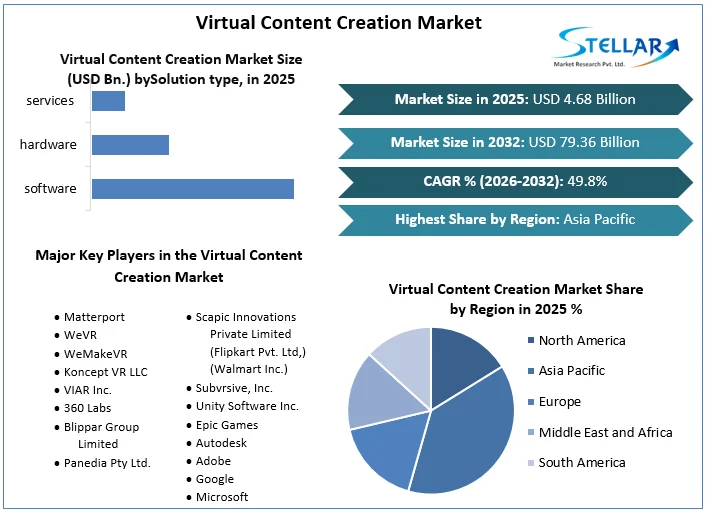
Asia-Pacific dominates the Virtual Content Creation Market due to rapid digitalization, expanding internet connectivity, and strong investments in gaming, e-commerce, and technology innovation. Countries such as China, India, Japan, and South Korea continue to experience increasing demand for immersive digital experiences.
Government initiatives supporting digital infrastructure and the rapid growth of creator economies are further strengthening regional market expansion.
North America Drives Technology Innovation
North America remains a key innovation hub, supported by leading software developers, cloud providers, gaming companies, and AI technology firms. Businesses throughout the region continue investing in immersive marketing, enterprise collaboration platforms, and virtual training solutions.
The region’s strong venture capital ecosystem also accelerates the commercialization of advanced virtual content creation technologies.
Challenges Facing the Industry
Despite remarkable growth prospects, several challenges continue to influence market development.
High Production Complexity
Developing high-quality virtual environments requires specialized technical expertise, advanced software, and powerful computing infrastructure.
Hardware Limitations
Although VR and AR devices have become more affordable, widespread adoption still depends on continued improvements in device performance, comfort, and pricing.
Intellectual Property and Data Security
As virtual content becomes increasingly valuable, protecting digital assets and ensuring data privacy remain significant concerns for creators and businesses.
Competitive Landscape
The Virtual Content Creation Market is highly competitive, with global technology companies, software developers, gaming studios, and specialized immersive content providers investing heavily in innovation.
Leading companies focus on:
AI-powered creative software
Real-time rendering technologies
Cloud-based collaboration platforms
Strategic acquisitions
VR and AR ecosystem development
Creator-focused subscription services
Enterprise virtual content solutions
Continuous product innovation and strategic partnerships are expected to remain central to competitive differentiation.
𝐃𝐨𝐰𝐧𝐥𝐨𝐚𝐝 𝐅𝐫𝐞𝐞 𝐏𝐃𝐅 𝐁𝐫𝐨𝐜𝐡𝐮𝐫𝐞: https://www.stellarmr.com/report/req_sample/Virtual-Content-Creation-Market/1472
Future Outlook
The future of the Virtual Content Creation Market is exceptionally promising as organizations continue embracing digital transformation. The convergence of AI, extended reality (XR), cloud computing, and high-speed connectivity will unlock new opportunities across multiple industries.
Demand for immersive education, virtual commerce, digital healthcare, industrial simulation, and metaverse applications is expected to accelerate throughout the forecast period. According to Stellar Market Research, the global market was valued at USD 4.68 billion in 2025 and is projected to reach USD 79.36 billion by 2032, expanding at a remarkable 49.8% CAGR.
Conclusion
The Virtual Content Creation Market is redefining how organizations communicate, educate, entertain, and engage with audiences. AI-powered production tools, immersive technologies, and cloud-based platforms are making high-quality virtual experiences more accessible than ever before.
As businesses increasingly prioritize digital engagement and personalized experiences, investment in virtual content creation will continue to grow. Companies that embrace innovation, scalable technologies, and immersive storytelling will be well positioned to capitalize on one of the fastest-growing digital markets in the coming decade.
