Orthopedic Extremity Market: Innovation in Minimally Invasive Surgery Fuels Global Healthcare Growth
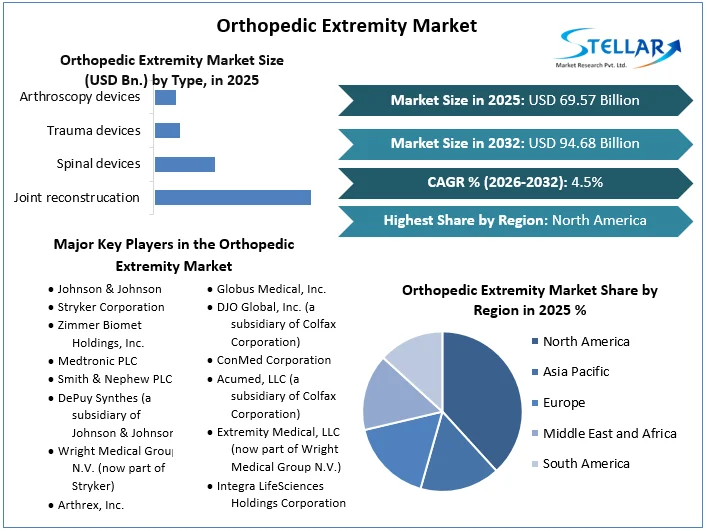
The rising prevalence of musculoskeletal disorders, sports injuries, and age-related joint conditions is driving significant demand for advanced orthopedic treatments worldwide. As healthcare providers increasingly adopt minimally invasive surgical techniques and technologically advanced implants, the Orthopedic Extremity Market is experiencing steady growth. According to the Stellar Market Research report, the market is projected to grow from USD 69.57 billion in 2025 to USD 94.68 billion by 2032, registering a CAGR of 4.5% during the forecast period.
What Is the Orthopedic Extremity Market?
The Orthopedic Extremity Market encompasses medical devices and treatment solutions used to diagnose, repair, and rehabilitate conditions affecting the upper and lower extremities, including the shoulders, elbows, wrists, hands, hips, knees, ankles, and feet. The market includes orthopedic implants, trauma fixation systems, arthroscopy devices, spinal devices, and soft tissue repair solutions used in hospitals, orthopedic clinics, and ambulatory surgical centers.
Growing patient expectations for faster recovery, improved mobility, and better long-term outcomes continue to encourage hospitals and surgeons to adopt innovative orthopedic technologies.
𝐃𝐨𝐰𝐧𝐥𝐨𝐚𝐝 𝐅𝐫𝐞𝐞 𝐏𝐃𝐅 𝐁𝐫𝐨𝐜𝐡𝐮𝐫𝐞: https://www.stellarmr.com/report/req_sample/Orthopedic-Extremity-Market/1486
Aging Population Continues to Drive Market Expansion
One of the most significant growth drivers is the rapidly expanding elderly population. As life expectancy increases, the incidence of osteoarthritis, osteoporosis, joint degeneration, and other musculoskeletal disorders continues to rise.
Many patients require joint replacement procedures, fracture fixation, and reconstructive surgeries to restore mobility and improve quality of life. This demographic trend is expected to sustain demand for orthopedic extremity devices throughout the forecast period.
Minimally Invasive Procedures Are Transforming Orthopedic Care
Orthopedic surgery has evolved considerably over the past decade. Surgeons increasingly prefer minimally invasive procedures because they reduce tissue damage, shorten hospital stays, minimize postoperative pain, and accelerate rehabilitation.
Advanced arthroscopy systems, image-guided navigation, robotic-assisted surgery, and patient-specific implants are improving surgical precision while enhancing clinical outcomes. These innovations are encouraging wider adoption across both developed and emerging healthcare markets.
Technological Innovation Improves Patient Outcomes
Continuous investment in research and development is reshaping the orthopedic industry.
Key technological advancements include:
Robotic-assisted orthopedic surgery
3D-printed customized implants
Artificial intelligence for surgical planning
Advanced biomaterials with improved durability
Computer-assisted navigation systems
Smart orthopedic implants with monitoring capabilities
Enhanced fracture fixation devices
These technologies enable surgeons to perform more accurate procedures while improving implant longevity and patient satisfaction.
Sports Injuries and Active Lifestyles Support Market Demand
Growing participation in professional sports, fitness activities, and recreational exercise has increased the incidence of ligament injuries, fractures, tendon damage, and joint trauma.
Younger patients increasingly seek advanced orthopedic treatments that allow faster recovery and quicker return to physical activity. As a result, demand for arthroscopy devices, trauma implants, and soft tissue repair systems continues to expand across sports medicine.
North America Leads While Asia-Pacific Shows Strong Growth
North America remains the largest regional market due to its advanced healthcare infrastructure, high healthcare expenditure, widespread adoption of innovative medical technologies, and aging population. The United States continues to account for a significant share of orthopedic procedures globally.
Meanwhile, Asia-Pacific is emerging as one of the fastest-growing regions, driven by expanding healthcare infrastructure, increasing healthcare spending, rising awareness of orthopedic care, and growing middle-class populations in countries such as China and India.
Ambulatory Surgical Centers Gain Popularity
Healthcare systems worldwide are shifting many orthopedic procedures from hospitals to ambulatory surgical centers (ASCs). These facilities offer lower treatment costs, shorter patient stays, and greater operational efficiency.
The increasing adoption of outpatient orthopedic procedures is encouraging manufacturers to develop implants and surgical systems specifically designed for minimally invasive, same-day surgeries.
Challenges Facing the Market
Despite positive long-term prospects, several challenges remain.
High Cost of Advanced Implants
Premium orthopedic implants and robotic surgical systems require significant investment, limiting accessibility in cost-sensitive healthcare markets.
Regulatory Approval Requirements
Medical device manufacturers must comply with rigorous regulatory standards to ensure product safety and effectiveness. Clinical testing and approval processes can increase development timelines and costs.
Reimbursement Variability
Differences in reimbursement policies across countries may influence patient access to advanced orthopedic procedures and affect hospital purchasing decisions.
Competitive Landscape
The Orthopedic Extremity Market is highly competitive, with leading medical device manufacturers investing heavily in innovation, strategic acquisitions, and global expansion.
Major companies focus on:
Advanced implant development
Robotic-assisted surgical platforms
Personalized orthopedic solutions
Biocompatible materials
Surgeon education and training
Geographic expansion into emerging markets
Partnerships with hospitals and research institutions
Continuous product innovation and minimally invasive surgical technologies remain key competitive differentiators.
𝐃𝐨𝐰𝐧𝐥𝐨𝐚𝐝 𝐅𝐫𝐞𝐞 𝐏𝐃𝐅 𝐁𝐫𝐨𝐜𝐡𝐮𝐫𝐞: https://www.stellarmr.com/report/req_sample/Orthopedic-Extremity-Market/1486
Future Outlook
The future of the Orthopedic Extremity Market remains promising as healthcare providers continue adopting advanced surgical techniques and personalized treatment approaches. Rising demand for outpatient procedures, AI-assisted surgical planning, robotic technologies, and patient-specific implants is expected to reshape orthopedic care over the coming years.
Growing healthcare investments in emerging economies, combined with technological advancements and an aging global population, are expected to support stable market expansion through 2032.
Conclusion
The Orthopedic Extremity Market continues to play a vital role in improving mobility, reducing pain, and enhancing the quality of life for millions of patients worldwide. Increasing rates of musculoskeletal disorders, sports injuries, and age-related joint conditions are driving sustained demand for innovative orthopedic solutions.
With advances in minimally invasive surgery, robotic assistance, customized implants, and digital healthcare technologies, the market is well positioned for long-term growth. Companies that prioritize clinical innovation, patient outcomes, and strategic partnerships will be best equipped to capitalize on the expanding opportunities in the global orthopedic extremity industry.
