Sodium Aluminum Silicate Market: Rising Demand Across Food, Pharmaceuticals, and Industrial Applications Fuels Growth
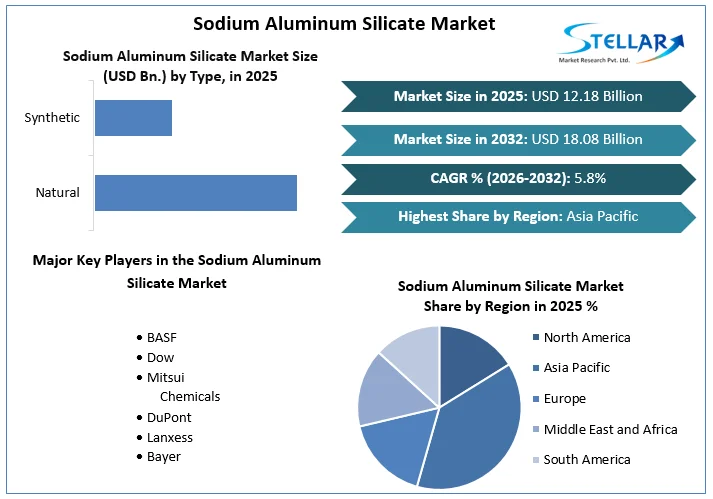
The global specialty chemicals industry continues to evolve as manufacturers seek multifunctional materials that improve product performance, safety, and production efficiency. Among these materials, sodium aluminum silicate has become an essential ingredient across food processing, pharmaceuticals, cosmetics, plastics, rubber, and construction applications. According to Stellar Market Research, the Sodium Aluminum Silicate Market was valued at USD 12.18 billion in 2025 and is projected to reach USD 18.08 billion by 2032, growing at a CAGR of 5.8% during the forecast period.
Understanding the Sodium Aluminum Silicate Market
Sodium aluminum silicate is an inorganic compound composed of sodium, aluminum, silicon, and oxygen. It is widely used as an anti-caking agent, thickener, stabilizer, filler, and reinforcing additive in a broad range of industrial and consumer products. The material is available in both natural and synthetic forms, allowing manufacturers to select grades based on specific application requirements.
Its low toxicity, excellent chemical stability, moisture resistance, and cost-effectiveness make it a preferred material across industries that require improved product consistency and performance.
𝐃𝐨𝐰𝐧𝐥𝐨𝐚𝐝 𝐅𝐫𝐞𝐞 𝐏𝐃𝐅 𝐁𝐫𝐨𝐜𝐡𝐮𝐫𝐞: https://www.stellarmr.com/report/req_sample/Sodium-Aluminum-Silicate-Market/1496
Food and Beverage Industry Remains a Major Growth Driver
One of the primary factors supporting the Sodium Aluminum Silicate Market is the continued expansion of the global food and beverage industry. Sodium aluminum silicate is commonly used as an anti-caking agent in powdered food products such as table salt, baking mixes, spices, seasoning blends, and powdered beverages.
As demand for processed, packaged, and convenience foods continues to increase, manufacturers require reliable ingredients that maintain product flowability and extend shelf life. Growing urbanization and changing consumer lifestyles are expected to sustain demand throughout the forecast period.
Cosmetics and Personal Care Applications Continue to Expand
The cosmetics and personal care industry represents another important market for sodium aluminum silicate. It is widely incorporated into facial powders, creams, lotions, and skincare products because of its thickening, opacifying, absorbent, and texture-enhancing properties.
The increasing popularity of premium beauty products, combined with rising consumer awareness of skincare and personal grooming, is creating new opportunities for manufacturers supplying cosmetic-grade sodium aluminum silicate.
Industrial Applications Support Long-Term Market Growth
Beyond consumer products, sodium aluminum silicate plays a critical role in several industrial sectors.
Major application areas include:
Plastic reinforcement
Rubber compounding
Paints and coatings
Adhesives and sealants
Building materials
Ceramics and glass manufacturing
Chemical processing
Its ability to improve strength, thermal stability, moisture resistance, and product durability makes it a valuable additive for industrial manufacturers seeking enhanced material performance.
Innovation in Material Science Drives Product Development
Continuous research in specialty chemicals is expanding the capabilities of sodium aluminum silicate. Manufacturers are developing high-purity grades with customized particle sizes and improved performance characteristics to meet increasingly specialized industrial requirements.
Key innovation trends include:
High-purity synthetic formulations
Improved particle size control
Enhanced thermal stability
Advanced filler technologies
Sustainable manufacturing processes
Application-specific chemical grades
Improved processing efficiency
These developments allow manufacturers to serve a wider range of industries while improving product quality and operational efficiency.
Asia-Pacific Leads Global Market Expansion
Asia-Pacific remains the largest and fastest-growing regional market due to rapid industrialization, expanding food processing industries, increasing cosmetic production, and strong growth in manufacturing activities.
Countries including China, India, Japan, and South Korea continue investing in chemical manufacturing and consumer goods production, supporting robust demand for sodium aluminum silicate. North America and Europe also represent significant markets due to their well-established pharmaceutical, food, and specialty chemical industries.
Sustainability and Regulatory Compliance Influence Market Dynamics
Environmental regulations and consumer safety standards continue shaping the specialty chemicals industry. Sodium aluminum silicate is often considered a safer alternative to certain conventional additives due to its relatively low toxicity and stable chemical properties.
Manufacturers are increasingly investing in cleaner production technologies, improved quality assurance systems, and sustainable sourcing practices to meet evolving regulatory requirements and customer expectations. These initiatives also help strengthen long-term market competitiveness.
Challenges Facing the Market
Despite positive growth prospects, several challenges remain.
Regulatory Requirements
Manufacturers supplying the food, pharmaceutical, and cosmetic industries must comply with stringent safety and quality regulations. Certification, testing, and documentation requirements can increase production costs and extend product approval timelines.
Raw Material Price Volatility
The availability and pricing of silica- and aluminum-based raw materials can fluctuate due to supply chain disruptions, mining activity, and global economic conditions, affecting production costs and profitability.
Economic Uncertainty
Industrial demand for sodium aluminum silicate may fluctuate during periods of economic slowdown, particularly in construction, manufacturing, and consumer goods sectors. Maintaining supply chain resilience remains an important priority for market participants.
𝐃𝐨𝐰𝐧𝐥𝐨𝐚𝐝 𝐅𝐫𝐞𝐞 𝐏𝐃𝐅 𝐁𝐫𝐨𝐜𝐡𝐮𝐫𝐞: https://www.stellarmr.com/report/req_sample/Sodium-Aluminum-Silicate-Market/1496
Competitive Landscape
The Sodium Aluminum Silicate Market features a mix of global chemical manufacturers and regional specialty material producers. Companies compete by improving product quality, expanding production capacity, and developing application-specific formulations.
Key competitive strategies include:
Investment in research and development
High-purity product innovation
Expansion into emerging markets
Sustainable manufacturing initiatives
Strategic partnerships with industrial customers
Supply chain optimization
Product portfolio diversification
Continuous innovation remains essential as manufacturers respond to evolving customer requirements across multiple industries.
Future Outlook
The outlook for the Sodium Aluminum Silicate Market remains positive as demand continues to increase across food processing, pharmaceuticals, cosmetics, plastics, and construction materials. Expanding industrialization, growing consumer markets, and advances in specialty chemical manufacturing are expected to support steady market growth through 2032.
Manufacturers that invest in sustainable production methods, regulatory compliance, and customized material solutions will be better positioned to capitalize on future opportunities. The combination of expanding end-use applications and ongoing technological innovation is expected to strengthen the market’s long-term growth trajectory.
Conclusion
The Sodium Aluminum Silicate Market continues to play an important role in supporting product quality, manufacturing efficiency, and material performance across diverse industries. Rising demand from food processing, pharmaceuticals, cosmetics, plastics, rubber, and construction sectors highlights its growing commercial significance.
As manufacturers prioritize performance, sustainability, and regulatory compliance, sodium aluminum silicate will remain a valuable specialty chemical in the global industrial landscape. Companies focused on innovation, quality improvement, and expanding application opportunities are expected to benefit from the market’s continued growth in the years ahead.
