The South Korea Bike Sharing Market is experiencing strong growth as the country embraces smart mobility solutions, eco-friendly transportation, and urban sustainability initiatives. With highly developed cities, advanced digital infrastructure, and government-backed smart city programs, South Korea is emerging as a leading adopter of modern bike-sharing systems.
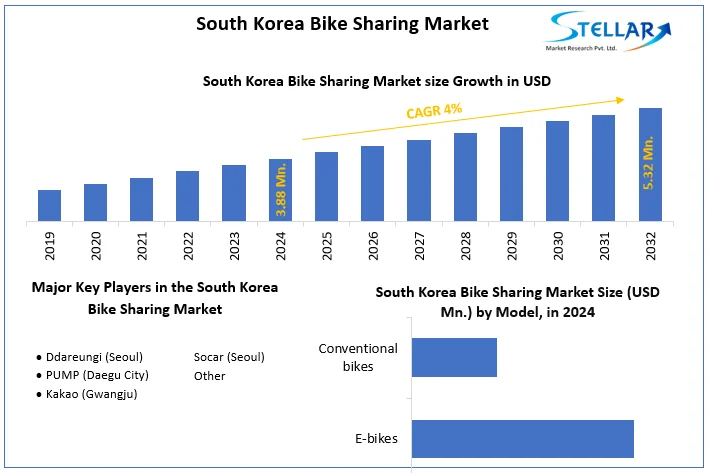
South Korea Bike Sharing Market size was valued at US$ 3.88 Million in 2024 and the total South Korea Bike Sharing Market revenue is expected to grow at 4% through 2025 to 2032, reaching nearly US$ 5.32 Million.
From public bike-sharing programs to app-based micromobility platforms, bike sharing is becoming an essential component of South Korea’s urban transportation ecosystem.
A Market Driven by Smart Cities and Digital Integration
A defining trend in the South Korea bike sharing market is the integration of bike-sharing systems with smart city infrastructure and digital platforms. Mobile applications, GPS tracking, and digital payment systems are enabling seamless access and improving user convenience.
The country’s strong IT ecosystem supports advanced features such as real-time bike availability, route optimization, and data-driven fleet management.
Key Market Insights
- South Korea is a technologically advanced bike-sharing market.
- Public bike-sharing programs dominate major cities.
- App-based platforms are gaining popularity.
- Electric bikes (e-bikes) are an emerging segment.
- Government support is driving infrastructure development.
- Integration with public transport enhances usability.
- Urban commuters are the primary user base.
𝐃𝐨𝐰𝐧𝐥𝐨𝐚𝐝 𝐅𝐫𝐞𝐞 𝐏𝐃𝐅 𝐁𝐫𝐨𝐜𝐡𝐮𝐫𝐞: https://www.stellarmr.com/report/req_sample/South-Korea-Bike-Sharing-Market/252
Market Drivers Accelerating Growth
1. Government Support for Sustainable Transport
Policies promoting green mobility are encouraging bike-sharing adoption.
2. Urban Congestion and Last-Mile Connectivity
Bike sharing offers efficient solutions for short-distance travel.
3. High Smartphone and Digital Payment Adoption
Advanced digital infrastructure enables seamless user experience.
Market Challenges and Restraints
1. Weather and Seasonal Limitations
Usage may decline during extreme weather conditions.
2. Maintenance and Fleet Management Issues
Ensuring availability and quality of bikes requires efficient operations.
Technology and Innovation Trends
Technology is at the core of the South Korea bike sharing market. Operators are leveraging IoT-enabled sensors, GPS tracking, mobile applications, and AI-based analytics to optimize fleet management and enhance user experience.
Dockless and hybrid bike-sharing systems are gaining traction, offering greater flexibility compared to traditional docked models. Electric bikes are also becoming popular, enabling longer-distance travel and attracting a broader user base.
Integration with public transportation systems, including metro and bus networks, is improving multimodal mobility. Smart locks, QR code access, and real-time tracking are enhancing convenience and security.
Data analytics is being used to predict demand, optimize bike distribution, and improve operational efficiency.
𝐃𝐨𝐰𝐧𝐥𝐨𝐚𝐝 𝐅𝐫𝐞𝐞 𝐏𝐃𝐅 𝐁𝐫𝐨𝐜𝐡𝐮𝐫𝐞: https://www.stellarmr.com/report/req_sample/South-Korea-Bike-Sharing-Market/252
Regional Insights: Seoul Leads, Other Cities Expand
Seoul dominates the South Korea bike sharing market, driven by its dense urban population, strong infrastructure, and well-established public bike-sharing program.
Other cities, including Busan, Incheon, and Daegu, are also expanding their bike-sharing networks, supported by government initiatives and urban development projects.
The widespread adoption across cities highlights the growing importance of bike sharing in South Korea’s transportation landscape.
Recent Industry Developments
- Seoul Metropolitan Government (2025): Expanded public bike-sharing infrastructure and services.
- Kakao T (2024): Integrated bike-sharing services into its platform.
- Hyundai Motor Company (2025): Invested in smart mobility and micromobility solutions.
- LG Electronics (2024): Explored IoT solutions for urban mobility.
- Ministry of Land, Infrastructure and Transport South Korea (2025): Promoted sustainable transportation initiatives.
Competitive Landscape
The South Korea bike sharing market is moderately competitive, with public operators, private companies, and mobility platforms offering integrated solutions. Companies are focusing on technology integration, user experience, and strategic partnerships to strengthen their market position.
Collaboration with government agencies and urban planners is essential for long-term success.
Analyst Perspective
A senior market analyst notes:
“South Korea’s bike sharing market is a model for smart urban mobility. The integration of technology and infrastructure is driving high adoption rates and improving urban transportation efficiency.”
Future Outlook
The South Korea Bike Sharing Market is expected to witness steady growth in the coming years, supported by increasing investments in smart city projects, advancements in micromobility technologies, and rising demand for sustainable transportation.
The adoption of electric bikes, expansion of bike-sharing networks, and integration with multimodal transport systems will continue to drive market development.
As cities focus on reducing congestion and emissions, bike sharing will play a critical role in shaping the future of urban mobility in South Korea.
Overall, the market presents significant opportunities for mobility providers, technology companies, and investors aiming to capitalize on the evolution of smart transportation systems.
