Introduction
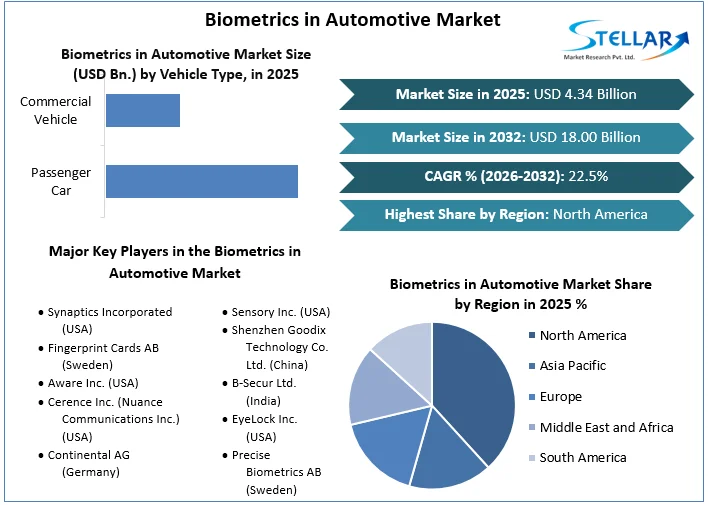
Biometrics in Automotive Market size was valued at US$ 4.34 Billion in 2025 and the total Biometrics in Automotive Market revenue is expected to grow at 22.5% through 2026 to 2032. reaching nearly US$ 18.00 Billion.
The global Biometrics in Automotive Market is witnessing rapid growth as the automotive industry embraces advanced authentication technologies to improve vehicle security, user convenience, and personalized driving experiences. Biometrics—including fingerprint recognition, facial recognition, iris scanning, voice recognition, and palm vein authentication—are increasingly being integrated into modern vehicles to replace conventional keys and passwords with secure, user-friendly access systems.
The growing popularity of connected cars, electric vehicles (EVs), autonomous driving technologies, and premium mobility solutions is accelerating the adoption of biometric systems across the automotive sector. Automakers are leveraging artificial intelligence (AI), machine learning, and advanced sensors to create intelligent vehicles capable of recognizing drivers, preventing unauthorized access, and delivering personalized in-cabin experiences. As demand for safer and smarter mobility solutions continues to rise, the Biometrics in Automotive Market is expected to experience strong growth during the forecast period.
Download Free PDF Brochure: https://www.stellarmr.com/report/req_sample/Biometrics-in-Automotive-Market/427
Market overview
Biometric technologies are transforming the automotive industry by enabling secure identification and authentication of vehicle users through unique biological characteristics. Unlike traditional physical keys or digital passwords, biometric systems provide higher levels of security while improving convenience for drivers and passengers.
The market includes biometric hardware such as fingerprint scanners, infrared cameras, facial recognition sensors, iris scanners, microphones, and software platforms powered by AI algorithms. These technologies are integrated into vehicle access systems, ignition controls, infotainment platforms, driver monitoring systems, and personalized vehicle settings.
As connected vehicles become increasingly intelligent, biometrics are emerging as a critical component of future mobility ecosystems.
Key market growth drivers
Rising demand for advanced vehicle security
Vehicle theft and cybersecurity concerns continue to encourage automakers to adopt stronger authentication technologies. Biometric systems significantly reduce the risk of unauthorized vehicle access by verifying a driver’s unique biological identity before granting access or enabling engine start.
Fingerprint recognition and facial authentication have become popular security solutions due to their speed, reliability, and convenience.
Growth of connected and electric vehicles
The rapid expansion of connected cars and electric vehicles has created new opportunities for biometric technologies. Modern vehicles increasingly rely on digital ecosystems that require secure authentication for vehicle access, remote operation, digital payments, and personalized infotainment services.
Biometrics provide seamless identity verification while supporting secure communication between vehicles, mobile applications, and cloud-based services.
Increasing adoption of personalized driving experiences
Consumers increasingly expect vehicles to automatically adjust seating positions, climate controls, mirrors, infotainment preferences, and navigation settings based on individual driver profiles.
Biometric authentication enables instant recognition of authorized drivers, allowing vehicles to deliver highly personalized experiences while improving comfort and convenience.
Emerging opportunities
Autonomous vehicles present one of the most significant opportunities for the Biometrics in Automotive Market. Future self-driving vehicles will require highly secure passenger identification systems to manage access, payment services, and personalized mobility experiences.
Shared mobility services, including ride-hailing and vehicle subscription platforms, also create substantial opportunities. Biometric authentication enables secure vehicle sharing without traditional keys while reducing fraud and improving fleet management.
Integration with digital wallets, insurance services, and connected smart city infrastructure further expands the application of automotive biometric technologies.
Emerging economies are expected to generate considerable growth as rising disposable incomes and increasing adoption of premium vehicles encourage demand for advanced safety and convenience features.
Technology trends transforming the market
Artificial intelligence continues to revolutionize automotive biometric systems. AI-powered facial recognition algorithms deliver faster, more accurate driver identification while adapting to changes in lighting conditions, facial expressions, and aging.
Driver monitoring systems equipped with infrared cameras and eye-tracking technologies can detect fatigue, distraction, and impaired driving, improving road safety by issuing real-time alerts or activating advanced driver assistance systems.
Multimodal biometrics—combining fingerprint, facial, voice, and iris recognition—provide enhanced security compared to single-factor authentication methods.
Cloud computing, edge computing, and over-the-air software updates enable continuous improvements in biometric system performance while supporting remote diagnostics and cybersecurity enhancements.
Sustainability and regulatory landscape
Governments and automotive regulators continue strengthening vehicle safety and cybersecurity requirements, encouraging manufacturers to integrate advanced driver monitoring and authentication technologies into future vehicle platforms.
Data privacy has become a critical consideration in biometric deployment. Automakers increasingly implement encryption, secure data storage, and privacy-by-design principles to protect sensitive biometric information while complying with global data protection regulations.
The shift toward digital vehicle ecosystems also supports sustainability by reducing dependence on physical keys, minimizing hardware requirements, and enabling more efficient fleet management solutions.
As smart mobility expands, regulatory frameworks governing cybersecurity, artificial intelligence, and digital identity management are expected to play an increasingly important role in market development.
Regional insights
North America remains a leading market due to rapid adoption of connected vehicles, advanced automotive technologies, and strong investments in artificial intelligence and autonomous driving research. Premium vehicle manufacturers continue integrating sophisticated biometric systems to enhance security and customer experience.
Europe represents another major market supported by stringent vehicle safety standards, increasing production of luxury automobiles, and strong emphasis on cybersecurity and digital innovation. Germany, France, Italy, and the United Kingdom remain key centers of automotive technology development.
Asia-Pacific is expected to register the fastest market growth during the forecast period. China, Japan, South Korea, and India continue expanding electric vehicle production while investing heavily in smart mobility solutions and intelligent transportation systems. Rising consumer demand for premium automotive technologies further strengthens regional growth.
Latin America and the Middle East & Africa are gradually adopting biometric automotive technologies as premium vehicle ownership increases and automotive digitalization expands.
Competitive landscape
- Fingerprint Cards AB (Sweden)
- Aware Inc. (USA)
- Cerence Inc. (Nuance Communications Inc.) (USA)
- Continental AG (Germany)
- Sensory Inc. (USA)
- Shenzhen Goodix Technology Co. Ltd. (China)
Download Free PDF Brochure: https://www.stellarmr.com/report/req_sample/Biometrics-in-Automotive-Market/427
Future outlook
The future of the Biometrics in Automotive Market appears exceptionally promising as connected vehicles, autonomous driving technologies, and digital mobility ecosystems continue evolving. Vehicle security, personalized driving experiences, and intelligent driver monitoring will remain major priorities for automotive manufacturers worldwide.
Artificial intelligence, machine learning, advanced sensors, and cloud-based software platforms will continue improving biometric accuracy, speed, and reliability while expanding application possibilities. Integration with autonomous vehicles, smart cities, shared mobility platforms, and digital payment systems will create new revenue opportunities for technology providers.
As consumers increasingly prioritize convenience, security, and personalized mobility, biometric technologies will become an essential feature of next-generation vehicles. Companies that invest in AI-driven innovation, cybersecurity, privacy protection, and strategic industry collaborations will be well positioned to capitalize on the growing demand within the global Biometrics in Automotive Market.
Media Contact
Stellar Market Research
Website: Stellar Market Research – Global Research Reports & Consulting
Email: sales@stellarmr.com
