Market Overview
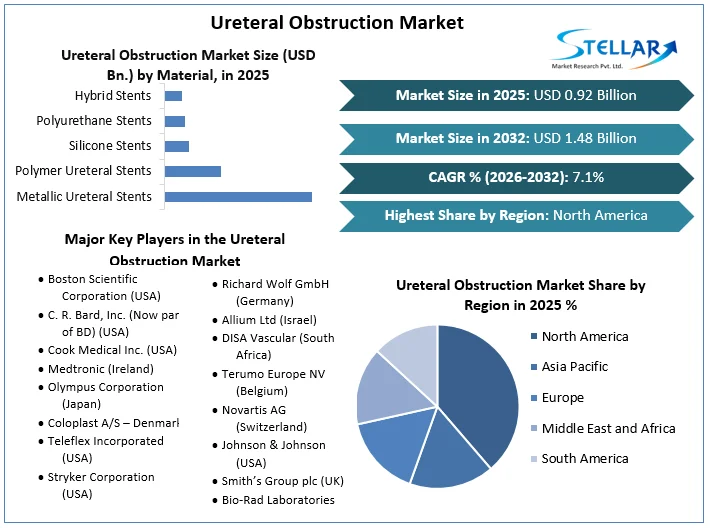
The size of the Ureteral Obstruction Market was valued at USD 0.92 Billion in 2025 and is projected to reach USD 1.48 Billion by 2032, with an expected CAGR of 7.10% during the forecast period.
The global Ureteral Obstruction Market is experiencing steady growth as healthcare systems increasingly focus on advanced diagnostic techniques, minimally invasive procedures, and innovative treatment solutions for urinary tract disorders. Ureteral obstruction is a medical condition where the flow of urine from the kidneys to the bladder is partially or completely blocked, potentially leading to complications such as kidney damage, infections, and reduced renal function if untreated.
The increasing prevalence of urological disorders, rising aging population, growing incidence of kidney stones, and advancements in endoscopic technologies are driving the expansion of this market. Healthcare providers are adopting improved stents, drainage systems, and surgical techniques to enhance patient outcomes and reduce treatment-related complications.
The shift toward early diagnosis and personalized treatment approaches is further strengthening demand for advanced ureteral obstruction management solutions. As medical technology continues to evolve, manufacturers are focusing on developing safer, more durable, and patient-friendly devices that address the growing burden of urinary tract conditions.
Download Free PDF Brochure: https://www.stellarmr.com/report/req_sample/ureteral-obstruction-market/2614
Increasing Prevalence of Urological Disorders Driving Market Growth
One of the major factors supporting the growth of the Ureteral Obstruction Market is the rising incidence of conditions associated with urinary blockages. Kidney stones, tumors, congenital abnormalities, and post-surgical complications are among the leading causes of ureteral obstruction.
The global increase in kidney stone cases has become a significant healthcare concern. Unhealthy dietary habits, inadequate hydration, sedentary lifestyles, and metabolic disorders are contributing to higher rates of stone formation. Since ureteral obstruction is commonly associated with kidney stones, the demand for effective diagnostic and treatment solutions continues to rise.
Additionally, the growing geriatric population is increasing the prevalence of age-related urological complications. Older adults are more likely to experience urinary tract issues, requiring advanced medical interventions such as ureteral stents, nephrostomy tubes, and minimally invasive procedures.
Growth of Minimally Invasive Treatment Procedures
The growing adoption of minimally invasive urological procedures is a key trend shaping the future of the ureteral obstruction market. Traditional surgical approaches often involve longer recovery periods and increased risks, while minimally invasive techniques provide improved patient comfort, faster recovery, and reduced hospitalization time.
Technologies such as ureteroscopy, laser lithotripsy, and advanced stent placement procedures are becoming increasingly common in hospitals and specialty clinics. These techniques enable physicians to treat blockages effectively while minimizing tissue damage.
Ureteral stents remain one of the most widely used solutions for managing ureteral obstruction. These devices help maintain urine flow and prevent complications after procedures. Continuous improvements in stent design, including enhanced biocompatibility, reduced encrustation, and improved patient comfort, are encouraging greater adoption.
Technological Advancements Improving Treatment Outcomes
Innovation in medical device technology is significantly influencing market development. Companies are investing in research and development to introduce next-generation ureteral obstruction treatment solutions with better performance and improved patient outcomes.
Modern ureteral stents are being developed using advanced materials that improve flexibility, durability, and compatibility with the human body. Anti-bacterial coatings and innovative designs are being explored to reduce infection risks and extend device effectiveness.
Digital healthcare technologies are also contributing to improved diagnosis and treatment planning. Advanced imaging systems, artificial intelligence-assisted diagnostics, and real-time monitoring tools are helping healthcare professionals identify obstructions more accurately and select appropriate treatment methods.
The integration of technology into urology is expected to improve clinical decision-making and support more personalized treatment approaches in the coming years.
Rising Healthcare Investment and Improved Access to Urological Care
Increasing healthcare expenditure and expanding medical infrastructure are creating new opportunities for the Ureteral Obstruction Market. Governments and private healthcare organizations are investing in modern hospitals, advanced surgical equipment, and specialized urology departments.
Developing economies are witnessing improvements in healthcare accessibility, allowing more patients to receive timely diagnosis and treatment. Countries in Asia Pacific, Latin America, and the Middle East are focusing on strengthening healthcare systems, which is expected to increase demand for urological devices and procedures.
Medical tourism is also contributing to market growth in regions offering cost-effective and advanced urological treatments. Patients are increasingly seeking high-quality procedures, creating opportunities for healthcare providers and medical device manufacturers.
Challenges Affecting Market Expansion
Despite positive growth prospects, the ureteral obstruction market faces several challenges. High treatment costs, limited access to specialized healthcare facilities in developing regions, and complications associated with certain devices may restrict market growth.
Ureteral stents and other medical devices require proper placement and monitoring to avoid complications such as infections, discomfort, migration, or blockage. These factors highlight the importance of continuous product improvement and physician training.
Regulatory approval processes for medical devices can also impact the speed of product commercialization. Manufacturers must meet strict safety and quality requirements before introducing new technologies into healthcare systems.
Regional Market Insights
North America holds a significant position in the global ureteral obstruction market due to advanced healthcare infrastructure, high adoption of minimally invasive procedures, and strong presence of medical device manufacturers. The United States continues to drive regional growth with increasing demand for advanced urological treatments and widespread availability of specialized healthcare services.
Europe is also witnessing steady market expansion due to rising healthcare investments, increasing prevalence of kidney-related disorders, and growing adoption of innovative medical technologies. Countries such as Germany, the United Kingdom, and France are focusing on improving urological care through advanced treatment methods.
The Asia Pacific region is expected to experience strong growth during the forecast period. Rising healthcare expenditure, increasing awareness of urological diseases, expanding hospital networks, and growing patient populations in countries such as China and India are creating significant opportunities for market players.
Competitive Landscape
- Stryker Corporation (USA)
- KARL STORZ SE & Co. KG (Germany)
- Dornier MedTech (Germany)
- BD (Becton, Dickinson and Company) (USA)
- Richard Wolf GmbH (Germany)
- Allium Ltd (Israel)
- DISA Vascular (South Africa)
- Terumo Europe NV (Belgium)
- Novartis AG (Switzerland)
- Johnson & Johnson (USA)
- Smith’s Group plc (UK)
Download Free PDF Brochure: https://www.stellarmr.com/report/req_sample/ureteral-obstruction-market/2614
Future Outlook of the Ureteral Obstruction Market
The future of the Ureteral Obstruction Market looks promising as demand for effective urinary obstruction management solutions continues to increase. Growing awareness of early diagnosis, rising adoption of minimally invasive procedures, and technological advancements in medical devices will remain key growth drivers.
The development of smart medical devices, improved biomaterials, and personalized treatment strategies is expected to transform the management of ureteral disorders. Healthcare providers will increasingly focus on reducing complications, improving patient recovery, and enhancing treatment efficiency.
As healthcare systems worldwide continue to prioritize advanced urological care, the market is expected to witness sustained investment and innovation. Companies that focus on technological advancement, affordability, and patient-centered solutions will be well positioned to capture emerging opportunities in the global ureteral obstruction industry.
Media Contact
Stellar Market Research
Website: Stellar Market Research – Global Research Reports & Consulting
Email: sales@stellarmr.com
