Market Overview
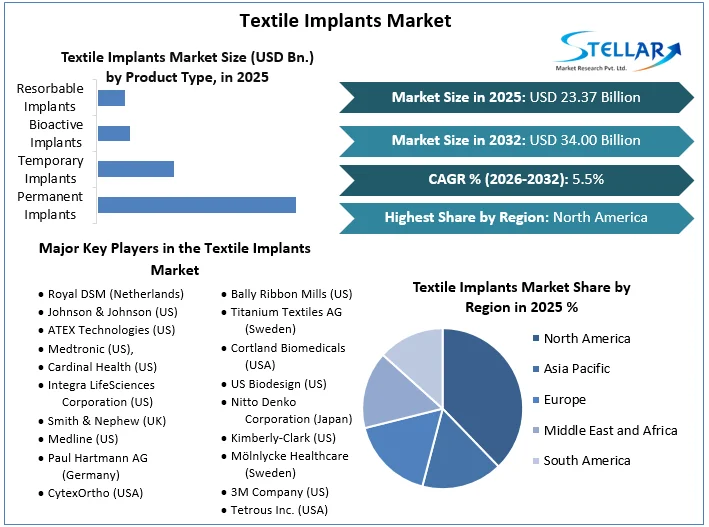
Textile Implants Market is expected to reach USD 34 billion in 2032, up from USD 23.37 billion in 2025, at a CAGR of 5.5%.
The global Textile Implants Market is emerging as a critical segment within the medical device industry, driven by increasing demand for advanced biomaterials, rising surgical procedures, and growing adoption of minimally invasive treatment approaches. Textile implants are specialized medical devices manufactured using textile-based structures designed to support tissue repair, regeneration, and reconstruction.
These implants are widely used in applications such as hernia repair, cardiovascular surgery, orthopedic reconstruction, soft tissue reinforcement, and wound management. Their flexibility, strength, biocompatibility, and ability to integrate with human tissues make them valuable alternatives to conventional implant materials.
The market is gaining momentum as healthcare providers increasingly focus on improving surgical outcomes, reducing recovery time, and enhancing patient comfort. Growing healthcare expenditure, rising prevalence of chronic diseases, and advancements in medical textile engineering are expected to create significant opportunities for manufacturers and investors.
Download Free PDF Brochure: https://www.stellarmr.com/report/req_sample/textile-implants-market/2648
Rising Demand for Advanced Surgical Solutions
One of the major factors supporting the expansion of the Textile Implants Market is the increasing number of surgical procedures worldwide. Aging populations, higher prevalence of cardiovascular disorders, orthopedic conditions, and abdominal complications are contributing to rising demand for implantable medical solutions.
Textile implants offer several advantages compared with traditional implant materials. Their porous structures promote tissue integration, while their flexibility allows better adaptation to anatomical movements. These characteristics make them suitable for complex surgical procedures where durability and patient safety are essential.
Hernia repair remains one of the leading application areas for textile implants due to the widespread use of surgical meshes for abdominal wall reconstruction. The continued rise in hernia procedures, along with improvements in mesh design and material technology, is strengthening market demand.
Technological Innovation Transforming Textile Implant Development
Advancements in biomaterials and manufacturing technologies are reshaping the textile implants industry. Manufacturers are focusing on developing implants with improved mechanical strength, enhanced tissue compatibility, and reduced risk of complications.
Modern textile implant technologies include advanced weaving, knitting, and three-dimensional textile manufacturing techniques. These innovations allow companies to create implants with customized structures, controlled porosity, and improved performance characteristics.
Three-dimensional textile implants are gaining attention because they can provide better anatomical conformity and support complex reconstruction procedures. Their ability to deliver customized solutions is expected to encourage adoption across orthopedic and regenerative medicine applications.
Additionally, researchers are exploring bioresorbable materials that gradually degrade after fulfilling their medical purpose, reducing the need for additional surgical interventions. These developments are creating new opportunities for next-generation implant solutions.
Growth Opportunities in Orthopedic and Cardiovascular Applications
The orthopedic sector is expected to become a significant growth area for textile implants due to increasing demand for ligament reconstruction, tendon repair, and soft tissue restoration procedures.
Sports-related injuries, age-related musculoskeletal disorders, and rising interest in active lifestyles are increasing the requirement for advanced orthopedic repair solutions. Textile-based scaffolds provide flexibility and structural support, making them suitable for various orthopedic applications.
Cardiovascular surgery is another important segment contributing to market growth. Textile implants are used in vascular grafts and other cardiovascular repair procedures because of their strength, durability, and ability to support blood flow pathways.
The rising burden of cardiovascular diseases globally is encouraging healthcare systems to invest in improved surgical technologies, creating further demand for high-performance implantable textile products.
Sustainability and Next-Generation Biomaterials
Sustainability is becoming increasingly important in medical device manufacturing. Companies are exploring environmentally responsible production methods and developing materials that minimize waste while maintaining clinical performance.
The development of biodegradable textile implants represents an important advancement in sustainable healthcare solutions. These implants are designed to support healing processes while reducing long-term material presence inside the body.
Manufacturers are also investing in cleaner production technologies and advanced material processing methods to improve efficiency and meet evolving regulatory expectations. As healthcare organizations prioritize environmentally responsible practices, sustainable textile implant solutions are expected to gain greater market acceptance.
Regulatory Standards Supporting Product Development
Regulatory compliance plays a significant role in shaping the textile implants industry. Medical device manufacturers must meet strict safety, quality, and biocompatibility standards before commercializing implant products.
Regulatory agencies continue to emphasize implant safety, clinical validation, and long-term performance evaluation. These requirements encourage companies to invest heavily in research and testing to develop reliable products.
Advancements in regulatory frameworks are also supporting innovation by creating clearer pathways for advanced implant technologies. Companies with strong regulatory expertise and robust clinical evidence are expected to gain competitive advantages in the global market.
Regional Market Insights
North America currently holds a leading position in the Textile Implants Market due to advanced healthcare infrastructure, high adoption of innovative surgical technologies, and strong presence of medical device manufacturers. The United States contributes significantly to regional growth because of increasing surgical procedures, research investments, and demand for advanced implant solutions.
Europe is another important market, supported by strong healthcare systems, rising adoption of minimally invasive procedures, and increasing focus on medical innovation. Countries such as Germany, France, and the United Kingdom are investing in advanced surgical technologies and biomaterial research.
The Asia Pacific region is expected to experience strong growth in the coming years. Increasing healthcare expenditure, expanding hospital infrastructure, growing patient populations, and rising awareness of advanced treatment options in countries such as China, India, and Japan are driving market expansion. The region is also benefiting from improving medical manufacturing capabilities and increasing investment in healthcare technology.
Competitive Landscape
- BSN Medical (Germany)
- Elkem Silicones (Germany)
- Bally Ribbon Mills (US)
- Titanium Textiles AG (Sweden)
- Cortland Biomedicals (USA)
- US Biodesign (US)
- Nitto Denko Corporation (Japan)
- Kimberly-Clark (US)
- Mölnlycke Healthcare (Sweden)
- 3M Company (US)
- Tetrous Inc. (USA)
Download Free PDF Brochure: https://www.stellarmr.com/report/req_sample/textile-implants-market/2648
Future Outlook
The future outlook of the Textile Implants Market remains positive as healthcare systems worldwide continue to prioritize advanced surgical solutions and patient-focused treatment approaches.
Increasing demand for minimally invasive procedures, rising adoption of regenerative medicine, and advancements in biomaterials will continue to support market growth. The integration of three-dimensional manufacturing, smart materials, and sustainable production practices will further transform the industry.
As healthcare providers seek safer, more effective, and durable implant solutions, textile implants are expected to play an increasingly important role in modern medicine. Companies that focus on innovation, regulatory compliance, and sustainable product development will be positioned to capture emerging opportunities in the global textile implants industry.
Media Contact
Stellar Market Research
Website: Stellar Market Research – Global Research Reports & Consulting
Email: sales@stellarmr.com
