Aviation Gasoline Market: Industry Analysis, Growth Trends, Opportunities, and Future Outlook (2026-2032)
Aviation Gasoline Market Overview
The global Aviation Gasoline Market is witnessing steady growth due to increasing demand for general aviation, private aircraft, flight training activities, and small piston-engine aircraft. Aviation gasoline, commonly known as Avgas, is a specialized fuel used primarily in piston-engine aircraft. It provides reliable engine performance, efficient combustion, and operational safety for smaller aircraft used in private, commercial, recreational, and military applications.
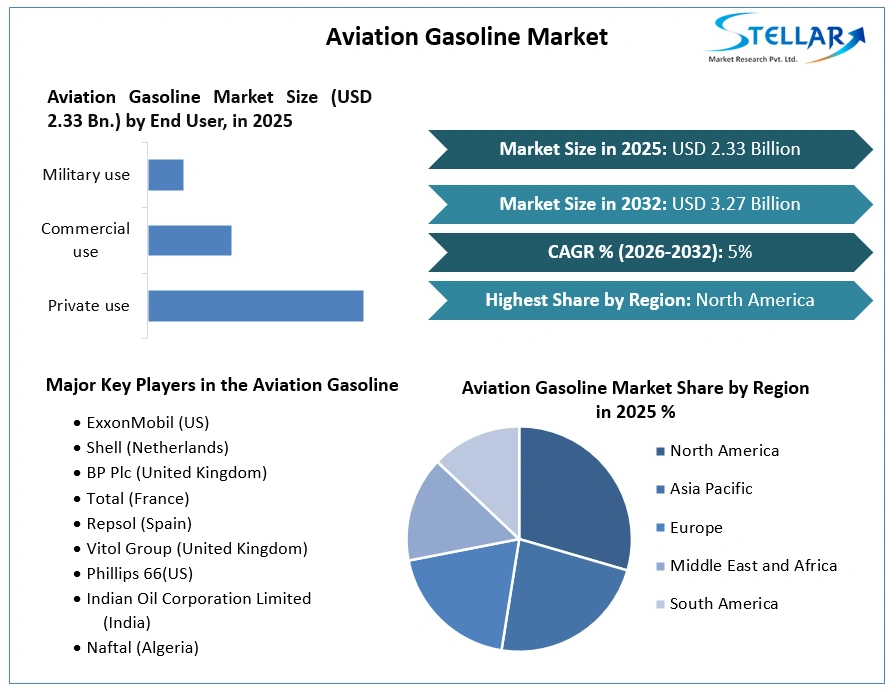
According to Stellar Market Research, the Aviation Gasoline Market was valued at USD 2.33 billion in 2025 and is expected to reach nearly USD 3.27 billion by 2032, growing at a CAGR of 5% during 2026-2032. Rising demand for small aircraft, increasing aviation activities, and advancements in aircraft design are key factors supporting market growth.
Increasing Demand for General Aviation and Small Aircraft
The growing popularity of general aviation is one of the major drivers of the aviation gasoline market. Small aircraft are increasingly used for personal transportation, pilot training, tourism, aerial photography, medical services, and recreational activities.
The expansion of flight schools and increasing interest in private aircraft ownership are creating additional demand for aviation gasoline. Piston-engine aircraft remain highly dependent on Avgas due to their reliability and suitability for short-distance aviation operations.
Growth of Private Aircraft Ownership
Rising wealth among high-net-worth individuals and increasing demand for business and private aviation are contributing to market expansion. Private aircraft users prefer smaller aircraft for flexibility, faster travel, and access to remote destinations.
The increasing number of private aviation operators, especially in developing economies, is expected to support long-term demand for aviation gasoline.
𝐃𝐨𝐰𝐧𝐥𝐨𝐚𝐝 𝐅𝐫𝐞𝐞 𝐏𝐃𝐅 𝐁𝐫𝐨𝐜𝐡𝐮𝐫𝐞: https://www.stellarmr.com/report/req_sample/Aviation-Gasoline-Market/521
Advancements in Aircraft Technology and Fuel Efficiency
Aircraft manufacturers are continuously developing more efficient piston-engine aircraft with improved fuel performance and reduced emissions. These advancements are encouraging the development of improved aviation gasoline formulations with better combustion efficiency and lower environmental impact.
The introduction of low-lead aviation fuels is also supporting the transition toward cleaner aviation operations while maintaining compatibility with existing aircraft engines.
Increasing Aviation Training Activities
Flight training centers represent an important consumer segment for aviation gasoline. The rising demand for commercial pilots is increasing the number of flight training hours worldwide.
Training aircraft commonly use piston engines, creating consistent demand for aviation gasoline. Growth in aviation education and pilot certification programs is expected to provide further market opportunities.
Aviation Gasoline Market Segmentation Analysis
By End User
The Aviation Gasoline Market is segmented into:
- Private Aviation
- Commercial Aviation
- Military Aviation
The private aviation segment holds a significant share due to increasing ownership of small aircraft and growing demand for personal and recreational flying activities.
By Aircraft Type
The market includes:
- Piston Engine Aircraft
- Small General Aviation Aircraft
- Training Aircraft
- Other Aircraft Types
Piston-engine aircraft remain the primary users of aviation gasoline due to their widespread application in general aviation.
By Region
The market is analyzed across:
- North America
- Europe
- Asia Pacific
- Middle East & Africa
- South America
Regional Market Outlook
North America
North America dominates the Aviation Gasoline Market due to its large general aviation fleet, strong private aviation industry, and high number of registered aircraft. The United States represents a major contributor due to extensive usage of piston-engine aircraft for business, training, and recreational purposes.
Europe
Europe is an important market due to established aviation infrastructure, increasing flight training activities, and growing demand for private aircraft. The region is also focusing on developing cleaner aviation fuel alternatives.
Asia Pacific
Asia Pacific is expected to witness significant growth due to rising disposable incomes, expanding aviation infrastructure, and increasing interest in private aviation. Countries such as China, India, and Japan are investing in aviation development, creating new opportunities for aviation fuel suppliers.
Key Growth Drivers of Aviation Gasoline Market
1. Expansion of General Aviation
Growth in private flying, pilot training, and recreational aviation is increasing demand for aviation gasoline.
2. Rising Private Aircraft Ownership
Increasing wealth and demand for flexible transportation solutions are supporting the growth of small aircraft usage.
3. Aircraft Fleet Modernization
Advancements in aircraft engineering are creating demand for efficient and improved aviation fuel solutions.
4. Growth of Flight Training Programs
Increasing demand for pilots worldwide is boosting the use of training aircraft powered by aviation gasoline.
Challenges in the Aviation Gasoline Market
Despite growth opportunities, the market faces several challenges:
- Increasing environmental concerns related to lead-based aviation fuels
- Fluctuating crude oil prices
- Rising competition from electric and hybrid aircraft technologies
- Development of alternative aviation fuels
The adoption of electric propulsion and hybrid aircraft technologies may impact long-term demand for traditional aviation gasoline.
Future Opportunities in Aviation Gasoline Industry
The future growth of the Aviation Gasoline Market is expected to be supported by:
- Development of low-lead and unleaded aviation fuels
- Expansion of general aviation in emerging markets
- Growth of flight training centers
- Modernization of small aircraft fleets
- Development of sustainable aviation fuel technologies
Companies investing in cleaner fuel alternatives and advanced aviation fuel solutions are expected to gain competitive advantages.
Competitive Landscape
Key players operating in the Aviation Gasoline Market include:
- ExxonMobil
- Shell
- BP Plc
- TotalEnergies
- Chevron Corporation
- Phillips 66
- Indian Oil Corporation Limited
- Bharat Petroleum Corporation Limited
- Repsol
- Vitol Group
These companies are focusing on fuel innovation, supply expansion, strategic partnerships, and development of advanced aviation fuel solutions to strengthen their market position.
𝐃𝐨𝐰𝐧𝐥𝐨𝐚𝐝 𝐅𝐫𝐞𝐞 𝐏𝐃𝐅 𝐁𝐫𝐨𝐜𝐡𝐮𝐫𝐞: https://www.stellarmr.com/report/req_sample/Aviation-Gasoline-Market/521
Conclusion
The Aviation Gasoline Market is expected to grow steadily during 2026-2032 due to increasing general aviation activities, rising private aircraft ownership, and growing demand for flight training. While alternative propulsion technologies may influence the future of aviation fuels, piston-engine aircraft will continue to support demand for aviation gasoline.
With advancements in low-emission fuel technologies and expanding aviation activities in emerging economies, the aviation gasoline industry will continue to play an important role in the global aviation sector.
