Market Overview
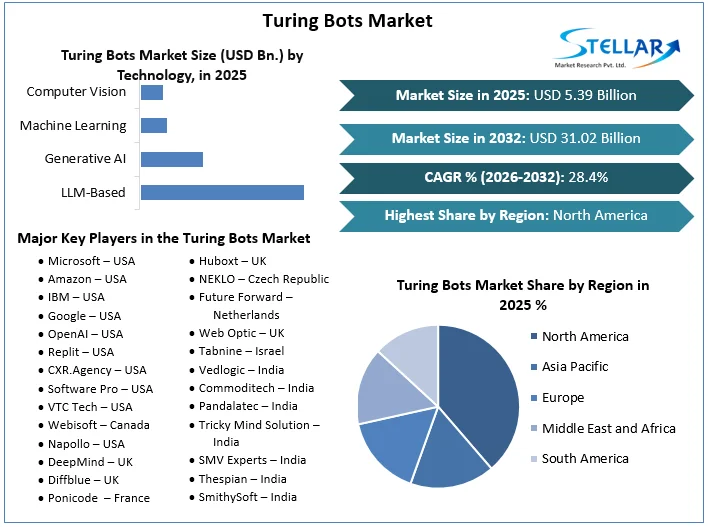
TuringBots Market is projected to grow at a CAGR of 28.4% through 2032. It was valued at USD 5.39 Bn in 2025 and is expected to become USD 31.02 Bn by 2032.
The global Turing Bots Market is experiencing rapid growth as businesses increasingly adopt artificial intelligence-driven conversational systems to improve customer engagement, automate operations, and deliver personalized digital experiences. Turing bots, powered by advanced artificial intelligence, machine learning, natural language processing (NLP), and automation technologies, are designed to simulate human-like conversations and provide intelligent responses across multiple platforms.
Organizations across industries such as banking, healthcare, retail, telecommunications, education, and enterprise services are integrating AI-powered bots to enhance efficiency, reduce operational costs, and provide 24/7 customer support. The growing shift toward digital transformation, increasing demand for automation, and advancements in generative AI technologies are accelerating the adoption of intelligent chatbot solutions.
Unlike traditional rule-based chatbots, Turing bots can understand context, learn from interactions, and improve response accuracy over time. This ability is creating new opportunities for businesses seeking scalable and intelligent communication solutions.
Download Free PDF Brochure: https://www.stellarmr.com/report/req_sample/turing-bots-market/2756
Increasing Adoption of Artificial Intelligence Driving Market Expansion
The rapid evolution of artificial intelligence is one of the major factors fueling the growth of the Turing Bots Market. Businesses are investing heavily in AI-based automation tools to streamline workflows, improve customer experiences, and enhance decision-making processes.
Modern enterprises generate large volumes of customer interactions through websites, mobile applications, and social media platforms. Managing these interactions manually requires significant resources and time. Turing bots provide an efficient solution by handling repetitive queries, processing requests, and assisting users instantly.
The integration of machine learning algorithms allows these bots to continuously analyze user behavior and improve their responses. This capability enables organizations to offer more accurate and personalized services, strengthening customer satisfaction and loyalty.
Additionally, the increasing availability of cloud-based AI platforms has made advanced chatbot technologies accessible to small and medium-sized enterprises, further supporting market growth.
Generative AI and Natural Language Processing Enhancing Bot Capabilities
Technological advancements in generative AI and natural language processing are transforming the capabilities of Turing bots. Traditional chatbots often depended on predefined responses, limiting their ability to handle complex conversations. However, modern AI-powered bots can understand natural language, recognize intent, and generate human-like responses.
Generative AI models are enabling Turing bots to perform advanced tasks such as content generation, customer assistance, data analysis, and personalized recommendations. These improvements are expanding their applications beyond basic customer service.
Natural language understanding technologies allow bots to process different languages, recognize conversational patterns, and respond more effectively. This development is particularly valuable for global enterprises that require multilingual customer engagement solutions.
As AI models continue to become more sophisticated, Turing bots are expected to deliver increasingly accurate and context-aware interactions.
Enterprise Automation Creating New Growth Opportunities
The growing focus on operational efficiency is encouraging organizations to adopt Turing bots for enterprise automation. Companies are using AI-powered bots to automate internal processes such as employee support, IT assistance, human resource management, and workflow optimization.
In the banking and financial services sector, Turing bots are helping customers with account inquiries, transaction support, and financial guidance. These solutions reduce response times while improving service availability.
The healthcare industry is also adopting intelligent bots for appointment scheduling, patient communication, symptom assessment, and healthcare information management. With increasing pressure on healthcare systems, AI-driven solutions provide valuable support by improving accessibility and reducing administrative workload.
Retail and e-commerce companies are leveraging Turing bots to provide personalized product recommendations, assist with purchases, and improve post-sale support. This ability to enhance customer journeys is becoming a major competitive advantage for businesses.
Rising Demand for Personalized Customer Experiences
Customer expectations have significantly changed with the growth of digital platforms. Consumers now expect faster responses, personalized recommendations, and seamless interactions across multiple channels.
Turing bots help businesses meet these expectations by analyzing customer data and delivering customized experiences. They can identify user preferences, understand previous interactions, and provide relevant information in real time.
Companies are increasingly integrating Turing bots with customer relationship management (CRM) systems, enterprise applications, and communication platforms to create unified customer engagement ecosystems.
The growing importance of customer experience management is expected to remain a major driver for market expansion as organizations compete to build stronger relationships with users.
Challenges Affecting Market Growth
Despite strong growth potential, the Turing Bots Market faces several challenges. Data privacy and security concerns remain significant issues as AI bots process large amounts of customer information.
Organizations must ensure compliance with data protection regulations and implement strong cybersecurity measures to prevent unauthorized access and misuse of sensitive information.
Another challenge is the complexity of developing and maintaining advanced AI systems. Building highly intelligent bots requires skilled professionals, quality training data, and continuous model improvements. Small businesses may face difficulties in adopting sophisticated AI solutions due to cost and technical limitations.
Additionally, concerns regarding inaccurate responses, AI bias, and ethical use of artificial intelligence may influence adoption decisions among enterprises.
Regional Market Insights
North America currently represents a leading region in the Turing Bots Market due to strong technology infrastructure, high AI adoption rates, and significant investments in automation solutions. The presence of major technology companies and early adoption of advanced AI platforms are supporting regional growth.
The United States is witnessing widespread implementation of AI-powered bots across industries such as financial services, healthcare, retail, and technology. Enterprises are increasingly using conversational AI to improve customer engagement and operational efficiency.
Europe is also experiencing steady growth as organizations focus on digital transformation and responsible AI adoption. Countries such as Germany, the United Kingdom, and France are investing in AI technologies while emphasizing data privacy and regulatory compliance.
The Asia Pacific region is expected to witness significant growth in the coming years. Increasing digitalization, expanding internet usage, and rising adoption of AI solutions in countries such as China, India, Japan, and South Korea are creating strong opportunities for market players.
Competitive Landscape
- DeepMind – UK
- Diffblue – UK
- Ponicode – France
- Linnify – Romania
- Tabnine – Israel
- Vedlogic – India
- Commoditech – India
- CI&T (Brazil)
- Globant (Argentina)
Download Free PDF Brochure: https://www.stellarmr.com/report/req_sample/turing-bots-market/2756
Future Outlook of the Turing Bots Market
The future of the Turing Bots Market is expected to be shaped by continuous advancements in artificial intelligence, increasing enterprise automation, and growing demand for personalized digital experiences.
The integration of generative AI, advanced analytics, and machine learning will enable Turing bots to handle increasingly complex tasks and deliver more human-like interactions. Businesses will continue adopting these solutions to improve efficiency, reduce costs, and enhance customer satisfaction.
As AI technologies become more accessible and regulatory frameworks develop, the adoption of Turing bots is expected to expand across industries and regions. Companies that focus on innovation, data security, and responsible AI implementation will be well positioned to capture emerging opportunities in the evolving conversational AI landscape.
Media Contact
Stellar Market Research
Website: Stellar Market Research – Global Research Reports & Consulting
Email: sales@stellarmr.com
