Automotive Active Safety Sensors Market: Industry Analysis, Growth Trends, Opportunities, and Future Outlook (2026-2032)
The global Automotive Active Safety Sensors Market is witnessing rapid growth as automobile manufacturers increasingly focus on improving vehicle safety, reducing road accidents, and advancing autonomous driving technologies. Active safety sensors help vehicles detect potential hazards, monitor road conditions, and assist drivers through advanced safety features such as adaptive cruise control, lane departure warning, automatic emergency braking, and collision avoidance systems.
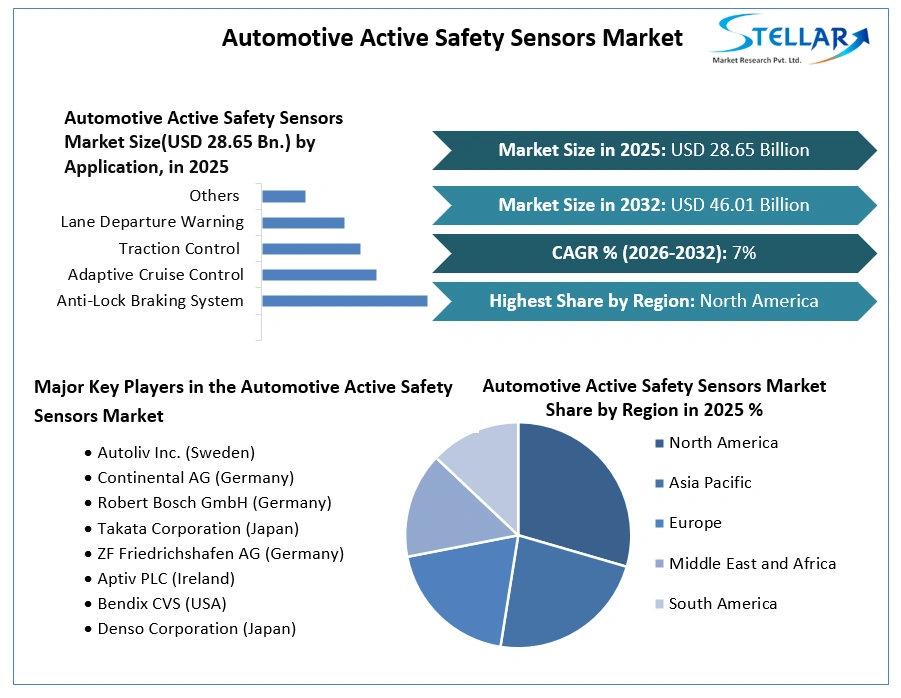
According to Stellar Market Research, the Automotive Active Safety Sensors Market was valued at USD 28.65 billion in 2025 and is expected to reach USD 46.01 billion by 2032, growing at a CAGR of 7% during 2026-2032. Increasing safety regulations, rising adoption of advanced driver assistance systems (ADAS), and growing demand for autonomous vehicles are key factors driving market expansion.
Growing Demand for Advanced Driver Assistance Systems (ADAS)
The increasing adoption of ADAS technologies is one of the major factors driving the automotive active safety sensors market. Modern vehicles are increasingly equipped with intelligent safety systems that use sensors to analyze surrounding environments and assist drivers in making safer decisions.
Active safety sensors enable features such as automatic braking, blind-spot monitoring, pedestrian detection, and lane-keeping assistance. These technologies are becoming essential components in modern vehicles as consumers demand improved safety, convenience, and driving comfort.
𝐃𝐨𝐰𝐧𝐥𝐨𝐚𝐝 𝐅𝐫𝐞𝐞 𝐏𝐃𝐅 𝐁𝐫𝐨𝐜𝐡𝐮𝐫𝐞: https://www.stellarmr.com/report/req_sample/Automotive-Active-Safety-Sensors-Market/544
Rising Focus on Vehicle Safety Regulations
Governments and regulatory authorities worldwide are implementing stricter vehicle safety standards to reduce traffic accidents and improve road safety. These regulations are encouraging automobile manufacturers to integrate advanced sensor technologies into new vehicle models.
Safety assessment programs and mandatory safety features are accelerating the adoption of radar sensors, camera sensors, LiDAR systems, and other technologies across passenger and commercial vehicles.
Increasing Adoption of Autonomous and Electric Vehicles
The growth of autonomous vehicles and electric vehicles is creating new opportunities for automotive active safety sensor manufacturers. Autonomous driving systems depend heavily on accurate environmental perception, requiring advanced sensor technologies for navigation and decision-making.
Electric vehicle manufacturers are increasingly integrating ADAS features to improve safety and provide enhanced driving experiences. The combination of electrification and automation is expected to further increase demand for advanced automotive sensors.
Technological Advancements in Sensor Technologies
Continuous innovation in sensor technology is transforming the automotive safety industry. Manufacturers are developing sensors with improved accuracy, faster response times, and better performance under different weather and road conditions.
Key technologies include:
- Radar sensors
- Camera sensors
- LiDAR sensors
- Ultrasonic sensors
- Sensor fusion technologies
- AI-powered perception systems
These advancements are improving vehicle intelligence and supporting the development of semi-autonomous and autonomous vehicles.
Automotive Active Safety Sensors Market Segmentation Analysis
By Sensor Type
The Automotive Active Safety Sensors Market is segmented into:
- Camera Sensors
- Radar Sensors
- LiDAR Sensors
- Others
Radar sensors are expected to witness strong demand due to their ability to detect objects accurately in different environmental conditions, including low visibility situations. They are widely used in adaptive cruise control, collision warning systems, and autonomous driving applications.
By Application
Major applications include:
- Anti-Lock Braking System (ABS)
- Adaptive Cruise Control
- Traction Control
- Lane Departure Warning
- Others
Anti-lock braking systems and adaptive cruise control remain important applications due to increasing adoption of vehicle safety technologies and regulatory requirements.
By Vehicle Type
The market is divided into:
- Passenger Cars
- Commercial Vehicles
Passenger vehicles represent a significant segment due to increasing consumer demand for advanced safety features and growing adoption of intelligent vehicles.
Regional Market Outlook
Europe
Europe is expected to hold a significant position in the automotive active safety sensors market due to strict vehicle safety regulations and strong adoption of advanced safety systems. The growing presence of autonomous and semi-autonomous vehicle technologies is also supporting regional growth.
Asia Pacific
Asia Pacific is expected to experience strong growth due to increasing vehicle production, rising automotive technology adoption, and improving safety standards in countries such as China, Japan, South Korea, and India. The expansion of electric vehicle manufacturing is also contributing to market development.
North America
North America is witnessing increasing demand for automotive active safety sensors due to strict safety regulations, growing adoption of ADAS technologies, and advancements in autonomous vehicle development.
Key Growth Drivers of Automotive Active Safety Sensors Market
1. Growth of Autonomous Vehicles
The development of self-driving vehicles is increasing demand for advanced sensors capable of detecting and analyzing road environments.
2. Increasing Road Safety Concerns
Growing concerns regarding traffic accidents are encouraging governments and manufacturers to implement advanced safety technologies.
3. Rising ADAS Adoption
Automotive manufacturers are increasingly integrating safety assistance systems into vehicles to improve driving experience and reduce accident risks.
4. Technological Innovation
Advancements in AI, machine learning, sensor fusion, and automotive electronics are improving sensor performance and reliability.
Challenges in the Automotive Active Safety Sensors Market
Despite strong growth potential, the market faces challenges including:
- High cost of advanced sensor systems
- Complex integration requirements
- Sensor reliability issues in extreme conditions
- Supply chain challenges for semiconductor components
The high cost of advanced safety technologies may limit adoption in budget vehicle segments, especially in developing markets.
Future Opportunities in Automotive Active Safety Sensors Industry
The future growth of the market is expected to be supported by:
- Expansion of autonomous driving technologies
- Development of low-cost sensor solutions
- Increased EV adoption
- AI-based vehicle safety systems
- Vehicle-to-everything (V2X) communication
- Advanced sensor fusion technologies
Companies investing in innovative, accurate, and affordable sensor solutions are expected to gain competitive advantages.
Competitive Landscape
Key players operating in the Automotive Active Safety Sensors Market include:
- Robert Bosch GmbH
- Continental AG
- ZF Friedrichshafen AG
- Aptiv PLC
- Denso Corporation
- Hyundai Mobis
These companies are focusing on sensor innovation, strategic partnerships, autonomous driving solutions, and advanced safety system development to strengthen their market position.
𝐃𝐨𝐰𝐧𝐥𝐨𝐚𝐝 𝐅𝐫𝐞𝐞 𝐏𝐃𝐅 𝐁𝐫𝐨𝐜𝐡𝐮𝐫𝐞: https://www.stellarmr.com/report/req_sample/Automotive-Active-Safety-Sensors-Market/544
Conclusion
The Automotive Active Safety Sensors Market is expected to grow significantly during 2026-2032 as the automotive industry moves toward safer, smarter, and more autonomous vehicles. Increasing safety regulations, rising ADAS adoption, and advancements in sensor technologies are creating strong growth opportunities worldwide.
With the continued development of electric vehicles, autonomous driving systems, and AI-powered automotive technologies, active safety sensors will remain a critical component in the future of mobility.
