Key Highlights
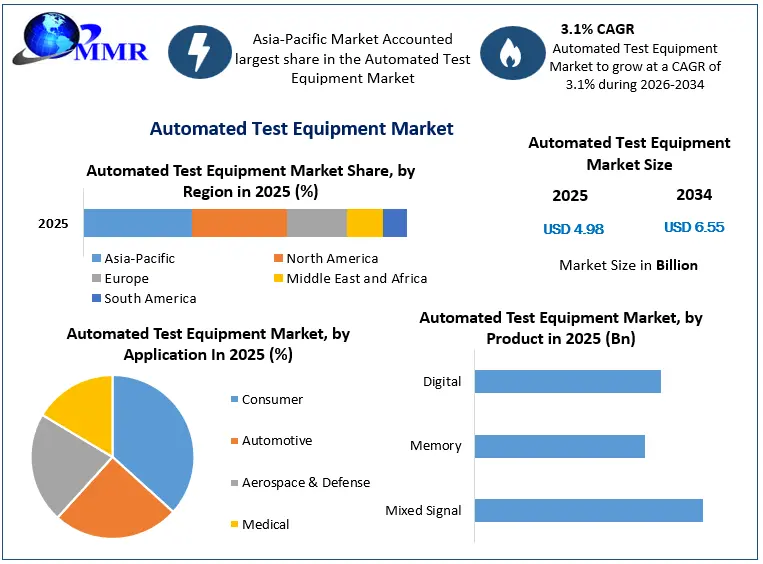
Automated Test Equipment Market size valued at USD 4.98 Billion in 2025.
Total ATE revenue expected to reach nearly USD 6.55 Billion by 2034 at a 3.1% CAGR from 2026 to 2034.
ATE serves semiconductor, electronic and system‑level testing across multiple industries, including automotive.
Market growth reflects rising complexity of electronic components and systems, especially in EVs, ADAS and connected vehicles.
Why This Matters Now
Automotive OEMs and Tier‑1 suppliers are pushing more electronics into every vehicle—battery management systems, power inverters, radar, lidar, cameras, domain controllers—while shortening development cycles. A USD 4.98 Billion ATE market growing to nearly USD 6.55 Billion by 2034 at 3.1% CAGR signals that test capacity, not just chip supply, will constrain who can launch safe and reliable EV and ADAS platforms on time.
Fleet operators and mobility strategists depend on electronics that work flawlessly in harsh, real‑world conditions. Failures in sensors, power electronics or communications modules translate directly into downtime, accidents and regulatory action. Automated test equipment sits at the gate between design and deployment; if automotive players cannot scale and modernize their test strategies, fleets will bear the consequences.
Market Overview
Automated Test Equipment comprises systems that execute structured, repeatable tests on semiconductors, printed circuit boards, electronic modules and, increasingly, integrated systems. These platforms automate stimulus, measurement and pass/fail decisions, dramatically reducing manual test time and improving consistency.
With a market size of USD 4.98 Billion in 2025 and a forecast to nearly USD 6.55 Billion by 2034 at 3.1% CAGR, ATE is on a steady growth path rather than explosive expansion. That trajectory reflects a maturing but essential technology base: test demand rises with electronics content and complexity, but investment cycles are disciplined, driven by long‑term capacity planning rather than short spikes. For automotive and transportation, this means ATE spending is a continuous strategic requirement, not a one‑off response to EV hype.
Key Trends Driving Growth
The foremost trend is the shift from mechanical to electronic complexity in vehicles. Power electronics in EVs, complex ECUs, connectivity modules and high‑density sensors all require thorough functional and reliability testing under a wide range of conditions. ATE platforms deliver the throughput and precision needed to validate these devices at scale.
A second trend is the move toward system‑level and mixed‑signal testing. As ADAS and autonomous functions rely on interaction between multiple sensors and compute elements, testing must go beyond individual chips to multi‑component systems. Automated test equipment increasingly supports these scenarios, enabling automotive players to simulate real‑world conditions and interactions rather than only verifying isolated performance.
Third, regulatory pressure around functional safety and cybersecurity intensifies the test burden. Standards such as ISO 26262 for functional safety and emerging automotive cyber regulations require documented, repeatable test coverage that manual approaches cannot deliver economically. ATE investment becomes a direct lever for compliance and for defending against liability claims.
Request a Free Sample Copy or View Report Summary: https://www.maximizemarketresearch.com/request-sample/21591/
Segment Insights
Dominant Segment – Application: Semiconductor And Component Test
The dominant use of ATE remains semiconductor and electronic component testing. For automotive, this includes microcontrollers, power devices, sensors and communication chips that form the foundation of EV and ADAS systems. OEMs and Tier‑1s that secure robust semiconductor test partnerships gain greater confidence in upstream quality.Fastest‑Growing Segment – Automotive Electronics And Power Devices
Within applications, automotive electronics and power devices rank among the fastest‑growing segments, given EV penetration and ADAS adoption. Testing battery management systems, traction inverters, onboard chargers and safety‑critical ECUs requires specialized ATE configurations and test programs, pushing suppliers to develop automotive‑focused solutions.Test Scope – Device, Board And System‑Level
ATE spans device‑level, board‑level and system‑level testing. As automotive architectures consolidate multiple functions into domain controllers and integrated power modules, system‑level test demand rises. Players who extend ATE beyond traditional device test into full module and subsystem validation will better detect interaction faults that cause field issues.End‑User – Automotive, Telecommunications, Consumer, Industrial
Automotive sits alongside telecommunications, consumer electronics and industrial sectors as a key ATE user. Cross‑sector sharing of test methodologies—such as for high‑frequency communications and power efficiency—benefits automotive, but also creates competition for capacity and engineering talent.
Regional Growth Story
The ATE market’s automotive‑relevant growth is concentrated in regions with strong semiconductor and vehicle production bases. The US, Germany, Japan, South Korea, China and India combine automotive OEM footprints with chip design and manufacturing activity, making them natural centres for ATE deployment.
In the US and Germany, ATE investments support both traditional ICE platforms and advanced EV and ADAS programs. These regions face tight regulatory and consumer expectations around safety and reliability, which increases test depth and breadth. ATE capacity decisions here directly affect global launch schedules and platform rollout.
Asia—especially Japan, South Korea, China and India—benefits from dense electronics ecosystems and aggressive EV ambitions. As local OEMs and Tier‑1s scale battery, inverter and sensor production, they must align ATE capacity with those ramps. Facilities that lag in test modernization risk becoming bottlenecks in global supply chains, even when fabrication and assembly capacity are adequate.
Competitive Landscape
The Automated Test Equipment space features specialized test companies and diversified electronics firms. Automotive‑oriented ATE providers compete on test coverage, throughput, support for complex mixed‑signal and power devices, and integration with customer workflows and data platforms.
Vendors investing in flexible architectures and software‑driven test platforms gain advantage. Automotive customers want to reuse hardware while updating test programs as designs evolve, rather than purchasing bespoke equipment for each generation. Suppliers offering modular systems and strong application engineering win deeper, stickier relationships and pricing power.
Competitively, OEMs and Tier‑1s must avoid over‑dependence on a single ATE partner while still building strategic alliances. Too little diversification raises supply‑chain risk; too much fragmentation increases integration and support complexity. The balance point shapes both negotiation leverage and long‑term technology direction.
Recent Developments
Focus On Automotive Functional Safety
Recent ATE deployments emphasize coverage of functional safety requirements for automotive ECUs and sensors, embedding safety‑specific test suites into standard flows. This trend underscores the move from performance‑only testing to safety and compliance‑centric validation.Expansion Of Power Device Testing Capacity
Investments in ATE capable of handling high‑current, high‑voltage devices reflect EV traction and charging electronics demand. As power stacks grow in complexity, test equipment must manage thermal behaviour and transient conditions with high precision.Increased Use Of Data And Analytics
New ATE solutions incorporate richer data logging and analytics capabilities, enabling automotive customers to track yield, failure patterns and drift over time. This elevates test from a pass/fail gate to a continuous improvement and design‑feedback mechanism.
Strategic Implications
For automotive boardrooms, ATE strategy is now central to product and platform roadmaps. Decisions on where and how to invest in test capacity directly influence launch timing, field reliability and warranty exposure. Treating ATE as a mere procurement line item is no longer viable.
OEMs must coordinate with Tier‑1s and semiconductor partners to map test requirements across EV powertrains, ADAS, connectivity and core compute. Shared test coverage plans and co‑investment in ATE platforms can reduce duplication and gaps, but require trust and clear IP boundaries. Players that manage this collaboration will move faster and with more confidence into new architectures.
Fleet operators and mobility providers should expect that robust ATE regimes sit behind the electronics they purchase. When evaluating suppliers, questions on test strategies, coverage metrics and ATE capabilities should join traditional KPIs like range, TCO and uptime. This will push weaker test practices to the surface and favour suppliers who invest consistently in automated test.
Future Outlook
By 2034, with the Automated Test Equipment Market reaching nearly USD 6.55 Billion at a 3.1% CAGR, ATE will remain a steadily growing but strategically critical segment. Test demands will continue to rise with vehicle electrification, connectivity and autonomy, even if spending appears moderate compared with headline EV investment figures.
Future leaders in automotive and transportation will treat ATE as a design and manufacturing asset—embedded in platform planning, safety cases and supplier selection; laggards will see test only as a necessary cost and discover too late that inadequate ATE capacity and strategy quietly erode reliability, delay launches and weaken trust in their brands.
Related Reports
Diamond Tools Market https://www.maximizemarketresearch.com/market-report/diamond-tools-market/194962/
Car Wash System Market https://www.maximizemarketresearch.com/market-report/global-car-wash-system-market/54740/
Positive Displacement Blowers Market https://www.maximizemarketresearch.com/market-report/positive-displacement-blowers-market/147304/
Analyst Perspective
“With the market rising from USD 4.98 Billion in 2025 to nearly USD 6.55 Billion by 2034 at a 3.1% CAGR, automotive and transportation players that design coherent, long‑term ATE strategies across EV, ADAS and connected vehicle programs will deliver safer, more reliable products than those treating test as an afterthought.”-Dharati Raut
About Maximize Market Research
Maximize Market Research Pvt. Ltd. (MMR) is a global market research and consulting company that provides reliable, data-focused, and practical business insights. The firm serves a wide range of industries, including healthcare, pharmaceuticals, technology, automotive, electronics, chemicals, personal care, and consumer goods. Through market forecasts, competitive analysis, strategic consulting, and industry impact assessments, MMR helps organizations understand changing market conditions, identify growth opportunities, and make informed business decisions for long-term success.
2nd Floor, Navale IT Park Phase 3
Pune Banglore Highway, Narhe
Pune, Maharashtra 411041, India
+91 9607365656
sales@maximizemarketresearch.com
