Key Highlights
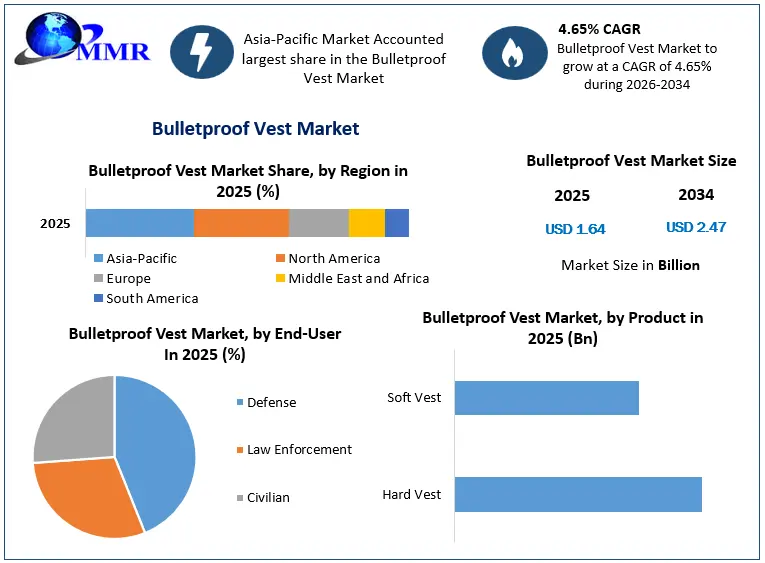
Bulletproof Vest Market size valued at USD 1.64 Billion in 2025.
Total market revenue expected to reach nearly USD 2.47 Billion by 2034 at a CAGR of 4.65% from 2026 to 2034.
Bulletproof vests are core protective equipment for military, law enforcement and selected civilian applications.
Market growth reflects rising security concerns, modernization programs and demand for advanced protective materials.
Why This Matters Now
Automotive OEMs, Tier‑1 suppliers and fleet operators are expanding production, logistics and service networks into geographies with heightened security risks—political instability, organized crime and cargo theft. A Bulletproof Vest Market growing from USD 1.64 Billion in 2025 to nearly USD 2.47 Billion by 2034 at 4.65% CAGR is a visible indicator that personal protection is being upgraded in many of these environments. Security strategy is no longer only about telematics and fences; it increasingly involves the safety of people operating in exposed transport roles.
Investors and mobility strategists considering EV hubs, battery plants or high‑value vehicle flows through risk‑prone corridors must factor personnel protection into their operating models. The rising market for bulletproof vests signals that governments, security providers and private operators are willing to pay for better protection; automotive players that fail to match that standard risk reputational damage and disruption if incidents impact drivers, yard staff or escort teams.
Market Overview
Bulletproof vests are personal protective garments designed to absorb and dissipate the kinetic energy of bullets and fragments, reducing or preventing penetration. They are typically categorized by protection level and material composition, including soft armor for handgun threats and hard plates for rifle rounds. The market is shaped by procurement cycles in military and law‑enforcement agencies, along with niche civilian demand.
With a 2025 market value of USD 1.64 Billion and a forecast near USD 2.47 Billion by 2034 at 4.65% CAGR, bulletproof vests represent a moderate‑growth but strategically important segment of the broader security and defense equipment landscape. The growth rate suggests ongoing modernization and replacement rather than one‑off spikes. For automotive and transportation operations, this pattern matters because it indicates durable demand for protection across the security services that often guard logistics routes, ports and yards.
Key Trends Driving Growth
One major trend is modernization and replacement of legacy armor. Many agencies and security providers are retiring older, heavier vests in favour of designs that offer comparable protection with less weight and improved ergonomics. This reduces fatigue and increases compliance with wear policies—critical where drivers, guards or yard supervisors must wear vests for extended shifts around high‑value vehicles or volatile routes.
A second trend is expanding use of lightweight and advanced materials, such as high‑performance fibres and composite plates. These materials can deliver better multi‑hit performance, improved comfort and, in some cases, enhanced environmental resistance. For transport and automotive logistics operations, lighter vests reduce physical strain on personnel working in hot climates or performing physically demanding tasks like loading high‑value components or vehicles.
Third, rising security concerns in urban and cross‑border corridors are driving more structured procurement by governments and private operators. As bulletproof vest adoption increases among security teams escorting valuable shipments, automotive OEMs and Tier‑1s involved in just‑in‑time, high‑value flows—such as EVs, luxury vehicles or critical spare parts—see new expectations around integrated security packages that include personnel protection.
Request a Free Sample Copy or View Report Summary: https://www.maximizemarketresearch.com/request-sample/146555/
Segment Insights
Dominant Segment – End‑User: Military And Law Enforcement
Military and law‑enforcement agencies remain the dominant users of bulletproof vests, driving baseline demand and setting performance standards. Their procurement decisions influence what technologies are available and affordable for private security firms protecting vehicle plants, rail ramps and truck yards that serve automotive and transportation networks.Fastest‑Growing Segment – Civilian And Private Security
Civilian and private security segments are among the fastest‑growing areas as corporations, logistics firms and critical‑infrastructure operators adopt vests for staff in higher‑risk roles. This includes guards, escorts and occasionally drivers in certain corridors. For automotive supply chains, this trend shows that personal protection is moving closer to frontline logistics and facility operations.Type – Soft Vests, Hard Vests, Plate Carriers
The market spans soft vests suitable for concealed wear, hard vests or carriers that mount ballistic plates, and hybrid configurations. Soft vests may be used by personnel who need discretion in public transport and urban settings; plate carriers are preferred for openly armed escorts in high‑risk zones. Automotive and transport players engaging contracted security must understand which type suits their risk profile and operating environment.Material – Ballistic Fibres And Composites
Materials include ballistic fibres and composite plates, each offering specific trade‑offs between weight, cost and ballistic level. The choice affects how easily staff can combine vests with other PPE, such as high‑visibility clothing or harnesses used in logistics and yard operations.
Regional Growth Story
Bulletproof vest demand is closely tied to regional security conditions and defence budgets. Markets such as the US and parts of Europe see continuous procurement for military and law‑enforcement, alongside growing private security sectors. These regions host major automotive OEMs and logistics hubs, meaning transport operations often share geography with security‑intensive environments and may draw on the same pool of protective equipment and services.
In Asia, including China and India, rising urbanization and infrastructure expansion intersect with varied security challenges. Bulletproof vests procured for policing, paramilitary forces and private security can indirectly support automotive logistics and distribution when the same entities protect industrial corridors and ports. As vehicle exports, EV shipments and component flows grow, the presence of properly equipped security personnel becomes part of route risk assessments.
Other regions with acute security concerns, including parts of Latin America, the Middle East and Africa, experience concentrated demand for bulletproof vests among both state actors and private firms. Automotive and transport operations in these areas—especially for high‑value or strategic cargo—often require coordination with security providers equipped with modern vests and related gear.
Competitive Landscape
The Bulletproof Vest Market includes global defence contractors, specialized armor manufacturers and regional PPE suppliers. Competitive dynamics revolve around material innovation, certification to ballistic standards, comfort, weight and price, plus the ability to scale production for large procurement cycles.
Manufacturers investing in lighter, more ergonomic designs with certified performance levels gain technology leadership and pricing power. Their products appeal to agencies and firms that must balance protection with mobility, which is particularly important for guards and drivers working long hours in automotive logistics contexts.
Regional suppliers may focus on meeting local regulatory standards and cost expectations, while larger players compete to win multinational contracts. For automotive and transportation companies partnering with security firms, the choice of vest suppliers indirectly influences staff safety and the perceived professionalism of protective operations.
Recent Developments
Shift To Lightweight, Flexible Armor
Market commentary emphasizes the trend toward lighter, more flexible vests to improve user comfort and reduce fatigue. This development supports longer wear times for personnel guarding transport hubs and vehicle plants.Material And Design Innovation
Ongoing innovation in ballistic materials and vest design targets improved multi‑hit resistance, better coverage and enhanced integration with other gear. These advancements help security teams operating in complex industrial environments where mobility and coverage both matter.Structured Procurement And Modernization Programs
Governments and large private operators continue to run modernization programs, replacing legacy vests with newer models. This creates predictable cycles of demand and influences available product configurations for security services supporting automotive and transport operations.
Strategic Implications
Automotive OEMs, Tier‑1 suppliers and logistics firms operating in higher‑risk environments should view bulletproof vests as part of an integrated security strategy, not an isolated purchase. Personal protection gear for guards, escorts and certain yard staff can materially influence incident outcomes, staff confidence and the ability to maintain operations in challenging conditions.
Security planning around plants, battery facilities, rail ramps and high‑value road routes should explicitly address whether bulletproof vests are required, which protection levels are appropriate, and how they integrate with training and other PPE. Procurement strategies must weigh cost against performance, comfort and certification, especially when operations rely on contracted security providers.
For fleet operators moving high‑value cargo or operating in urban areas with elevated risk, coordination with security services on vest choice and deployment is essential. Clear alignment on standards helps avoid gaps where staff believe they are protected but equipment does not match threat levels or regulatory expectations.
Future Outlook
By 2034, with the Bulletproof Vest Market approaching USD 2.47 Billion at a 4.65% CAGR, ballistic personal protection will remain a growing, professionalizing segment of the security ecosystem. Automotive and transportation operations that intersect with high‑risk areas will increasingly be expected to engage with well‑equipped security providers and, where appropriate, equip their own exposed teams.
Future leaders will treat bulletproof vest deployment as a deliberate component of transport and site‑security design—aligned with route risk, facility exposure and staff roles; laggards will leave personal protection decisions entirely to ad‑hoc providers and discover in crisis that gaps in ballistic protection carry human and reputational costs far greater than the savings achieved.
Related Reports
Global Automatic Coffee Machines Market https://www.maximizemarketresearch.com/market-report/global-automatic-coffee-machines-market/23473/
Marine HVAC Market https://www.maximizemarketresearch.com/market-report/marine-hvac-market/221761/
Personal safety alarms Market https://www.maximizemarketresearch.com/market-report/personal-safety-alarms-market/148479/
Analyst Perspective
“With the market rising from USD 1.64 Billion in 2025 to nearly USD 2.47 Billion by 2034 at a 4.65% CAGR, automotive and transportation players that work proactively with security partners on appropriate ballistic protection for high‑risk routes and hubs will manage human risk and operational continuity far better than those that treat personal protection as someone else’s problem.”-Dharati Raut
About Maximize Market Research
Maximize Market Research Pvt. Ltd. (MMR) is a global market research and consulting company that provides reliable, data-focused, and practical business insights. The firm serves a wide range of industries, including healthcare, pharmaceuticals, technology, automotive, electronics, chemicals, personal care, and consumer goods. Through market forecasts, competitive analysis, strategic consulting, and industry impact assessments, MMR helps organizations understand changing market conditions, identify growth opportunities, and make informed business decisions for long-term success.
2nd Floor, Navale IT Park Phase 3
Pune Banglore Highway, Narhe
Pune, Maharashtra 411041, India
+91 9607365656
sales@maximizemarketresearch.com
