Market Overview
The global Spirits Packaging Market is witnessing significant transformation as beverage manufacturers increasingly focus on premium presentation, sustainable materials, innovative designs, and enhanced consumer experiences. Spirits packaging plays a crucial role beyond product protection by influencing brand identity, shelf appeal, transportation efficiency, and consumer purchasing decisions.
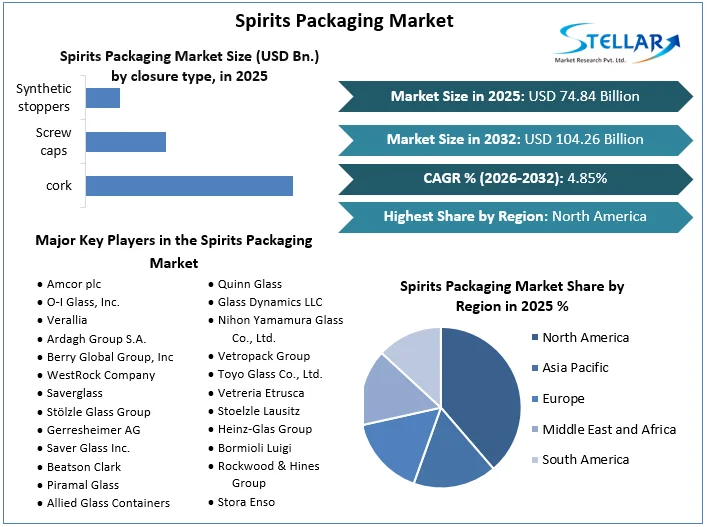
According to Stellar Market Research, the Spirits Packaging Market was valued at USD 74.84 billion in 2025 and is expected to reach approximately USD 104.26 billion by 2032, growing at a CAGR of 4.85% during the forecast period 2026–2032. The market expansion is driven by rising consumption of alcoholic beverages, increasing demand for premium spirits, growth of craft beverage brands, and advancements in sustainable packaging technologies.
Modern spirits packaging has evolved from traditional containers into a strategic branding tool. Distillers are increasingly investing in distinctive bottle shapes, premium closures, eco-friendly materials, and customized labeling solutions to differentiate products in a competitive global marketplace.
Download Free PDF Brochure: https://www.stellarmr.com/report/req_sample/Global-spirits-packaging-Market-/1430
Premiumization Trend Driving Spirits Packaging Demand
One of the strongest growth drivers for the Spirits Packaging Market is the increasing premiumization of alcoholic beverages. Consumers are showing greater interest in high-quality spirits, craft beverages, limited-edition releases, and luxury products that offer unique experiences.
Premium spirits brands are investing heavily in visually appealing packaging designs to communicate product quality and exclusivity. Glass bottles with customized shapes, embossed branding, decorative labels, and premium closures are becoming increasingly popular among whiskey, vodka, rum, gin, and tequila producers.
Packaging has become an important factor influencing consumer perception. A sophisticated bottle design can create stronger brand recognition and improve the overall value proposition of premium spirits. This trend is encouraging manufacturers to collaborate with packaging designers and invest in innovative solutions.
The growth of gifting culture and luxury beverage consumption is also supporting demand for attractive secondary packaging, including gift boxes, tubes, and specialty containers.
Rising Demand for Sustainable Packaging Solutions
Sustainability is becoming a major focus area within the spirits packaging industry. Beverage manufacturers are under increasing pressure from consumers, governments, and environmental organizations to reduce packaging waste and improve recyclability.
Glass remains one of the most preferred packaging materials due to its premium appearance, recyclability, and ability to preserve beverage quality. However, companies are increasingly exploring lightweight glass bottles, recycled glass content, and alternative materials to reduce carbon emissions associated with production and transportation.
Plastic and PET-based packaging solutions are also gaining attention for specific applications due to their lightweight characteristics and lower transportation costs. Manufacturers are developing improved PET solutions with enhanced barrier properties and recyclability.
Sustainable packaging initiatives are expected to become a key competitive advantage as global beverage companies work toward environmental goals and circular economy models.
Innovation in Bottle Design and Branding Strategies
Packaging innovation has become essential for spirits brands seeking differentiation in crowded markets. Companies are experimenting with unique bottle shapes, artistic designs, smart labels, and interactive packaging technologies.
Contemporary packaging solutions allow brands to communicate their heritage, craftsmanship, and product story directly to consumers. Luxury whiskey and premium liquor brands often use handcrafted bottles, specialty finishes, and customized designs to create stronger emotional connections.
Digital technologies are also influencing packaging development. QR codes, NFC-enabled labels, and augmented reality features are being integrated into bottles to provide consumers with information about product origin, authenticity, and brand experiences.
These technologies help brands improve consumer engagement while supporting transparency and anti-counterfeiting efforts.
Growth of Craft Spirits and Emerging Beverage Brands
The rapid expansion of craft spirits is creating new opportunities for packaging manufacturers. Independent distilleries and boutique beverage producers are increasingly entering the market with unique products that require distinctive packaging solutions.
Craft brands often rely on packaging as a primary marketing tool because they compete against established global companies. Creative bottle designs, customized labels, and premium finishes help smaller brands establish recognition and attract consumers.
The popularity of craft whiskey, artisanal gin, specialty rum, and flavored spirits is encouraging packaging suppliers to offer flexible production capabilities and customized solutions.
Emerging markets are also contributing to industry growth as rising disposable incomes and changing consumer preferences increase demand for premium alcoholic beverages.
Market Segmentation Insights
The Spirits Packaging Market is segmented based on packaging type, application, design and branding, closure type, and material type.
Based on packaging type, glass bottles represent a dominant segment due to their premium appearance, durability, and widespread acceptance among spirits manufacturers. Glass packaging continues to be preferred for whiskey, vodka, rum, and other premium alcoholic beverages.
The pouch and bag-in-box segments are gaining attention due to convenience, portability, and reduced material usage. These formats are particularly relevant for bulk packaging and innovative beverage applications.
By closure type, cork closures and screw caps remain widely used because they provide product protection while contributing to brand positioning. Premium spirits often utilize customized corks and specialty closures to enhance consumer perception.
Based on material type, glass bottles maintain strong demand, while plastic and metal containers are experiencing growth in applications requiring lightweight and cost-efficient packaging.
Role of E-Commerce and Changing Distribution Channels
The expansion of online alcohol sales and digital retail platforms is influencing spirits packaging requirements. E-commerce growth has increased demand for packaging solutions that provide durability during transportation while maintaining premium presentation.
Brands are focusing on protective secondary packaging to prevent damage during shipping. Attractive packaging also plays an important role in online purchasing decisions because consumers rely heavily on product images and visual appeal.
Subscription-based beverage services and direct-to-consumer models are further encouraging brands to develop innovative packaging formats that improve customer experience.
Regional Market Insights
North America represents a significant region in the global spirits packaging market due to strong demand for premium spirits, craft beverages, and innovative packaging formats. The United States has a well-established spirits industry with increasing consumer interest in luxury and artisanal products.
Europe remains a major market due to its strong beverage heritage, advanced packaging industry, and growing emphasis on sustainability. Countries such as Germany, France, Italy, and the United Kingdom are investing in environmentally responsible packaging solutions.
Asia Pacific is expected to witness strong growth during the forecast period due to rising disposable incomes, expanding middle-class populations, and increasing consumption of premium alcoholic beverages. Countries including China, India, Japan, and South Korea are becoming attractive markets for spirits manufacturers and packaging suppliers.
Competitive Landscape
The Spirits Packaging Market includes major packaging manufacturers focusing on innovation, sustainability, and customized solutions. Leading companies are investing in advanced manufacturing technologies, lightweight packaging, recycled materials, and premium designs.
Key players operating in the market include Amcor plc, O-I Glass Inc., Verallia, Ardagh Group, Berry Global, WestRock Company, Saverglass, Gerresheimer AG, Piramal Glass, Vidrala, Vetropack Group, and Ardagh Glass Packaging.
Companies are strengthening their market position through strategic partnerships with beverage producers, expansion of production facilities, and development of environmentally friendly packaging solutions.
Download Free PDF Brochure: https://www.stellarmr.com/report/req_sample/Global-spirits-packaging-Market-/1430
Future Outlook
The future of the Spirits Packaging Market is expected to remain positive as beverage companies continue investing in premium branding, sustainability, and consumer-focused packaging innovations.
Growing demand for luxury spirits, expansion of craft beverage categories, and increasing adoption of recyclable materials will shape market development through 2032. Packaging manufacturers that combine design innovation, environmental responsibility, and advanced technology will gain stronger competitive advantages.
As spirits brands increasingly view packaging as a key element of marketing strategy and consumer engagement, the industry is expected to experience continued evolution toward smarter, greener, and more personalized packaging solutions.
Media Contact
Stellar Market Research
Website: Stellar Market Research – Global Research Reports & Consulting
Email: sales@stellarmr.com
