Market Overview
The global Kevlar Fiber Market is experiencing steady expansion as industries increasingly demand lightweight, high-strength, and durable materials for advanced applications. Kevlar fiber, a para-aramid synthetic fiber known for its exceptional tensile strength, thermal stability, impact resistance, and low weight, has become a critical material across defense, aerospace, automotive, industrial, and protective equipment sectors.
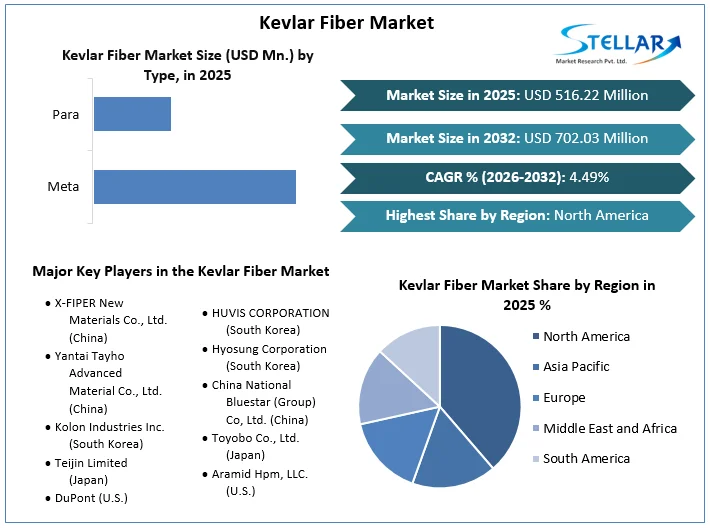
According to Stellar Market Research, the Kevlar Fiber Market was valued at USD 516.22 million in 2025 and is projected to reach approximately USD 702.03 million by 2032, registering a CAGR of 4.49% during 2026–2032. The market growth is supported by rising demand for advanced protective materials, increasing defense expenditure, growing adoption of lightweight automotive components, and expanding applications in high-performance composites.
Kevlar fiber has become a preferred material where strength, safety, and efficiency are essential. Its ability to provide superior protection while reducing overall weight makes it highly valuable in applications ranging from ballistic protection systems to aerospace structures and industrial reinforcement materials.
Download Free PDF Brochure: https://www.stellarmr.com/report/req_sample/Kevlar-Fiber-Market/1439
Rising Demand for Lightweight and High-Performance Materials
One of the major factors driving the Kevlar Fiber Market is the growing requirement for lightweight materials with exceptional mechanical properties. Industries are continuously searching for alternatives to traditional metals and heavier materials to improve efficiency, reduce energy consumption, and enhance product performance.
Kevlar fiber offers a high strength-to-weight ratio, making it suitable for applications where weight reduction is critical. Aerospace manufacturers use Kevlar composites in aircraft components to reduce structural weight while maintaining durability and safety standards.
The automotive industry is also adopting Kevlar-based materials to improve vehicle performance. Lightweight components help manufacturers enhance fuel efficiency in conventional vehicles and extend battery range in electric vehicles. Applications include tires, brake systems, reinforced plastics, and other high-performance automotive parts.
As industries continue focusing on efficiency and sustainability, demand for advanced fibers such as Kevlar is expected to increase.
Defense and Security Applications Driving Market Expansion
The defense sector remains one of the most important application areas for Kevlar fiber. Increasing investments in military modernization programs and rising demand for advanced protective equipment are strengthening market opportunities.
Kevlar fibers are widely used in body armor, helmets, ballistic protection panels, military vehicles, and protective shields due to their excellent impact absorption capabilities. The material provides strong protection against ballistic threats while remaining lightweight, allowing greater mobility for military personnel.
Government investments in defense infrastructure and increasing security requirements across regions are expected to support continued demand for Kevlar-based solutions.
The growing need for advanced protection among law enforcement agencies, emergency responders, and security organizations is also contributing to market development. Protective gloves, fire-resistant clothing, and safety equipment made from Kevlar are increasingly adopted across various industries.
Growing Adoption in Aerospace and Composite Manufacturing
The aerospace industry represents a significant growth opportunity for the Kevlar Fiber Market due to increasing demand for lightweight and durable composite materials.
Aircraft manufacturers use Kevlar composites in interior structures, reinforcement components, and protective applications because the material provides strength without adding excessive weight. Reduced aircraft weight contributes to improved fuel efficiency and lower operational costs.
Beyond aviation, Kevlar composites are gaining popularity in marine applications, sporting equipment, and industrial components. High-performance boats, racing equipment, and specialized machinery benefit from Kevlar’s resistance to impact and wear.
The expansion of composite manufacturing technologies is enabling manufacturers to develop more advanced Kevlar-based products with improved performance characteristics.
Automotive Lightweighting and Electric Vehicle Opportunities
The transition toward electric mobility is creating new opportunities for Kevlar fiber manufacturers. Electric vehicle producers are focusing on lightweight construction to improve battery efficiency and driving range.
Kevlar-based composites can support EV development by providing strong, lightweight structures and enhanced protection for critical components. The material’s heat resistance and durability make it suitable for applications requiring long-term reliability.
In traditional automotive manufacturing, Kevlar is already used in tire reinforcement, belts, hoses, and friction materials. Its ability to withstand high temperatures and mechanical stress makes it valuable for improving vehicle safety and performance.
As global automotive manufacturers increase investments in lightweight engineering, Kevlar fiber adoption is expected to expand.
Protective Equipment and Industrial Safety Applications
Increasing workplace safety regulations are supporting the demand for Kevlar fiber-based protective products. Industries such as construction, oil and gas, manufacturing, and mining require materials that provide resistance against cuts, heat, and impact.
Kevlar is widely used in:
Cut-resistant gloves
Protective clothing
Firefighter equipment
Industrial safety gear
Heat-resistant applications
The growing emphasis on employee safety and compliance with occupational protection standards is encouraging companies to adopt high-performance protective solutions.
Additionally, industrial workers operating in extreme environments require durable materials that provide protection without limiting movement and comfort.
Technological Advancements and Sustainable Material Development
Innovation in fiber manufacturing and composite technologies is shaping the future of the Kevlar Fiber Market. Manufacturers are investing in research and development to improve fiber performance, processing efficiency, and application possibilities.
Advanced production methods are helping improve material consistency, strength, and compatibility with different composite systems.
Sustainability is also becoming an important focus area. Companies are exploring improved recycling methods, efficient production processes, and responsible material management strategies to reduce environmental impact.
The development of next-generation composite materials is expected to create additional opportunities in renewable energy, transportation, and industrial applications.
Market Challenges and Restraints
Despite strong growth opportunities, the Kevlar Fiber Market faces several challenges. High manufacturing costs remain one of the primary limitations affecting widespread adoption.
Kevlar production requires advanced polymer processing technologies, specialized equipment, and controlled manufacturing conditions, which increase overall costs compared with conventional materials.
Competition from alternative high-performance fibers such as carbon fiber, fiberglass, and other aramid materials also creates market pressure. These alternatives may offer advantages in specific applications depending on cost, performance requirements, and availability.
Additionally, limited application awareness in emerging markets can restrict market penetration.
Segment Analysis
Based on type, the para-aramid segment dominates the Kevlar Fiber Market due to its widespread usage in military protection, aerospace applications, and high-strength composite materials. Para-aramid fibers provide excellent tensile strength and impact resistance, making them suitable for demanding applications.
The meta-aramid segment is expected to witness growth due to increasing adoption in thermal protective clothing, electrical insulation, and industrial applications requiring heat resistance.
By application, the security and protection segment holds a leading position due to strong demand for body armor, helmets, protective clothing, and safety equipment. Friction materials, rubber reinforcement, aerospace, electrical insulation, and optical fiber applications also contribute significantly to market growth.
Regional Market Insights
North America represents a leading market for Kevlar fiber due to strong defense spending, advanced aerospace industries, and strict workplace safety regulations. The United States remains a major contributor because of significant demand for protective equipment and military applications.
Asia Pacific is emerging as a high-growth region due to rapid industrialization, expanding automotive production, increasing defense investments, and growing manufacturing capabilities. Countries such as China, India, Japan, and South Korea are creating new opportunities for advanced material suppliers.
Europe is also witnessing increasing adoption due to aerospace innovation, automotive lightweighting initiatives, and demand for sustainable engineering materials.
Competitive Landscape
The Kevlar Fiber Market is moderately consolidated, with leading companies focusing on product development, capacity expansion, and strategic partnerships. Key players include:
DuPont
Teijin Limited
Kolon Industries Inc.
Hyosung Corporation
Yantai Tayho Advanced Material Co., Ltd.
Toyobo Co., Ltd.
These companies are investing in advanced fiber technologies, expanding regional production capabilities, and developing customized solutions for aerospace, defense, automotive, and industrial applications.
Download Free PDF Brochure: https://www.stellarmr.com/report/req_sample/Kevlar-Fiber-Market/1439
Future Outlook
The future of the Kevlar Fiber Market remains positive as industries continue shifting toward lightweight, durable, and high-performance materials. Increasing defense modernization, electric vehicle development, aerospace expansion, and rising workplace safety requirements will continue driving demand.
Future growth will depend on technological innovation, sustainable manufacturing practices, and expansion into emerging applications such as renewable energy, advanced transportation, and next-generation composites.
As industries prioritize efficiency, safety, and performance, Kevlar fiber is expected to remain a vital advanced material supporting innovation across global markets.
Media Contact
Stellar Market Research
Website: Stellar Market Research – Global Research Reports & Consulting
Email: sales@stellarmr.com
