Market Overview and Definition
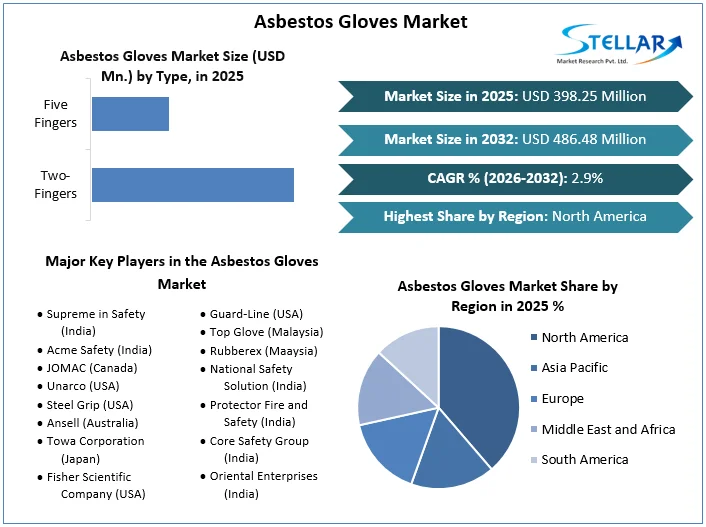
Asbestos Gloves Market is expected to grow at a CAGR of 2.9% during the forecast period. Asbestos Gloves Market is expected to reach US$ 486.48 Mn. in 2032 from US$ 398.25 Mn. in 2025.
The Asbestos Gloves Market represents a specialized segment of the industrial protective equipment industry, focused on manufacturing heat-resistant gloves designed to protect workers from extreme temperatures, thermal hazards, and fire-related risks. Historically, asbestos-based gloves were widely used because of their exceptional heat resistance, durability, and insulation properties. However, due to the severe health hazards associated with asbestos exposure, the market has undergone significant transformation toward safer alternatives and advanced protective materials.
Today, industries such as metal processing, glass manufacturing, foundries, welding, firefighting, and high-temperature laboratory applications require protective gloves that can withstand extreme environments while meeting strict workplace safety regulations. The evolution of the market is strongly influenced by increasing industrial safety standards, technological improvements in protective fibers, and the transition toward asbestos-free heat-resistant solutions.
Download Free PDF Brochure: https://www.stellarmr.com/report/req_sample/Asbestos-Gloves-Market/674
Industrial Safety Regulations Driving Market Transformation
Workplace safety regulations have become one of the most important factors shaping the future of protective equipment markets. Governments and occupational safety organizations across the world have implemented strict guidelines regarding asbestos handling, exposure prevention, and the use of safer protective materials.
Asbestos has been restricted or banned in many countries due to its connection with serious respiratory diseases, including mesothelioma and lung-related disorders. These regulatory changes have reduced the use of traditional asbestos gloves while encouraging manufacturers to develop alternatives using materials such as aramid fibers, fiberglass, silica-based fabrics, and advanced thermal insulation composites.
The growing focus on employee safety and compliance requirements is encouraging industries to invest in certified protective equipment. Companies operating in hazardous environments are increasingly prioritizing gloves that provide similar thermal protection without the health risks associated with asbestos.
Key Growth Drivers of the Asbestos Gloves Market
Rising Demand from High-Temperature Industries
Industries involving extreme heat exposure remain major users of specialized protective gloves. Foundries, steel plants, welding operations, glass manufacturing facilities, and metal fabrication units require protective equipment capable of handling high temperatures and preventing burn injuries.
Industrial expansion in emerging economies, particularly in Asia-Pacific and Latin America, is increasing demand for heat-resistant protective solutions. As manufacturing activities grow, companies are focusing more on worker safety measures, creating opportunities for advanced thermal glove manufacturers.
Increasing Focus on Occupational Health and Safety
Employee protection has become a strategic priority for industries worldwide. Organizations are investing in personal protective equipment (PPE) to reduce workplace accidents, improve compliance, and maintain operational efficiency.
Safety audits, government inspections, and corporate sustainability initiatives are encouraging companies to upgrade protective equipment. This trend is supporting demand for high-quality heat-resistant gloves that meet international safety standards.
Technological Advancements in Protective Materials
Innovation in fiber technology is reshaping the protective glove industry. Manufacturers are developing lightweight, flexible, and highly durable alternatives that provide enhanced thermal protection compared with traditional materials.
Advanced fibers such as Kevlar, Nomex, ceramic fibers, and silica fabrics are being integrated into protective gloves to improve heat resistance, abrasion protection, and user comfort. These innovations are helping industries replace outdated asbestos-based products with safer solutions.
Challenges Affecting Market Growth
Declining Use of Traditional Asbestos-Based Products
The primary challenge for the asbestos gloves market is the global decline in asbestos usage. Regulatory restrictions and growing awareness of health risks have significantly reduced demand for traditional asbestos-containing protective products.
Manufacturers must continuously adapt by investing in asbestos-free technologies and developing replacement products that meet industry requirements. Companies unable to transition toward safer materials may face declining market opportunities.
High Cost of Advanced Protective Alternatives
Modern heat-resistant gloves made from advanced fibers and specialized materials often involve higher production costs compared with conventional protective equipment. Small and medium-sized industries may experience challenges in adopting premium protective solutions due to budget limitations.
However, increasing regulatory pressure and long-term workplace safety benefits are expected to encourage broader adoption of advanced alternatives.
Emerging Trends Shaping the Market
Shift Toward Asbestos-Free Protective Equipment
One of the strongest trends in the industry is the replacement of asbestos-based gloves with environmentally safer and health-conscious alternatives. Manufacturers are focusing on developing products that deliver comparable thermal protection while eliminating hazardous materials.
This shift aligns with global sustainability goals and stricter occupational health policies. Companies are increasingly marketing asbestos-free gloves as safer, durable, and compliant solutions for industrial applications.
Development of Lightweight and Ergonomic Designs
Modern workers require protective equipment that provides safety without restricting movement. Manufacturers are investing in ergonomic glove designs that improve flexibility, grip performance, and comfort during extended usage.
Lightweight protective gloves help increase worker productivity by reducing fatigue while maintaining high levels of protection.
Growth of Customized Industrial Safety Solutions
Industries are increasingly seeking customized protective equipment based on specific operational requirements. Different sectors require gloves with varying levels of heat resistance, chemical protection, mechanical strength, and durability.
Manufacturers are responding by offering application-specific solutions designed for welding, metal handling, furnace operations, and laboratory environments.
Regional Market Insights
North America
North America remains a significant market due to strict workplace safety regulations and strong adoption of advanced protective equipment. Countries such as the United States and Canada have implemented comprehensive occupational safety standards that encourage industries to use certified heat-resistant gloves.
The region’s developed manufacturing sector, including aerospace, automotive, metal processing, and energy industries, continues to generate demand for high-performance protective solutions.
Europe
Europe represents another important market driven by strong regulatory frameworks and sustainability initiatives. European industries are actively replacing hazardous materials with safer alternatives, supporting innovation in protective equipment manufacturing.
The region’s emphasis on environmental responsibility and worker safety is accelerating demand for asbestos-free thermal protection products.
Asia-Pacific
Asia-Pacific is expected to witness significant growth opportunities due to rapid industrialization, expanding manufacturing activities, and increasing awareness of workplace safety. Countries such as China, India, Japan, and South Korea are investing heavily in industrial infrastructure.
Growing metal production, construction activities, and manufacturing expansion are increasing the need for reliable protective equipment across the region.
Competitive Landscape and Industry Outlook
- JOMAC (Canada)
- Unarco (USA)
- Steel Grip (USA)
- Ansell (Australia)
- Towa Corporation (Japan)
- Fisher Scientific Company (USA)
- Guard-Line (USA)
- Top Glove (Malaysia)
Download Free PDF Brochure: https://www.stellarmr.com/report/req_sample/Asbestos-Gloves-Market/674
Future Outlook
The Asbestos Gloves Market is undergoing a major transformation driven by safety regulations, technological innovation, and changing industrial requirements. While traditional asbestos-based products are declining, opportunities are emerging for manufacturers offering advanced asbestos-free protective solutions.
Future growth will be supported by increasing industrial safety investments, rising demand from high-temperature applications, and continuous improvements in protective material technologies. Companies that focus on innovation, sustainability, and compliance will be better positioned to capture emerging opportunities in the global protective equipment industry.
As industries worldwide continue moving toward safer workplace environments, the market for advanced thermal protection gloves is expected to expand steadily through the forecast period.
Media Contact
Stellar Market Research
Website: Stellar Market Research – Global Research Reports & Consulting
Email: sales@stellarmr.com
