Introduction
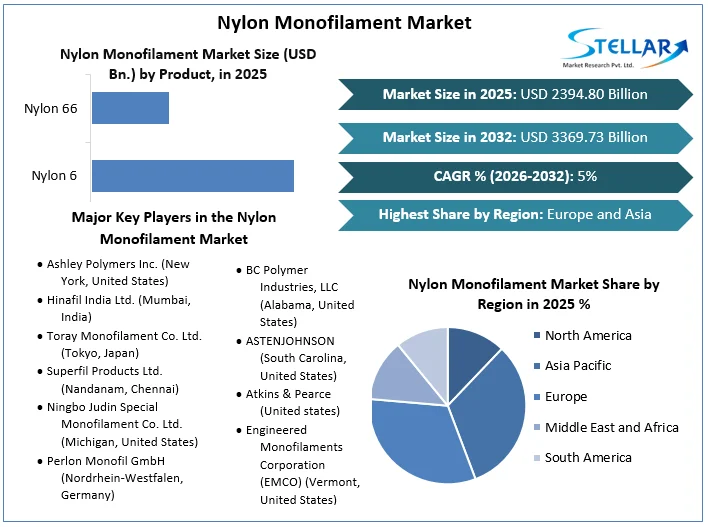
Nylon Monofilament Market was valued at USD 2394.80 billion in 2025. Global Nylon Monofilament Market size is estimated to grow at a CAGR of 5 % over the forecast period.
The Nylon Monofilament Market continues to expand steadily as industries worldwide seek durable, lightweight, and high-performance materials for a wide range of applications. Nylon monofilaments are single continuous strands of synthetic polymer known for their excellent tensile strength, flexibility, abrasion resistance, and chemical stability. These fibers are extensively used in industrial filtration, fishing lines, textiles, automotive components, medical devices, agriculture, sporting equipment, and precision engineering products.
Growing industrialization, technological advancements, and increasing demand for engineered materials are driving the adoption of nylon monofilaments across both developed and emerging economies. According to Stellar Market Research, the market is expected to witness healthy growth through 2032, supported by expanding manufacturing activities, rising filtration requirements, and continuous innovation in polymer technology.
Download Free PDF Brochure: https://www.stellarmr.com/report/req_sample/Nylon-Monofilament-Market/938
Market Dynamics Driving Growth
The global nylon monofilament market is benefiting from strong demand across multiple end-use industries. Manufacturers continue to develop advanced monofilament products capable of meeting increasingly demanding performance requirements while improving production efficiency and sustainability.
Rapid industrial automation has significantly increased the use of nylon monofilaments in conveyor systems, filtration equipment, industrial brushes, printing machinery, and engineering applications. Their ability to withstand high mechanical stress and harsh operating environments makes them an ideal material for industrial processes.
Another major growth factor is the increasing adoption of advanced filtration technologies. Water treatment facilities, chemical processing plants, pharmaceutical manufacturers, and food processing industries rely on nylon monofilament filter fabrics due to their excellent dimensional stability and chemical resistance.
Expanding Applications Across Industries
Industrial Filtration
Industrial filtration remains one of the largest application segments for nylon monofilaments. Growing environmental regulations and increasing demand for clean water have accelerated investments in filtration systems worldwide.
Nylon monofilament fabrics provide precise filtration performance while maintaining durability under continuous operation. Industries including wastewater treatment, mining, chemical manufacturing, food processing, and pharmaceuticals continue adopting advanced filtration solutions to improve operational efficiency.
Automotive Industry
The automotive sector is another significant consumer of nylon monofilament products. Modern vehicles incorporate nylon monofilaments in fuel filters, air filtration systems, cable protection, seat structures, and various engineered components.
As automotive manufacturers focus on lightweight vehicle design and improved fuel efficiency, demand for high-performance polymer materials continues to increase. The transition toward electric vehicles is also creating additional opportunities for nylon monofilament manufacturers supplying specialized engineering applications.
Medical Applications
The healthcare sector increasingly utilizes nylon monofilaments in surgical sutures, medical meshes, catheter assemblies, and diagnostic equipment. Their excellent strength, flexibility, and biocompatibility make them suitable for various medical applications requiring precision and reliability.
Rising healthcare expenditure, expanding access to surgical procedures, and growing demand for advanced medical devices continue supporting market growth.
Fishing and Recreational Products
Fishing lines remain one of the most recognizable applications for nylon monofilament. Recreational fishing, commercial fisheries, and aquaculture operations continue generating consistent demand due to nylon’s superior flexibility, knot strength, and resistance to water absorption.
Manufacturers continue introducing specialized fishing products with enhanced durability and improved casting performance.
Key Market Drivers
Increasing Industrialization
Rapid industrial growth across Asia-Pacific, Latin America, and the Middle East has significantly increased demand for engineering materials capable of supporting advanced manufacturing processes.
Expanding production facilities, infrastructure development, and industrial modernization projects continue creating opportunities for nylon monofilament manufacturers.
Growth in Water Treatment Infrastructure
Governments worldwide are investing heavily in water purification and wastewater treatment infrastructure to address growing environmental concerns.
Advanced filtration systems using nylon monofilament fabrics play an important role in improving water quality while supporting sustainable industrial operations.
Technological Advancements
Continuous innovation in polymer science has enabled manufacturers to develop monofilaments with improved strength, heat resistance, dimensional stability, and chemical compatibility.
Advanced extrusion technologies also allow manufacturers to produce highly consistent products that meet increasingly demanding industrial specifications.
Challenges Facing the Market
Despite favorable growth prospects, the nylon monofilament market faces several challenges.
Fluctuating raw material prices remain one of the primary concerns for manufacturers. Nylon production depends largely on petrochemical feedstocks, making production costs sensitive to changes in crude oil prices.
Environmental concerns surrounding plastic waste and synthetic polymers have also prompted governments to introduce stricter regulations regarding plastic usage, recycling, and waste management.
To remain competitive, manufacturers are investing in recyclable materials, energy-efficient manufacturing technologies, and sustainable production practices.
Emerging Industry Trends
Sustainable Manufacturing
Sustainability has become a major focus throughout the polymer industry. Manufacturers are adopting environmentally responsible production methods that reduce energy consumption, greenhouse gas emissions, and production waste.
The development of bio-based nylon materials and recyclable engineering polymers is expected to become increasingly important over the coming years.
Smart Manufacturing
Automation and digital manufacturing technologies are transforming nylon monofilament production. Artificial intelligence, predictive maintenance, automated inspection systems, and real-time quality monitoring help improve operational efficiency while reducing manufacturing costs.
These technologies also enable manufacturers to produce customized products that meet specific customer requirements.
Product Customization
Customers increasingly require nylon monofilaments with specialized properties for demanding industrial applications. Manufacturers are responding by developing customized solutions offering enhanced abrasion resistance, UV stability, chemical resistance, and thermal performance.
This trend is expected to strengthen customer relationships while creating higher-value product opportunities.
Regional Market Analysis
Asia-Pacific
Asia-Pacific dominates the global Nylon Monofilament Market due to its strong manufacturing sector, expanding automotive production, textile industry growth, and increasing industrialization.
China, India, Japan, and South Korea remain major production centers supported by favorable manufacturing ecosystems and growing domestic demand.
North America
North America continues experiencing stable growth driven by advanced healthcare infrastructure, industrial automation, environmental regulations, and high-value manufacturing industries.
Increasing investments in water treatment and medical technologies continue supporting regional demand.
Europe
European manufacturers are emphasizing sustainability, innovation, and high-performance engineering materials. Strong automotive production, industrial filtration requirements, and environmental regulations continue driving nylon monofilament consumption across the region.
Competitive Landscape
- Ningbo Judin Special Monofilament Co. Ltd. (Michigan, United States)
- Perlon Monofil GmbH (Nordrhein-Westfalen, Germany)
- Wenzhou Ruichang Special Monofilament Factory. (china)
- BC Polymer Industries, LLC (Alabama, United States)
- ASTENJOHNSON (South Carolina, United States)
- Atkins & Pearce (United states)
- Engineered Monofilaments Corporation (EMCO) (Vermont, United States)
- RUICHANG MONOFILAMENT (Zhejiang, China)
- Shakespeare Company, LLC (Columbia, SC, United States)
Download Free PDF Brochure: https://www.stellarmr.com/report/req_sample/Nylon-Monofilament-Market/938
Future Outlook
The future of the Nylon Monofilament Market remains highly promising as industries continue seeking lightweight, durable, and sustainable engineering materials. Increasing industrial automation, expanding healthcare applications, rising demand for advanced filtration systems, and continuous innovation in polymer technology will support long-term market growth.
Manufacturers are expected to accelerate investments in bio-based materials, recyclable polymers, smart manufacturing systems, and customized product development to address changing customer expectations and environmental regulations.
As global industries increasingly prioritize operational efficiency, sustainability, and high-performance materials, nylon monofilaments will continue playing a critical role across manufacturing, healthcare, automotive, filtration, agriculture, and consumer applications. With ongoing technological advancements and expanding industrial demand, the Nylon Monofilament Market is well positioned for sustained growth throughout the forecast period.
Media Contact
Stellar Market Research
Website: Stellar Market Research – Global Research Reports & Consulting
Email: sales@stellarmr.com
