Automotive Smart Display Market: Revolutionizing In-Vehicle Experience Through Connected and Intelligent Cockpits (2026-2032)
The global Automotive Smart Display Market is experiencing rapid growth as automobile manufacturers increasingly integrate advanced digital technologies into vehicles. Smart displays have become a key component of modern vehicle interiors, offering features such as navigation, entertainment, driver assistance, connectivity, and real-time vehicle information.
The rising adoption of electric vehicles (EVs), connected cars, autonomous driving technologies, and premium vehicle features is accelerating demand for advanced automotive display solutions. Smart displays are transforming traditional vehicle dashboards into interactive digital cockpits that improve driver convenience, safety, and overall user experience.
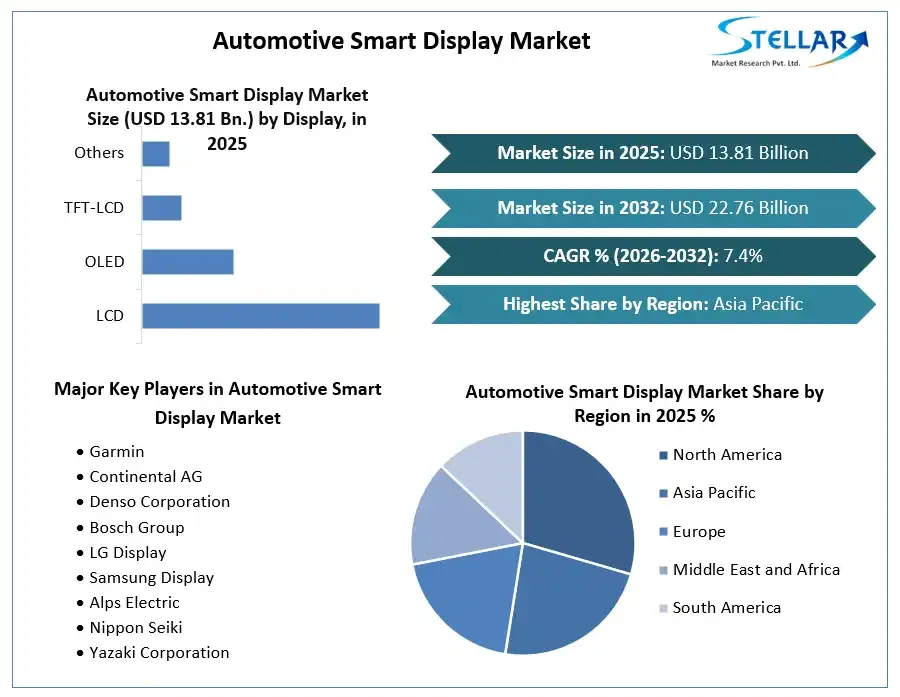
According to Stellar Market Research, the global Automotive Smart Display Market was valued at USD 13.81 Billion in 2025 and is expected to reach USD 22.76 Billion by 2032, growing at a CAGR of 7.4% during 2026-2032.
Increasing Demand for Connected and Digital Vehicles
The automotive industry is undergoing a major transformation with the growing shift toward connected and software-driven vehicles. Consumers are demanding vehicles equipped with advanced infotainment systems, touchscreen controls, digital instrument clusters, and smart connectivity features.
Automotive smart displays provide drivers with seamless access to navigation, entertainment, communication, vehicle settings, and safety information. The increasing preference for enhanced in-vehicle experiences is encouraging manufacturers to integrate larger and more intelligent display systems into new vehicle models.
𝐃𝐨𝐰𝐧𝐥𝐨𝐚𝐝 𝐅𝐫𝐞𝐞 𝐏𝐃𝐅 𝐁𝐫𝐨𝐜𝐡𝐮𝐫𝐞: https://www.stellarmr.com/report/req_sample/Automotive-Smart-Display-Market/1483
Key Market Growth Drivers
Growth of Electric and Autonomous Vehicles
The expansion of electric vehicles and autonomous driving technologies is one of the major factors supporting the growth of automotive smart displays. Modern EVs require advanced digital interfaces to manage battery information, charging status, energy consumption, and vehicle performance.
Autonomous and semi-autonomous vehicles also depend on advanced display systems to communicate driving information, alerts, and navigation assistance to users.
Rising Consumer Preference for Premium Vehicle Features
Consumers are increasingly seeking advanced technology features in vehicles, including touchscreens, voice control, digital dashboards, and connected entertainment systems.
Luxury and premium vehicle manufacturers are adopting advanced smart displays to differentiate their products and provide enhanced driving experiences.
Increasing Adoption of Connected Car Technologies
Connected vehicle technology is driving demand for smart displays that can integrate smartphones, cloud services, artificial intelligence, and vehicle operating systems.
Modern displays support features such as real-time traffic updates, wireless connectivity, voice assistants, and over-the-air software updates, improving vehicle functionality and convenience.
Technological Advancements in Automotive Smart Displays
Integration of Artificial Intelligence and Voice Control
Artificial intelligence is improving the capabilities of automotive smart displays by enabling voice-based commands, personalized recommendations, and intelligent driver assistance features.
AI-powered systems allow drivers to control navigation, entertainment, climate settings, and vehicle functions without manual interaction, improving safety and convenience.
Development of OLED and High-Resolution Displays
Automotive display manufacturers are focusing on advanced display technologies such as OLED, TFT-LCD, and high-resolution screens.
These technologies provide better image quality, improved visibility, lower power consumption, and flexible design options for modern vehicle interiors.
Expansion of Head-Up Display Technology
Head-up displays (HUDs) are becoming increasingly important in modern vehicles by projecting essential driving information directly into the driver’s field of view.
HUD technology helps reduce distractions by displaying speed, navigation instructions, and safety alerts without requiring drivers to look away from the road.
Automotive Smart Display Market Segmentation
By Display Type
Center Stack Display
Center stack displays represent a major segment due to their widespread use in infotainment systems. These displays provide access to navigation, entertainment, climate control, and connectivity features.
Digital Instrument Cluster
Digital instrument clusters are replacing traditional analog dashboards by providing customizable vehicle information, driving statistics, and safety alerts.
Head-Up Display
Head-up displays are gaining popularity due to increasing demand for enhanced driver safety and advanced driver assistance systems.
Rear Seat Entertainment Display
Rear seat entertainment displays are increasingly used in luxury vehicles to improve passenger comfort and entertainment experiences.
By Vehicle Type
Passenger Cars
Passenger cars represent a significant share of the market due to increasing consumer demand for connected features and advanced infotainment systems.
Commercial Vehicles
Commercial vehicle manufacturers are adopting smart displays for fleet management, navigation, driver monitoring, and operational efficiency.
By Electric Vehicle Type
Battery Electric Vehicles (BEV)
BEVs are expected to witness strong growth in smart display adoption due to their reliance on advanced digital systems and connected technologies.
Hybrid and Plug-in Hybrid Vehicles
Hybrid vehicles are also incorporating smart displays to provide information about fuel efficiency, battery usage, and energy management.
Regional Market Outlook
Asia-Pacific
Asia-Pacific is expected to dominate the Automotive Smart Display Market due to rapid automotive production, increasing EV adoption, and growing demand for connected vehicles.
Countries such as China, Japan, South Korea, and India are investing heavily in automotive electronics and smart mobility technologies. The region accounted for the largest market share in 2025.
North America
North America is experiencing strong demand due to advanced automotive technology adoption, increasing connected vehicle penetration, and consumer preference for premium vehicle features.
Automakers in the region are focusing on digital cockpit development and advanced infotainment solutions.
Europe
Europe is a major market for automotive smart displays due to strong automotive manufacturing capabilities and increasing adoption of electric and luxury vehicles.
The region’s focus on vehicle safety, connectivity, and digital transformation is supporting market expansion.
𝐃𝐨𝐰𝐧𝐥𝐨𝐚𝐝 𝐅𝐫𝐞𝐞 𝐏𝐃𝐅 𝐁𝐫𝐨𝐜𝐡𝐮𝐫𝐞: https://www.stellarmr.com/report/req_sample/Automotive-Smart-Display-Market/1483
Challenges Affecting Market Growth
Despite strong growth opportunities, the Automotive Smart Display Market faces several challenges:
- High development and integration costs
- Increasing cybersecurity concerns in connected vehicles
- Complex software and hardware integration
- Supply chain challenges for semiconductor components
- Driver distraction concerns related to large displays
Manufacturers are focusing on safer interfaces, improved cybersecurity, and user-friendly designs to address these challenges.
Competitive Landscape
The Automotive Smart Display Market includes several global companies focusing on advanced display technologies, automotive electronics, and connected vehicle solutions.
Key players include:
- Garmin
- Jabil
- Nippon Seiki
- Flex
- Samsung Display
- Continental AG
- Bosch
- LG Display
Companies are investing in research and development, display innovation, connected cockpit solutions, and partnerships with automobile manufacturers to strengthen their market position.
Future Outlook of the Automotive Smart Display Market
The future of the Automotive Smart Display Market is closely linked with the development of connected vehicles, electric mobility, and autonomous driving technologies.
As vehicles become more software-driven, smart displays will evolve from simple infotainment screens into advanced digital platforms supporting navigation, artificial intelligence, vehicle control, and personalized user experiences.
Increasing demand for premium interiors, advanced safety features, and connected mobility solutions will continue driving market growth through 2032.
Keywords: Automotive Smart Display Market, Digital Cockpit Market, Connected Car Technology, Vehicle Display Systems, Automotive Infotainment Display, Head-Up Display Market, Electric Vehicle Display Technology, Smart Vehicle Interior.
