3D Printing Automotive Market: Transforming Vehicle Manufacturing Through Additive Manufacturing Technology
The automotive industry is undergoing a major transformation as manufacturers increasingly adopt advanced technologies to improve efficiency, reduce production costs, and accelerate innovation. Among these technologies, 3D printing (additive manufacturing) has emerged as a revolutionary solution that enables automotive companies to design, prototype, and manufacture complex vehicle components with greater flexibility.
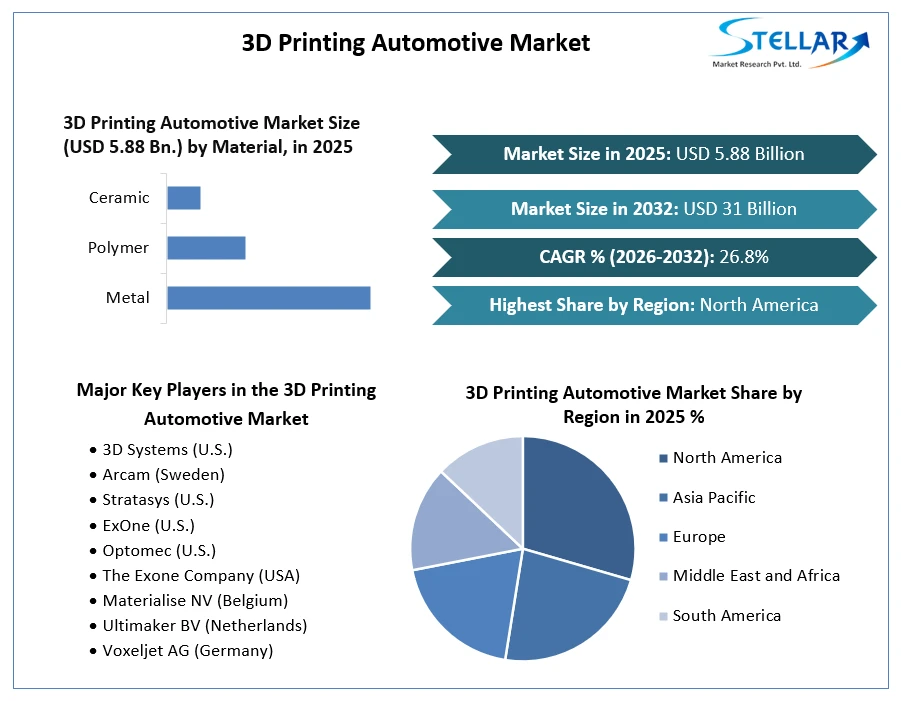
The 3D Printing Automotive Market is witnessing rapid expansion due to rising demand for lightweight vehicle components, faster product development cycles, customization capabilities, and sustainable manufacturing processes. According to Stellar Market Research, the global 3D Printing Automotive Market was valued at USD 5.88 billion in 2025 and is expected to grow significantly, reaching nearly USD 31 billion by 2032, with a CAGR of 26.8% during 2026–2032.
Understanding 3D Printing in Automotive Manufacturing
3D printing, also known as additive manufacturing, creates physical objects by adding materials layer by layer from a digital design model. Unlike traditional manufacturing methods that involve cutting or molding materials, 3D printing minimizes waste and allows manufacturers to produce highly complex geometries.
In the automotive sector, this technology is used for:
- Rapid prototyping and design testing
- Production of lightweight vehicle parts
- Customized interiors and exterior components
- Manufacturing of tools, jigs, and fixtures
- Spare parts production
- Electric vehicle component development
Automakers are adopting 3D printing to shorten development timelines and enhance vehicle performance through innovative designs.
𝐃𝐨𝐰𝐧𝐥𝐨𝐚𝐝 𝐅𝐫𝐞𝐞 𝐏𝐃𝐅 𝐁𝐫𝐨𝐜𝐡𝐮𝐫𝐞: https://www.stellarmr.com/report/req_sample/3D-Printing-Automotive-Market/327
Key Factors Driving the Growth of the 3D Printing Automotive Market
1. Increasing Demand for Lightweight Vehicle Components
Reducing vehicle weight has become a priority for automotive manufacturers due to strict fuel efficiency regulations and the rapid growth of electric vehicles. 3D printing enables the production of lightweight structures with optimized designs that maintain strength while reducing material usage.
Lightweight components help improve fuel economy in internal combustion engine vehicles and extend battery range in electric vehicles.
2. Faster Prototyping and Reduced Development Costs
Traditional automotive prototyping requires expensive tooling, molds, and long production cycles. With 3D printing, manufacturers can quickly create prototypes, test designs, and make modifications before mass production.
This capability allows automotive companies to reduce development costs and bring new vehicle models to market faster.
3. Growing Adoption of Electric Vehicles (EVs)
The expansion of electric vehicles is creating new opportunities for additive manufacturing. EV manufacturers require innovative battery structures, lightweight components, and customized designs to improve vehicle efficiency.
3D printing supports EV development by enabling complex designs that are difficult to manufacture using conventional methods.
4. Rising Demand for Vehicle Customization
Consumers are increasingly looking for personalized vehicles with unique designs and features. 3D printing allows manufacturers to create customized dashboards, interior components, decorative elements, and performance parts without significant tooling investments.
This trend is creating new opportunities for luxury vehicle manufacturers and aftermarket companies.
Major Applications of 3D Printing in the Automotive Industry
Rapid Prototyping
Prototyping remains one of the largest applications of 3D printing in automotive manufacturing. Engineers can quickly test new designs, evaluate performance, and improve components before final production.
Automotive Spare Parts Manufacturing
3D printing provides an effective solution for producing replacement parts, especially for older or discontinued vehicle models. Manufacturers can digitally store designs and produce parts whenever required.
Tooling and Manufacturing Equipment
Automotive companies use 3D printing for producing customized tools, fixtures, and production aids. This improves manufacturing efficiency and reduces downtime.
End-Use Component Production
Advancements in materials such as metals, polymers, and composites are allowing manufacturers to use 3D printing for functional vehicle components rather than only prototypes.
Role of Materials in Automotive 3D Printing
Materials play a critical role in determining the performance and applications of 3D-printed automotive components.
Polymers
Polymers are widely used due to their affordability, flexibility, and suitability for prototypes and interior components.
Metals
Metal 3D printing is gaining popularity for producing high-strength components that require durability and resistance to heat and pressure.
Composite Materials
Composite materials provide improved strength-to-weight ratios, making them suitable for advanced automotive applications.
Challenges Affecting Market Growth
Despite strong growth potential, the 3D Printing Automotive Market faces several challenges:
- High initial investment costs for advanced 3D printers
- Limited availability of specialized materials
- Lack of standardized manufacturing processes
- Challenges in large-scale production
- Regulatory and safety requirements
Mass production remains a challenge because traditional manufacturing methods are still more economical for high-volume vehicle production.
Future Opportunities in the 3D Printing Automotive Market
The future of automotive 3D printing is expected to be shaped by advancements in artificial intelligence, automation, material science, and digital manufacturing.
Key opportunities include:
- Integration of AI-powered design optimization
- Expansion of EV manufacturing applications
- Development of sustainable printing materials
- Growth of on-demand spare parts production
- Increased adoption among automotive suppliers
As manufacturers focus on sustainability and efficiency, additive manufacturing is expected to become an important part of next-generation automotive production systems.
𝐃𝐨𝐰𝐧𝐥𝐨𝐚𝐝 𝐅𝐫𝐞𝐞 𝐏𝐃𝐅 𝐁𝐫𝐨𝐜𝐡𝐮𝐫𝐞: https://www.stellarmr.com/report/req_sample/3D-Printing-Automotive-Market/327
Conclusion
The 3D Printing Automotive Market is transforming traditional vehicle manufacturing by enabling faster innovation, reduced material waste, lightweight designs, and customized production. With increasing adoption from automotive OEMs, EV manufacturers, and suppliers, 3D printing is becoming a strategic technology for the future of mobility.
As advancements in printing technologies and materials continue, the automotive industry is expected to move toward more flexible, sustainable, and digitally driven manufacturing processes.
