Commercial Greenhouse Market: Driving the Future of Sustainable and Controlled Agriculture
The global agriculture industry is experiencing a major transformation as farmers and businesses adopt advanced cultivation technologies to improve productivity, reduce resource consumption, and ensure year-round crop production. Among these innovations, commercial greenhouses have become a key solution for sustainable farming by providing controlled environments that optimize plant growth regardless of external weather conditions.
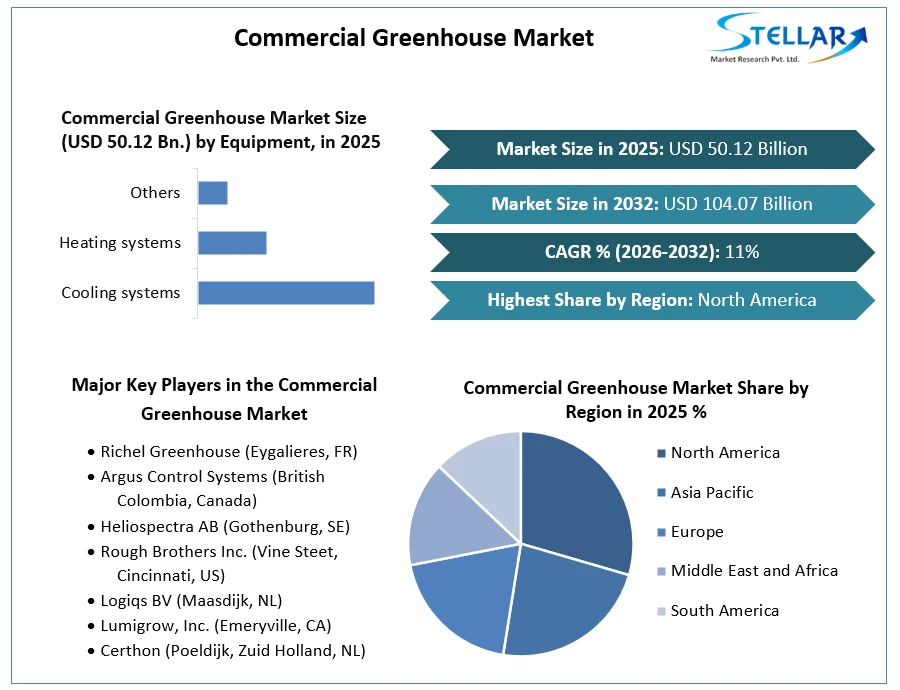
The Commercial Greenhouse Market is witnessing strong growth due to increasing food demand, shrinking agricultural land, climate uncertainties, and rising adoption of smart farming technologies. According to Stellar Market Research, the global Commercial Greenhouse Market was valued at USD 50.52 billion in 2025 and is projected to reach nearly USD 104.07 billion by 2032, growing at a CAGR of 11% during 2026–2032.
What is a Commercial Greenhouse?
A commercial greenhouse is a large-scale controlled agricultural structure designed for growing crops such as vegetables, fruits, flowers, and nursery plants under optimized environmental conditions.
Unlike traditional open-field farming, greenhouses allow growers to regulate:
- Temperature
- Humidity levels
- Irrigation
- Light exposure
- Nutrient supply
- Pest and disease control
These capabilities help farmers achieve higher yields, better crop quality, and more predictable production cycles.
𝐃𝐨𝐰𝐧𝐥𝐨𝐚𝐝 𝐅𝐫𝐞𝐞 𝐏𝐃𝐅 𝐁𝐫𝐨𝐜𝐡𝐮𝐫𝐞: https://www.stellarmr.com/report/req_sample/Commercial-Greenhouse-Market/347
Key Factors Driving the Commercial Greenhouse Market Growth
1. Rising Global Food Demand and Food Security Concerns
Population growth and increasing urbanization are creating pressure on global food production systems. Limited agricultural land availability has encouraged farmers to adopt controlled farming solutions.
Commercial greenhouses enable higher crop productivity by maximizing land utilization and supporting continuous cultivation throughout the year.
2. Increasing Adoption of Sustainable Agriculture
Sustainable farming practices are becoming increasingly important due to water scarcity, climate change, and environmental concerns.
Commercial greenhouses help reduce:
- Water consumption through efficient irrigation systems
- Crop losses caused by extreme weather
- Dependence on pesticides
- Agricultural land requirements
These benefits are encouraging governments and agricultural businesses to invest in greenhouse farming solutions.
3. Growth of Smart Farming Technologies
Technology integration is transforming traditional greenhouse operations. Modern commercial greenhouses are increasingly equipped with:
- Automated climate control systems
- IoT-based monitoring sensors
- Artificial intelligence-based crop management
- Automated irrigation systems
- LED lighting solutions
Smart greenhouse technologies allow farmers to analyze real-time crop conditions and improve operational efficiency.
4. Expansion of Urban Farming
Rapid urbanization has reduced the availability of farmland near cities. Commercial greenhouses are supporting urban agriculture by enabling food production closer to consumers.
Vertical farming and greenhouse-based cultivation are becoming attractive solutions for cities looking to improve local food supply chains.
Major Types of Commercial Greenhouses
Glass Greenhouses
Glass greenhouses provide excellent sunlight transmission and durability. They are commonly used for large-scale commercial farming where long-term performance is important.
Plastic Greenhouses
Plastic greenhouses are widely adopted due to their lower installation costs and flexibility. They are suitable for small and medium-sized growers as well as large agricultural operations.
Key Applications of Commercial Greenhouses
Vegetable Production
Vegetables such as tomatoes, cucumbers, peppers, and leafy greens are among the most common crops grown in commercial greenhouses.
Controlled environments help maintain consistent quality and increase production efficiency.
Fruit Cultivation
Commercial greenhouses support the cultivation of high-value fruits by providing protection from unfavorable climatic conditions.
Floriculture
The demand for flowers and ornamental plants has contributed significantly to greenhouse adoption. Controlled environments allow growers to produce premium-quality flowers throughout the year.
Nursery Crops
Greenhouses provide ideal conditions for developing healthy seedlings and young plants before transplantation.
Role of Automation in Commercial Greenhouse Farming
Automation is becoming one of the most important trends shaping the future of greenhouse agriculture.
Advanced systems help manage:
- Climate conditions
- Fertilizer application
- Water usage
- Crop monitoring
- Harvest planning
The integration of sensors, robotics, and AI allows growers to improve productivity while reducing labor dependency.
Challenges in the Commercial Greenhouse Market
Despite significant growth opportunities, the market faces several challenges:
High Initial Investment
Setting up advanced commercial greenhouse facilities requires significant capital investment for construction, equipment, and automation systems.
Energy Consumption
Heating, cooling, and lighting systems can increase operational costs, especially in regions with extreme climates.
Technical Expertise Requirements
Operating advanced greenhouse systems requires skilled workers who understand automation, climate control, and crop management technologies.
Maintenance Costs
Regular maintenance of equipment and technology infrastructure is necessary to ensure efficient operations.
Future Opportunities in the Commercial Greenhouse Market
The future growth of the commercial greenhouse industry will be driven by innovation and increasing demand for sustainable food production.
Major opportunities include:
- AI-powered greenhouse management systems
- Renewable energy integration
- Expansion of vertical greenhouse farming
- Development of climate-resilient agriculture
- Increasing adoption in emerging economies
Countries facing agricultural challenges are expected to increase investments in controlled farming technologies.
Regional Outlook
Regions with limited agricultural land, advanced farming technologies, and strong food demand are expected to witness significant greenhouse adoption.
Europe has been a major market due to advanced horticulture practices, while Asia-Pacific is experiencing rapid growth because of increasing food demand, urbanization, and government support for modern agriculture.
𝐃𝐨𝐰𝐧𝐥𝐨𝐚𝐝 𝐅𝐫𝐞𝐞 𝐏𝐃𝐅 𝐁𝐫𝐨𝐜𝐡𝐮𝐫𝐞: https://www.stellarmr.com/report/req_sample/Commercial-Greenhouse-Market/347
Conclusion
The Commercial Greenhouse Market is reshaping the future of agriculture by enabling efficient, sustainable, and technology-driven crop production. With growing concerns about food security, climate change, and resource limitations, greenhouse farming is becoming an essential solution for modern agriculture.
As automation, artificial intelligence, and smart farming technologies continue to advance, commercial greenhouses will play a crucial role in creating a more reliable and sustainable global food system.
Keywords: Commercial Greenhouse Market, Smart Greenhouse Farming, Controlled Environment Agriculture, Greenhouse Agriculture Technology, Sustainable Farming Solutions, Vertical Farming, Agricultural Automation, Precision Agriculture.
