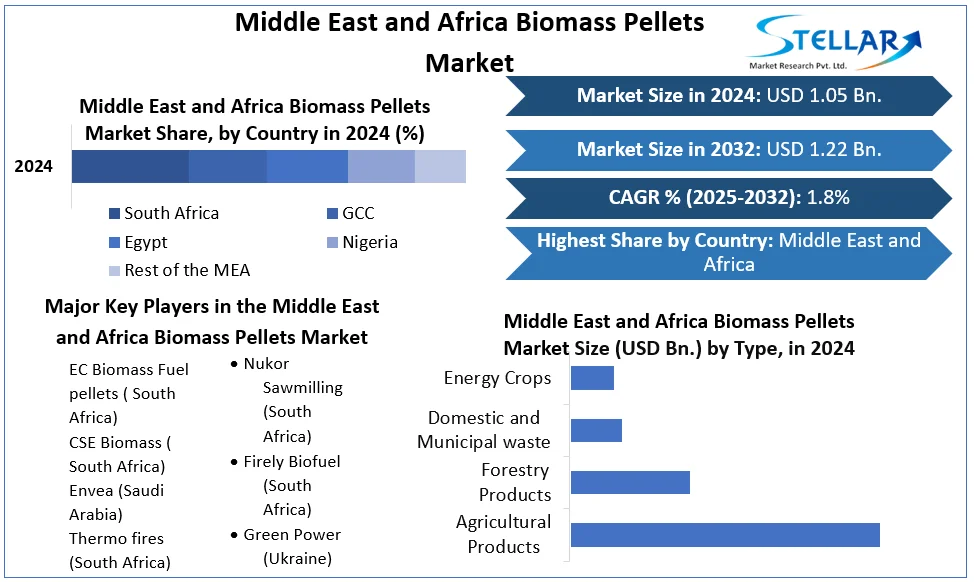
The Middle East and Africa Biomass Pellets Market is experiencing steady growth as governments and industries increasingly adopt renewable energy solutions to diversify energy sources, reduce carbon emissions, and promote sustainable resource utilization. Biomass pellets, produced from compressed agricultural residues, forestry waste, wood chips, sawdust, and other organic materials, are gaining traction as an efficient and environmentally friendly alternative to fossil fuels. Rising investments in clean energy projects, industrial decarbonization, and waste-to-energy initiatives are accelerating the demand for biomass pellets across the Middle East and Africa.
Manufacturers are expanding production capacities, improving feedstock utilization, and investing in advanced pelletizing technologies to meet growing regional demand. As countries implement long-term sustainability strategies and energy transition plans, biomass pellets are becoming an increasingly important component of the renewable energy landscape.
𝐃𝐨𝐰𝐧𝐥𝐨𝐚𝐝 𝐅𝐫𝐞𝐞 𝐏𝐃𝐅 𝐁𝐫𝐨𝐜𝐡𝐮𝐫𝐞: https://www.stellarmr.com/report/req_sample/MEA-Biomass-Pellets-Market/803
Growing Renewable Energy Investments Drive Market Growth
One of the primary drivers of the Middle East and Africa Biomass Pellets Market is the increasing investment in renewable energy infrastructure. Governments across the region are promoting diversified energy portfolios to reduce dependence on conventional fossil fuels while achieving national climate and sustainability objectives.
Biomass pellets are increasingly being utilized for electricity generation, industrial boilers, district heating, and combined heat and power (CHP) systems due to their high energy density, ease of storage, and relatively low environmental impact. Supportive renewable energy policies continue encouraging biomass utilization across multiple industries.
The ongoing transition toward cleaner energy sources is expected to sustain long-term market expansion.
Agricultural Residues Create Abundant Feedstock Opportunities
The Middle East and Africa possess substantial agricultural resources that generate significant quantities of biomass residues suitable for pellet production. Crop residues, sugarcane bagasse, palm waste, cotton stalks, maize residues, wheat straw, and forestry by-products are increasingly being converted into value-added biomass pellets.
Utilizing agricultural waste for pellet manufacturing reduces open-field burning, minimizes environmental pollution, and creates additional revenue opportunities for farmers and rural communities. This circular economy approach improves resource efficiency while supporting sustainable agricultural development.
Growing feedstock availability continues strengthening regional production capabilities.
Industrial Decarbonization Supports Commercial Demand
Industrial sectors are increasingly adopting biomass pellets to reduce greenhouse gas emissions and improve energy efficiency. Cement manufacturing, food processing, mining, pulp and paper, textiles, and other energy-intensive industries are replacing conventional fossil fuels with biomass-based alternatives to meet environmental regulations and corporate sustainability goals.
Biomass pellets provide stable combustion characteristics, lower sulfur emissions, and reduced carbon intensity, making them suitable for industrial heating and steam generation applications. Rising industrial sustainability commitments continue creating substantial commercial opportunities.
Technological Advancements Improve Production Efficiency
Advances in pellet manufacturing technologies are improving product quality, production efficiency, and supply chain reliability across the Middle East and Africa Biomass Pellets Market. Automated pellet mills, moisture control systems, biomass drying technologies, and digital process monitoring enable manufacturers to produce high-density pellets with consistent combustion performance.
Research into advanced biomass processing techniques, torrefied biomass pellets, and improved feedstock blending is further enhancing fuel efficiency and transportation economics. These technological improvements are strengthening the competitiveness of biomass pellets within regional energy markets.
Continuous innovation remains an important growth driver.
𝐀𝐜𝐜𝐞𝐬𝐬 𝐭𝐡𝐞 𝐅𝐮𝐥𝐥 𝐑𝐞𝐩𝐨𝐫𝐭: https://www.stellarmr.com/report/MEA-Biomass-Pellets-Market/803
Sustainability and Waste Management Encourage Market Expansion
Governments and private organizations are increasingly integrating biomass pellets into broader waste management and environmental sustainability strategies. Converting agricultural and forestry waste into renewable fuel supports landfill reduction, resource recovery, and carbon emission mitigation while contributing to circular economy initiatives.
Many countries are promoting bioenergy development through renewable energy frameworks, green financing programs, and investments in sustainable infrastructure. Growing awareness of climate change and responsible resource management continues supporting biomass pellet adoption.
Environmental sustainability remains a key factor shaping market development.
Regional Market Outlook
Saudi Arabia is emerging as a significant market due to its expanding renewable energy investments, industrial diversification initiatives, and growing focus on sustainable energy solutions under long-term national development strategies.
The United Arab Emirates continues investing in clean energy projects, waste-to-energy facilities, and industrial sustainability programs, creating favorable conditions for biomass pellet utilization in commercial and industrial applications.
South Africa leads the African market owing to its well-established industrial sector, expanding renewable energy projects, abundant agricultural resources, and increasing demand for alternative fuels. Egypt is witnessing growing adoption through biomass utilization programs, agricultural residue management, and industrial energy diversification.
Other countries including Kenya, Nigeria, Morocco, Ethiopia, and Tanzania are gradually expanding biomass pellet production and consumption as investments in renewable energy infrastructure, agricultural modernization, and sustainable rural development continue increasing.
Competitive Landscape
The Middle East and Africa Biomass Pellets Market is highly competitive, with biomass fuel producers, renewable energy companies, forestry enterprises, agricultural processing firms, and energy technology providers focusing on production capacity expansion, sustainable feedstock sourcing, quality certification, and supply chain optimization. Companies are investing in advanced pellet manufacturing technologies, automated quality control systems, biomass logistics, and export capabilities to strengthen their competitive positions.
Strategic collaborations with utility companies, industrial energy consumers, agricultural cooperatives, government agencies, and renewable energy developers continue accelerating market expansion. Research and development efforts remain focused on improving pellet energy density, reducing production costs, enhancing feedstock flexibility, and increasing combustion efficiency.
Manufacturers are also expanding regional production facilities to address growing domestic and export demand.
Future Outlook
The future of the Middle East and Africa Biomass Pellets Market remains promising as renewable energy adoption, industrial decarbonization, agricultural waste utilization, and circular economy initiatives continue driving market development. Advances in biomass conversion technologies, automated manufacturing, carbon management solutions, and digital supply chain systems will further improve production efficiency and fuel quality.
Growing investments in renewable power generation, industrial heating, sustainable agriculture, waste-to-energy projects, and green infrastructure are expected to sustain long-term market growth. Companies that prioritize technological innovation, sustainable feedstock management, operational efficiency, and strategic partnerships will be well positioned to capitalize on the region’s evolving renewable energy landscape, ensuring continued expansion of the Middle East and Africa biomass pellets market.
About Stellar Market Research:
Stellar Market Research is a multifaceted market research and consulting company with professionals from several industries. Some industries we cover include medical devices, pharmaceutical manufacturers, science and engineering, electronic components, industrial equipment, technology and communication, cars and automobiles, chemical products and substances, general merchandise, beverages, personal care, and automated systems.
Contact Stellar Market Research:
Address: Phase 3, Navale IT Zone, S.No. 51/2A/2, Office No. 202, 2nd floor, Near, Navale Brg, Narhe, Pune, Maharashtra 411041
Website: http://stellarmr.com/
Email: sales@stellarmr.com
Mobile: +91 9607365656
