Polyimide Fibers Market: Advancing High-Performance Materials for Aerospace, Electronics, and Industrial Applications
As industries demand materials capable of performing under extreme temperatures, harsh chemical environments, and high mechanical stress, polyimide fibers have become an essential solution for advanced engineering applications. Known for their exceptional thermal stability, flame resistance, and lightweight properties, these high-performance fibers are increasingly used across aerospace, electronics, automotive, industrial filtration, and protective clothing.
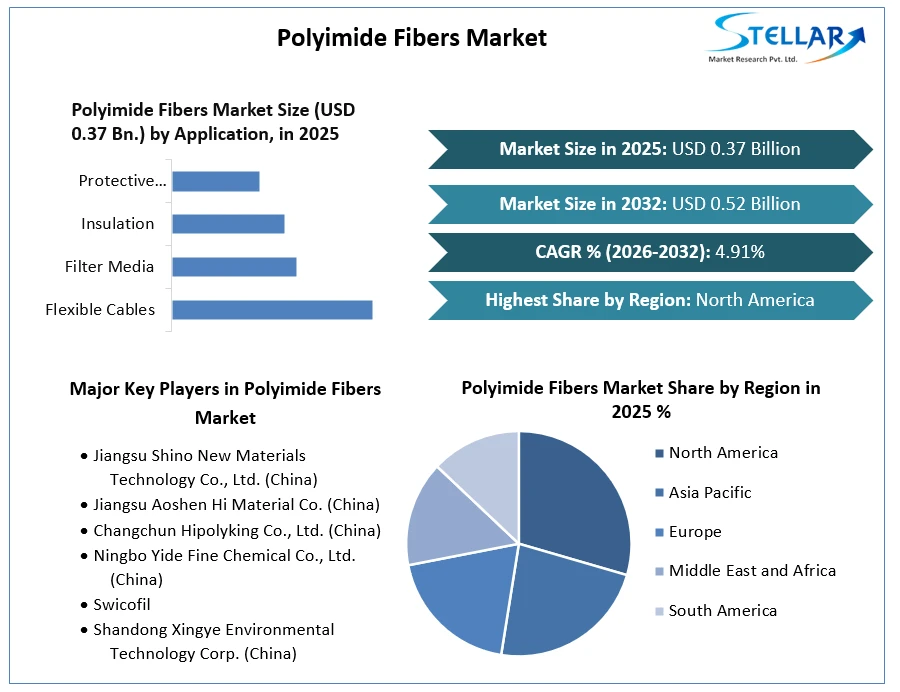
According to Stellar Market Research, the global Polyimide Fibers Market was valued at USD 0.37 billion in 2025 and is expected to reach nearly USD 0.52 billion by 2032, growing at a CAGR of 4.91% during 2026–2032.
What are Polyimide Fibers?
Polyimide (PI) fibers are advanced synthetic fibers manufactured from aromatic polyimide polymers. They are designed to maintain excellent mechanical strength and dimensional stability under extreme operating conditions.
Some of their key characteristics include:
- Outstanding heat resistance
- Excellent flame retardancy
- High chemical resistance
- Lightweight construction
- Superior mechanical strength
- Long service life
These properties make polyimide fibers ideal for industries where conventional fibers cannot withstand demanding environments.
𝐃𝐨𝐰𝐧𝐥𝐨𝐚𝐝 𝐅𝐫𝐞𝐞 𝐏𝐃𝐅 𝐁𝐫𝐨𝐜𝐡𝐮𝐫𝐞: https://www.stellarmr.com/report/req_sample/Polyimide-Fibers-Market/421
Key Factors Driving the Polyimide Fibers Market
1. Rising Demand for Protective Clothing
One of the primary growth drivers is the increasing use of polyimide fibers in protective apparel for firefighters, military personnel, industrial workers, and emergency responders.
Their excellent flame resistance and thermal insulation provide superior protection in hazardous working environments. As workplace safety regulations become stricter worldwide, demand for advanced protective fabrics continues to rise.
2. Growth of Aerospace and Space Exploration
The aerospace industry requires lightweight materials capable of performing under extreme temperatures and mechanical stress.
Polyimide fibers are increasingly used in:
- Aircraft insulation
- Spacecraft components
- Thermal protection systems
- High-performance composites
Growing investments in commercial aviation and space exploration are creating significant opportunities for manufacturers of advanced polymer materials.
3. Expanding Electronics Industry
Modern electronic devices require materials that provide excellent insulation and thermal stability.
Polyimide fibers are widely used in:
- Flexible cables
- Electronic insulation
- High-temperature electrical components
- Advanced electronic manufacturing
As electronic devices become smaller and more powerful, demand for heat-resistant insulating materials continues to increase.
4. Industrial Filtration Applications
Industrial facilities operating under high-temperature conditions require durable filter media capable of maintaining performance over long periods.
Polyimide fibers are increasingly used in:
- Power plants
- Waste incineration facilities
- Chemical processing plants
- Industrial dust collection systems
Their resistance to heat and chemicals makes them suitable for demanding filtration applications.
Major Applications of Polyimide Fibers
Protective Clothing
Protective apparel remains one of the largest application segments.
Products include:
- Firefighter uniforms
- Military protective gear
- Industrial safety clothing
- Heat-resistant gloves
- Protective fabrics
Flexible Cables
Polyimide fibers provide excellent electrical insulation and flexibility, making them suitable for advanced cable manufacturing.
These cables are commonly used in aerospace, automotive electronics, and industrial automation.
Filter Media
High-temperature filtration systems use polyimide fibers because they maintain structural integrity under continuous exposure to elevated temperatures.
Applications include:
- Flue gas filtration
- Air pollution control
- Industrial exhaust systems
Thermal Insulation
Polyimide fibers are widely used as insulation materials in industries requiring exceptional thermal resistance and long-term durability.
Key End-Use Industries
Aerospace
Aircraft manufacturers and space agencies rely on lightweight, high-strength materials that improve fuel efficiency while maintaining safety.
Polyimide fibers meet these requirements through superior thermal performance and flame resistance.
Automotive
The automotive industry is adopting advanced lightweight materials to improve fuel efficiency and support electric vehicle development.
Polyimide fibers contribute to thermal insulation, electrical systems, and lightweight composite components.
Electronics
Electronic manufacturers use polyimide fibers for insulation, flexible circuits, and heat-resistant applications where reliability is critical.
Chemical Industry
Chemical processing facilities require materials that can withstand corrosive environments and high operating temperatures.
Polyimide fibers help improve equipment durability and operational safety.
Emerging Technology Trends
Advanced Composite Materials
Manufacturers are combining polyimide fibers with composite materials to create stronger, lighter, and more durable engineering products for aerospace and automotive applications.
Sustainable Manufacturing
Research is focusing on improving production efficiency while reducing manufacturing costs and environmental impact.
Innovations in polymer processing are expected to make polyimide fibers more accessible for additional industrial applications.
Growing Research and Development
Continuous investment in material science is expanding the performance capabilities of polyimide fibers, creating opportunities in emerging sectors such as renewable energy and advanced electronics.
Challenges Facing the Market
Despite strong growth prospects, several challenges remain.
High Manufacturing Costs
Producing polyimide fibers requires specialized raw materials and complex manufacturing processes, resulting in relatively high production costs.
Complex Production Process
Manufacturing involves multiple processing stages and advanced technologies, making large-scale production more challenging than conventional synthetic fibers.
Limited Market Penetration
Compared with standard industrial fibers, polyimide fibers remain a niche material primarily used in specialized high-performance applications.
𝐃𝐨𝐰𝐧𝐥𝐨𝐚𝐝 𝐅𝐫𝐞𝐞 𝐏𝐃𝐅 𝐁𝐫𝐨𝐜𝐡𝐮𝐫𝐞: https://www.stellarmr.com/report/req_sample/Polyimide-Fibers-Market/421
Future Opportunities
Several factors are expected to support long-term market expansion:
- Rising investment in aerospace technologies
- Growth of electric vehicles
- Increasing demand for industrial filtration systems
- Expansion of advanced electronics manufacturing
- Greater adoption of high-performance protective clothing
- Development of cost-effective manufacturing techniques
Asia-Pacific is expected to remain a major manufacturing hub due to its growing electronics, automotive, and industrial production sectors.
Conclusion
The Polyimide Fibers Market is steadily expanding as industries seek advanced materials capable of delivering exceptional thermal resistance, durability, and mechanical performance. Applications across aerospace, electronics, automotive, industrial filtration, and protective clothing continue to drive demand.
With ongoing innovations in polymer technology, increasing industrial automation, and growing investments in high-performance materials, polyimide fibers are expected to play an increasingly important role in the future of advanced manufacturing.
