5G in Defense Market: Revolutionizing Military Communications and Next-Generation Defense Operations
Modern defense forces are rapidly adopting advanced communication technologies to improve battlefield awareness, mission coordination, intelligence gathering, and autonomous military operations. Among these innovations, 5G technology is emerging as a game-changing capability, enabling ultra-fast, low-latency, and highly secure communications across defense networks.
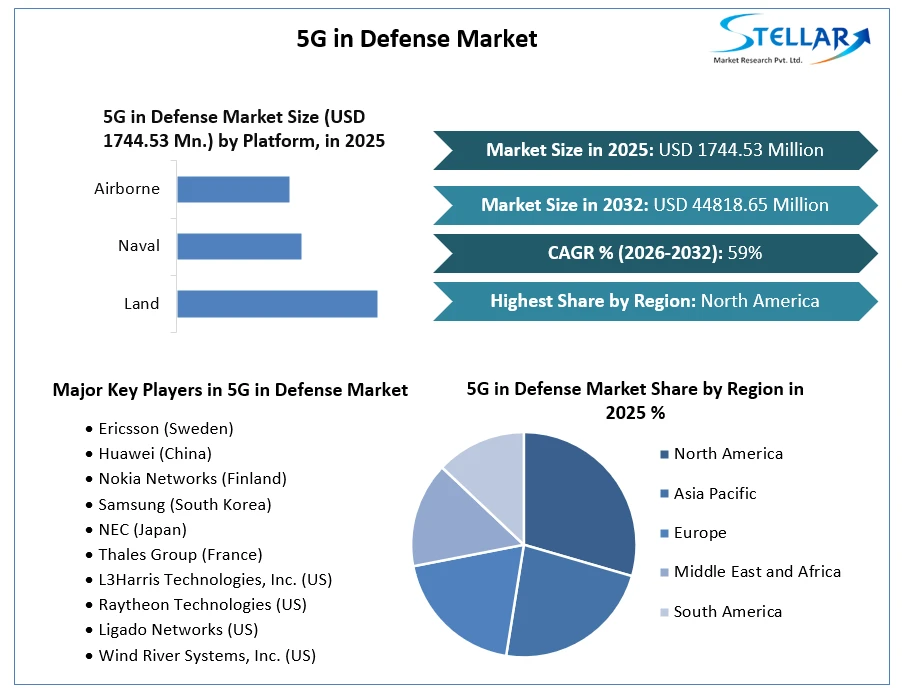
The adoption of 5G is transforming military operations by supporting real-time data sharing, connected sensors, autonomous vehicles, and advanced command-and-control systems. According to Stellar Market Research, the global 5G in Defense Market was valued at USD 1.10 billion in 2024 and is expected to expand at a remarkable CAGR of 59% during the forecast period, driven by increasing defense modernization programs and investments in secure communication infrastructure.
What is 5G in Defense?
5G in defense refers to the deployment of fifth-generation wireless communication technology for military and national security applications. Compared to previous wireless generations, 5G provides:
- Ultra-low latency
- High-speed data transmission
- Massive device connectivity
- Improved network reliability
- Enhanced support for artificial intelligence (AI) and Internet of Things (IoT) applications
These capabilities enable defense organizations to improve battlefield communications, surveillance, logistics, and autonomous operations.
𝐃𝐨𝐰𝐧𝐥𝐨𝐚𝐝 𝐅𝐫𝐞𝐞 𝐏𝐃𝐅 𝐁𝐫𝐨𝐜𝐡𝐮𝐫𝐞: https://www.stellarmr.com/report/req_sample/5G-in-Defense-Market/422
Key Factors Driving the 5G in Defense Market
1. Growing Military Modernization Programs
Governments worldwide are investing heavily in modernizing defense infrastructure. Military agencies are upgrading legacy communication systems with secure, high-speed 5G networks to improve operational efficiency and decision-making.
Next-generation communication systems enable seamless coordination between soldiers, command centers, aircraft, naval vessels, and unmanned systems.
2. Rising Demand for Real-Time Intelligence
Modern military missions rely on rapid data exchange from surveillance drones, satellites, sensors, and reconnaissance platforms.
5G networks provide the bandwidth and low latency required for:
- Intelligence gathering
- Surveillance
- Reconnaissance (ISR)
- Real-time battlefield monitoring
- Mission planning
These capabilities significantly improve situational awareness during defense operations.
3. Increasing Adoption of Autonomous Military Systems
Autonomous drones, unmanned ground vehicles (UGVs), robotic systems, and autonomous naval platforms require fast and reliable wireless communication.
5G supports these systems by enabling:
- Low-latency remote control
- Real-time video transmission
- AI-powered navigation
- Swarm drone coordination
As autonomous defense technologies continue to evolve, demand for private 5G networks is expected to increase.
4. Expansion of AI and IoT in Defense
Defense organizations are integrating Artificial Intelligence (AI) and the Internet of Things (IoT) into military operations.
5G acts as the communication backbone for connected military devices, allowing sensors, vehicles, and command systems to exchange information almost instantly.
The combination of AI, IoT, and 5G is creating smarter and more responsive defense ecosystems.
Major Applications of 5G in Defense
Command and Control Systems
5G improves command-and-control (C2) operations by enabling secure, high-speed communication between headquarters and deployed forces.
Military leaders can receive real-time operational updates and make faster strategic decisions.
Intelligence, Surveillance, and Reconnaissance (ISR)
ISR systems generate massive amounts of data from drones, satellites, radars, and sensors.
5G networks enable rapid transmission of this information for immediate analysis and response.
Military Logistics
Defense logistics operations benefit from connected supply chains, autonomous transportation, and real-time asset tracking.
5G supports efficient movement of personnel, equipment, and supplies across military operations.
Unmanned Systems
Military drones and autonomous vehicles depend on reliable communication for navigation, mission execution, and data sharing.
5G enables more efficient coordination among multiple autonomous platforms operating simultaneously.
Key Technologies Supporting 5G Defense Networks
Private 5G Networks
Private 5G infrastructure provides secure, dedicated communication networks for military installations and sensitive operations.
These networks offer improved cybersecurity and operational control compared to public networks.
Edge Computing
Edge computing processes data closer to the battlefield, reducing latency and improving response times for mission-critical applications.
It supports real-time analytics for surveillance, autonomous systems, and tactical decision-making.
Network Slicing
Network slicing enables defense organizations to create dedicated virtual networks for different military missions, ensuring secure and reliable communications even during high network demand.
Artificial Intelligence Integration
AI-powered network management enhances communication performance, detects cyber threats, and optimizes bandwidth utilization across defense networks.
Challenges Facing the 5G in Defense Market
Despite its strong growth potential, the market faces several challenges.
Cybersecurity Risks
As military networks become more connected, protecting sensitive communications from cyberattacks becomes increasingly critical.
Defense organizations must implement robust encryption, authentication, and network security measures.
High Infrastructure Costs
Deploying secure 5G infrastructure requires significant investment in hardware, software, spectrum, and network management systems.
Regulatory and Standardization Issues
The military adoption of 5G is still evolving, and differences in standards, interoperability requirements, and security regulations can slow implementation in some regions.
𝐃𝐨𝐰𝐧𝐥𝐨𝐚𝐝 𝐅𝐫𝐞𝐞 𝐏𝐃𝐅 𝐁𝐫𝐨𝐜𝐡𝐮𝐫𝐞: https://www.stellarmr.com/report/req_sample/5G-in-Defense-Market/422
Future Opportunities
The future of the 5G in Defense Market will be driven by continuous innovation and defense modernization initiatives.
Key opportunities include:
- Expansion of private military 5G networks
- Growth in autonomous defense systems
- AI-enabled battlefield communications
- Advanced cyber defense solutions
- Integration of satellite and terrestrial 5G communications
- Smart military bases and connected defense infrastructure
North America is expected to remain a leading market due to substantial defense spending and ongoing investments in advanced military communication technologies, while Asia-Pacific is anticipated to witness rapid growth as countries strengthen their defense capabilities.
Conclusion
The 5G in Defense Market is set to transform military communications by delivering ultra-fast, secure, and reliable connectivity for modern defense operations. From intelligent surveillance and autonomous vehicles to real-time command systems and AI-driven decision-making, 5G is becoming a foundational technology for next-generation defense.
As governments continue investing in digital transformation and advanced military capabilities, the adoption of 5G-enabled defense solutions is expected to accelerate, creating significant opportunities for technology providers, defense contractors, and communication infrastructure companies.
