Gaming Gadgets Market: Fueling the Next Generation of Interactive Entertainment
The gaming industry has evolved far beyond traditional consoles, becoming one of the world’s fastest-growing entertainment sectors. Rising esports competitions, online multiplayer gaming, game streaming, and immersive technologies such as virtual reality (VR) and augmented reality (AR) are driving unprecedented demand for advanced gaming gadgets.
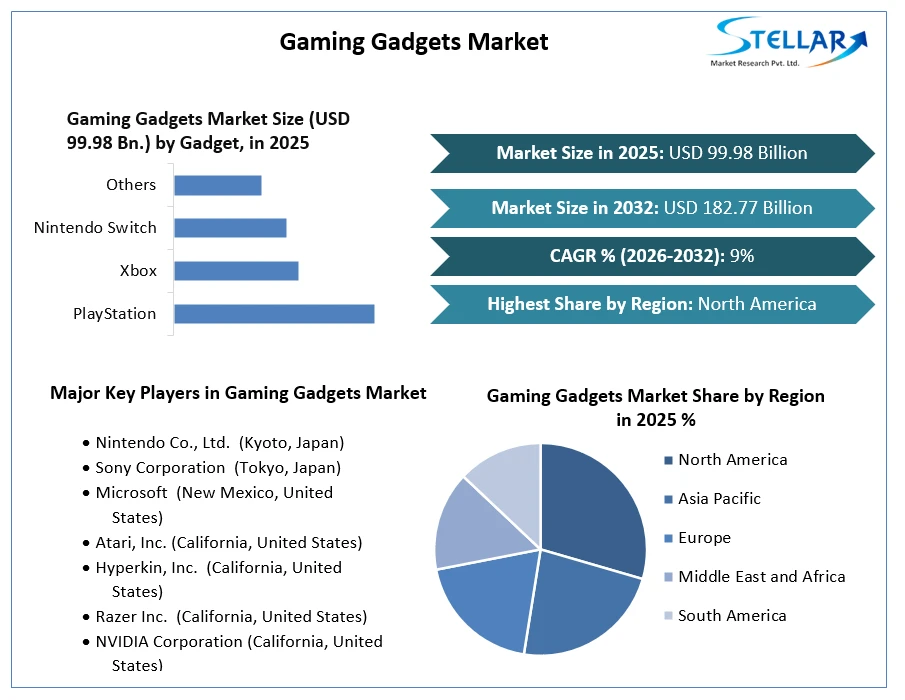
Gaming gadgets—including consoles, handheld devices, gaming controllers, headsets, keyboards, mice, and VR accessories—have become essential for delivering immersive and competitive gaming experiences. According to Stellar Market Research, the global Gaming Gadgets Market was valued at USD 91.73 billion in 2024 and is projected to reach USD 182.78 billion by 2032, expanding at a CAGR of 9% during the forecast period.
What Are Gaming Gadgets?
Gaming gadgets are specialized electronic devices and accessories designed to enhance video gaming performance, comfort, and user experience across consoles, PCs, mobile devices, and cloud gaming platforms.
Common gaming gadgets include:
- Gaming consoles
- Handheld gaming devices
- Gaming keyboards and mice
- Gaming headsets
- Wireless controllers
- VR headsets
- Racing wheels and flight simulators
- Streaming equipment
Modern gaming gadgets feature advanced processors, ergonomic designs, wireless connectivity, customizable controls, and immersive audio technologies to meet the needs of both casual and professional gamers.
𝐃𝐨𝐰𝐧𝐥𝐨𝐚𝐝 𝐅𝐫𝐞𝐞 𝐏𝐃𝐅 𝐁𝐫𝐨𝐜𝐡𝐮𝐫𝐞: https://www.stellarmr.com/report/req_sample/Gaming-Gadgets-Market/432
Key Factors Driving the Gaming Gadgets Market
1. Rapid Growth of Esports
Esports has become a global phenomenon, attracting millions of players and spectators worldwide. Professional gamers require high-performance gaming equipment that delivers precision, speed, and reliability.
The expansion of esports tournaments, gaming leagues, and competitive gaming organizations continues to boost demand for premium gaming gadgets.
2. Rising Popularity of Online Gaming
High-speed internet and cloud gaming services have transformed how people access games.
Online multiplayer games, live streaming, and cross-platform gaming encourage consumers to invest in advanced accessories that improve gameplay, communication, and responsiveness.
3. Technological Advancements
Manufacturers continue introducing innovative gaming products featuring:
- Artificial Intelligence (AI)
- Haptic feedback
- Adaptive triggers
- Wireless connectivity
- High-refresh-rate displays
- Spatial audio
- Motion sensing
- VR and AR integration
Continuous innovation keeps gamers upgrading their equipment to access the latest features.
4. Increasing Disposable Income
Growing consumer spending on entertainment and digital lifestyles has contributed significantly to gaming hardware sales.
As gaming becomes a mainstream hobby across different age groups, demand for premium consoles and accessories continues to increase.
Major Types of Gaming Gadgets
Gaming Consoles
Gaming consoles remain one of the largest product categories, offering high-performance gaming with exclusive titles and advanced graphics.
Leading console platforms include:
- PlayStation
- Xbox
- Nintendo Switch
Continuous hardware improvements and exclusive game releases support strong consumer demand.
Handheld Gaming Devices
Portable gaming systems are gaining popularity due to their convenience and ability to deliver console-quality gaming experiences on the move.
Improvements in battery life and graphics capabilities continue to drive this segment.
Gaming Accessories
Gaming accessories significantly enhance player performance and comfort.
Popular accessories include:
- Mechanical keyboards
- Gaming mice
- Wireless controllers
- Gaming headsets
- Webcams
- Streaming microphones
- Gaming chairs
The increasing popularity of game streaming and content creation is also boosting accessory sales.
Applications Across Different User Groups
Casual Gamers
Casual gamers primarily seek affordable, user-friendly devices that offer entertainment and social interaction.
Mobile gaming and entry-level gaming accessories remain popular within this segment.
Professional Gamers
Competitive players demand high-performance equipment with low latency, superior precision, and ergonomic designs.
Professional esports athletes frequently invest in premium peripherals to maximize performance.
Content Creators and Streamers
Gaming content creators require additional equipment such as:
- Streaming cameras
- Professional microphones
- Lighting systems
- Capture cards
- Advanced audio equipment
The rise of platforms like Twitch and YouTube Gaming continues to expand this customer segment.
𝐃𝐨𝐰𝐧𝐥𝐨𝐚𝐝 𝐅𝐫𝐞𝐞 𝐏𝐃𝐅 𝐁𝐫𝐨𝐜𝐡𝐮𝐫𝐞: https://www.stellarmr.com/report/req_sample/Gaming-Gadgets-Market/432
Emerging Technology Trends
Virtual Reality (VR) and Augmented Reality (AR)
Immersive gaming experiences are becoming increasingly popular as VR and AR technologies continue to improve.
These innovations enable players to interact naturally with virtual environments, creating more engaging gameplay experiences.
Cloud Gaming
Cloud gaming allows users to play high-quality games without expensive hardware by streaming games directly over the internet.
This trend is creating opportunities for lightweight gaming accessories and cross-platform devices.
Artificial Intelligence
AI is improving gaming hardware through adaptive controls, intelligent cooling systems, personalized settings, and enhanced gaming performance.
Manufacturers are integrating AI into both gaming devices and software to improve user experiences.
Regional Market Insights
North America continues to hold a significant share of the Gaming Gadgets Market due to high consumer spending, widespread console adoption, and a well-established esports ecosystem.
Meanwhile, Asia-Pacific is expected to experience the fastest growth, driven by expanding gaming communities in China, India, Japan, and South Korea, increasing smartphone penetration, and growing investments in esports infrastructure.
Challenges Facing the Market
Despite strong growth prospects, several challenges remain:
High Cost of Premium Gaming Hardware
Advanced gaming systems and accessories often carry premium price tags, which may limit adoption among budget-conscious consumers.
Rapid Technological Changes
Frequent hardware upgrades and evolving gaming technologies can shorten product life cycles and increase development costs.
Supply Chain Disruptions
Semiconductor shortages and global logistics challenges can affect manufacturing schedules and product availability.
Future Opportunities
Several trends are expected to accelerate market growth over the coming years:
- Expansion of esports worldwide
- Growth of cloud gaming platforms
- Increasing adoption of VR and AR gaming
- Rising demand for wireless gaming accessories
- AI-powered gaming hardware innovations
- Growth in gaming content creation and live streaming
As gaming becomes increasingly integrated into mainstream entertainment, demand for advanced gaming gadgets is expected to remain strong across both developed and emerging markets.
Conclusion
The Gaming Gadgets Market is entering a new phase of growth driven by technological innovation, expanding esports participation, cloud gaming, and immersive entertainment experiences. Consumers are investing in high-performance devices and accessories that enhance gameplay, improve comfort, and support competitive gaming.
With continuous advancements in AI, VR, wireless connectivity, and gaming hardware, the market is well-positioned for sustained expansion, offering significant opportunities for manufacturers, retailers, and technology companies worldwide.
