Food and Agriculture Technology Market: Transforming Farming Through Smart and Sustainable Innovation
The agriculture industry is undergoing a digital transformation as farmers increasingly adopt advanced technologies to improve productivity, optimize resource utilization, and meet the growing global demand for food. From precision farming and artificial intelligence (AI) to robotics, drones, and Internet of Things (IoT)-enabled monitoring systems, food and agriculture technologies are reshaping how crops are cultivated and livestock is managed.
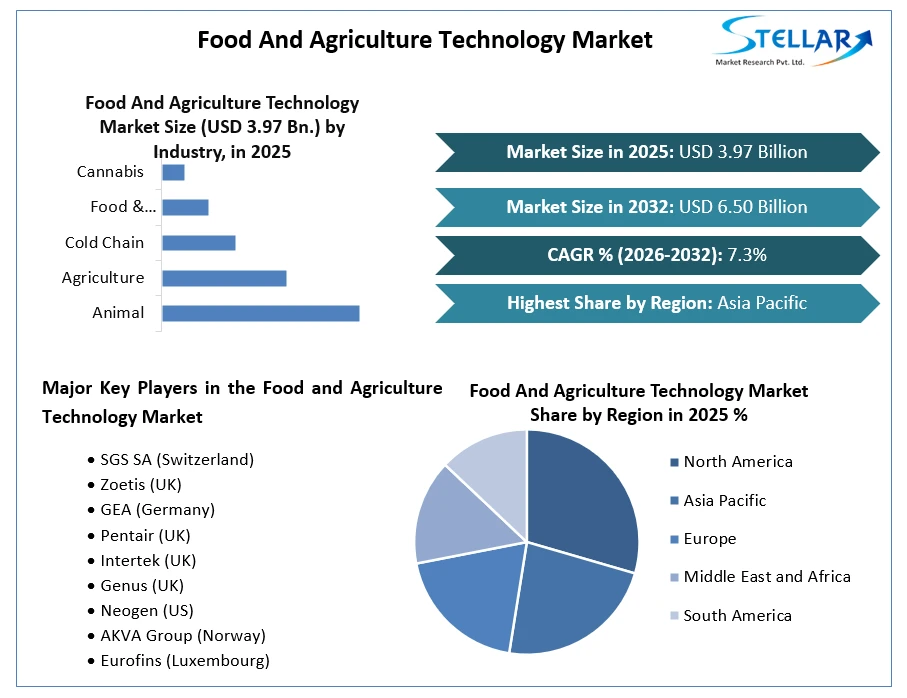
According to Stellar Market Research, the global Food and Agriculture Technology Market was valued at USD 3.97 billion in 2025 and is projected to grow at a CAGR of 7.3% during the forecast period (2026–2032). Rising adoption of smart farming solutions, increasing food safety awareness, and technological advancements are expected to drive sustained market growth.
What is Food and Agriculture Technology?
Food and agriculture technology, often referred to as AgTech, encompasses advanced technologies, equipment, and digital solutions used to improve agricultural production, food processing, and supply chain efficiency.
Key technologies include:
- Precision agriculture
- Internet of Things (IoT) sensors
- Artificial intelligence (AI)
- Agricultural robotics
- Drone and satellite imaging
- GPS-enabled farm management
- Smart irrigation systems
- Livestock monitoring technologies
These innovations help farmers increase crop yields, reduce operational costs, improve sustainability, and make data-driven decisions.
𝐃𝐨𝐰𝐧𝐥𝐨𝐚𝐝 𝐅𝐫𝐞𝐞 𝐏𝐃𝐅 𝐁𝐫𝐨𝐜𝐡𝐮𝐫𝐞: https://www.stellarmr.com/report/req_sample/Food-and-Agriculture-technology-Market/445
Key Factors Driving the Food and Agriculture Technology Market
1. Growing Global Food Demand
The world’s growing population is increasing the need for higher agricultural productivity. Farmers are adopting smart technologies to maximize crop yields while using fewer natural resources.
Precision agriculture enables more efficient use of water, fertilizers, pesticides, and labor, supporting sustainable food production.
2. Rising Adoption of Precision Agriculture
Precision farming has become one of the fastest-growing agricultural practices.
Modern farms utilize:
- GPS-guided machinery
- Soil monitoring sensors
- Variable-rate fertilizer application
- Drone-based crop monitoring
- Automated irrigation systems
These technologies improve farm efficiency while reducing waste and environmental impact.
3. Increasing Demand for Livestock Monitoring
Livestock producers are adopting smart technologies to monitor animal health, nutrition, and movement.
Wearable sensors and connected monitoring systems help farmers detect diseases early, improve breeding programs, and enhance productivity.
Growing consumption of meat, dairy, and seafood products is further accelerating investment in livestock technologies.
4. Expansion of Artificial Intelligence and IoT
AI and IoT are transforming agricultural operations by providing real-time insights into crop conditions, weather patterns, irrigation requirements, and pest management.
Connected devices enable farmers to make informed decisions that improve productivity while minimizing resource consumption.
Major Technologies Shaping the Market
Precision Agriculture
Precision agriculture combines GPS, sensors, drones, and data analytics to optimize crop production.
Benefits include:
- Higher crop yields
- Reduced fertilizer usage
- Improved water management
- Better soil health monitoring
- Lower production costs
Agricultural Robotics
Automation is becoming increasingly important in modern farming.
Agricultural robots perform tasks such as:
- Planting
- Harvesting
- Weeding
- Spraying
- Fruit picking
Robotic systems help address labor shortages while improving operational efficiency.
Drone Technology
Agricultural drones provide aerial imaging for:
- Crop health assessment
- Disease detection
- Irrigation monitoring
- Field mapping
- Precision spraying
Drone technology enables faster decision-making and more efficient farm management.
Smart Irrigation Systems
Water scarcity has increased demand for intelligent irrigation technologies.
Smart irrigation systems use weather forecasts, soil moisture sensors, and automated controls to optimize water usage while maintaining crop productivity.
Applications Across the Agriculture Value Chain
Crop Production
Smart farming technologies help farmers monitor crop growth, detect diseases early, and optimize nutrient application.
This leads to improved yields and better-quality produce.
Livestock Management
Connected livestock monitoring systems improve:
- Animal health tracking
- Feeding efficiency
- Reproductive management
- Disease prevention
These technologies contribute to increased productivity and reduced losses.
Greenhouse Automation
Modern greenhouses use automated climate control, irrigation, lighting, and environmental monitoring systems to maximize crop production year-round.
Greenhouse automation is becoming increasingly popular for high-value crops.
Food Supply Chain Management
Digital technologies improve traceability, inventory management, transportation, and food safety across the agricultural supply chain.
Blockchain, IoT, and cloud computing are enhancing transparency from farm to consumer.
𝐃𝐨𝐰𝐧𝐥𝐨𝐚𝐝 𝐅𝐫𝐞𝐞 𝐏𝐃𝐅 𝐁𝐫𝐨𝐜𝐡𝐮𝐫𝐞: https://www.stellarmr.com/report/req_sample/Food-and-Agriculture-technology-Market/445
Emerging Trends in Food and Agriculture Technology
Artificial Intelligence-Based Farm Management
AI-powered platforms analyze agricultural data to recommend optimal planting schedules, irrigation plans, fertilizer usage, and pest control strategies.
Climate-Smart Agriculture
Climate change is encouraging the adoption of technologies that improve resilience against droughts, floods, and unpredictable weather conditions.
Climate-smart farming supports sustainable food production while reducing environmental impact.
Big Data Analytics
Agricultural data collected from sensors, drones, weather stations, and machinery helps farmers make better operational decisions and improve overall farm efficiency.
Challenges Facing the Market
Despite strong growth prospects, the Food and Agriculture Technology Market faces several challenges.
High Initial Investment
Advanced agricultural equipment, sensors, drones, and automation systems require substantial capital investment, making adoption difficult for small-scale farmers.
Energy and Infrastructure Requirements
Many smart farming technologies depend on reliable electricity and internet connectivity, which remain limited in some rural regions.
Limited Technical Expertise
Successful implementation requires training and technical knowledge, creating challenges for farmers unfamiliar with digital technologies.
Future Opportunities
The market offers significant long-term growth opportunities through:
- Expansion of precision agriculture
- AI-powered crop monitoring
- Autonomous farming equipment
- Smart greenhouse technologies
- Sustainable farming solutions
- Digital food supply chains
- Increased adoption in developing economies
As governments and private organizations continue investing in agricultural modernization, technology adoption is expected to accelerate across both developed and emerging markets.
Conclusion
The Food and Agriculture Technology Market is transforming the future of farming through automation, digitalization, and data-driven decision-making. Technologies such as AI, IoT, robotics, drones, and precision agriculture are enabling farmers to increase productivity, improve sustainability, and meet rising global food demand.
With continued innovation and investment in smart agriculture, the market is expected to play a vital role in enhancing food security, optimizing resource utilization, and building a more resilient agricultural ecosystem.
