Underwater Drone Market: Transforming Ocean Exploration, Defense, and Marine Research
The world’s oceans remain one of the least explored frontiers, creating a growing demand for advanced technologies capable of operating safely and efficiently beneath the water’s surface. Underwater drones, also known as Unmanned Underwater Vehicles (UUVs), are revolutionizing marine exploration by providing cost-effective solutions for underwater inspections, scientific research, offshore energy operations, and defense missions.
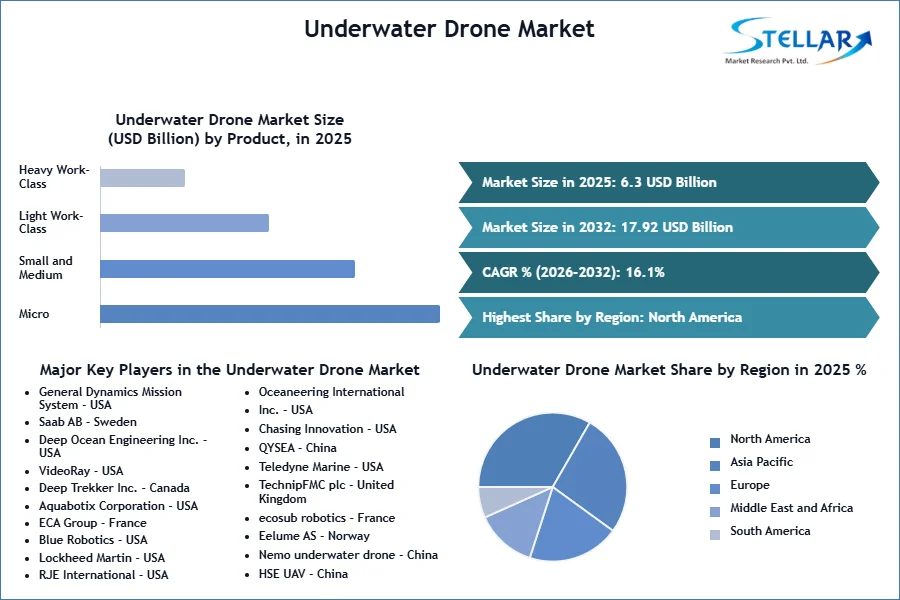
Equipped with high-resolution cameras, sonar systems, robotic arms, and artificial intelligence (AI), underwater drones can perform complex underwater tasks while reducing risks to human divers. According to Stellar Market Research, the global Underwater Drone Market was valued at USD 6.3 billion in 2025 and is projected to reach nearly USD 17.92 billion by 2032, growing at a CAGR of 16.1% during 2026–2032.
What are Underwater Drones?
Underwater drones are robotic vehicles designed to operate beneath the water’s surface for exploration, inspection, surveillance, and data collection. They are generally classified into three categories:
- Remotely Operated Vehicles (ROVs) – Controlled by an operator through cables or wireless communication.
- Autonomous Underwater Vehicles (AUVs) – Operate independently using pre-programmed navigation and onboard sensors.
- Hybrid Underwater Vehicles – Combine the capabilities of both ROVs and AUVs for greater operational flexibility.
These systems are widely used across defense, offshore oil and gas, marine research, environmental monitoring, underwater construction, and search-and-rescue operations.
𝐃𝐨𝐰𝐧𝐥𝐨𝐚𝐝 𝐅𝐫𝐞𝐞 𝐏𝐃𝐅 𝐁𝐫𝐨𝐜𝐡𝐮𝐫𝐞: https://www.stellarmr.com/report/req_sample/Underwater-Drone-Market/1983
Key Factors Driving the Underwater Drone Market
1. Growing Demand for Marine Research
Increasing concerns about ocean health, biodiversity conservation, and climate change have accelerated investments in marine exploration.
Underwater drones enable scientists to:
- Study marine ecosystems
- Monitor coral reefs
- Track marine wildlife
- Map the ocean floor
- Conduct deep-sea exploration
Their ability to operate at significant depths while collecting high-quality data makes them indispensable tools for oceanographic research.
2. Rising Defense and Maritime Security Investments
Naval forces worldwide are increasingly deploying underwater drones for:
- Mine detection and disposal
- Anti-submarine warfare
- Coastal surveillance
- Harbor security
- Intelligence gathering
Their ability to perform hazardous missions without putting personnel at risk has made them an essential component of modern maritime defense strategies.
3. Expansion of Offshore Energy Projects
The offshore oil, gas, and renewable energy industries require frequent underwater inspections of pipelines, drilling platforms, subsea cables, and offshore wind farms.
Underwater drones significantly reduce inspection costs while improving operational safety by replacing human divers in dangerous environments.
4. Advancements in AI and Sensor Technologies
Continuous improvements in artificial intelligence, battery technology, sonar imaging, navigation systems, and underwater communication have greatly enhanced drone capabilities.
Modern underwater drones now offer:
- Autonomous navigation
- Real-time obstacle avoidance
- High-definition imaging
- Advanced sonar mapping
- AI-assisted data analysis
These innovations are expanding their use across commercial and scientific applications.
Major Types of Underwater Drones
Remotely Operated Vehicles (ROVs)
ROVs remain one of the most widely used underwater drone categories due to their precision and reliability.
They are commonly deployed for:
- Offshore infrastructure inspection
- Underwater maintenance
- Scientific exploration
- Search and recovery missions
Their real-time operator control makes them suitable for complex underwater tasks.
Autonomous Underwater Vehicles (AUVs)
AUVs operate independently without continuous human control.
Applications include:
- Seafloor mapping
- Oceanographic surveys
- Environmental monitoring
- Military reconnaissance
Their autonomous capabilities enable long-duration missions across large underwater areas.
Hybrid Underwater Vehicles
Hybrid systems combine the strengths of both ROVs and AUVs, providing greater flexibility for commercial, scientific, and defense applications.
Applications Across Industries
Defense and Security
Military organizations use underwater drones for:
- Maritime surveillance
- Mine countermeasure operations
- Underwater reconnaissance
- Port security
The increasing need to protect maritime borders continues to drive demand.
Scientific Research
Research institutions deploy underwater drones to study marine ecosystems, geological formations, and ocean currents while collecting valuable environmental data.
𝐃𝐨𝐰𝐧𝐥𝐨𝐚𝐝 𝐅𝐫𝐞𝐞 𝐏𝐃𝐅 𝐁𝐫𝐨𝐜𝐡𝐮𝐫𝐞: https://www.stellarmr.com/report/req_sample/Underwater-Drone-Market/1983
Commercial Exploration
Commercial industries use underwater drones for:
- Offshore oil and gas inspections
- Underwater infrastructure monitoring
- Pipeline surveys
- Renewable energy projects
These systems improve operational efficiency while reducing maintenance costs.
Environmental Monitoring
Government agencies and environmental organizations use underwater drones to monitor pollution, assess marine habitats, and evaluate the impact of climate change on ocean ecosystems.
Emerging Technology Trends
Artificial Intelligence Integration
AI-powered underwater drones can autonomously navigate challenging underwater environments, identify objects, and optimize mission routes with minimal human intervention.
Improved Battery Technology
Advances in battery efficiency are extending operational endurance, allowing drones to complete longer and more complex underwater missions.
High-Resolution Imaging and Sonar
Modern underwater drones feature advanced imaging systems that produce detailed visual and sonar data for scientific research, inspections, and mapping.
Miniaturization
Compact and lightweight underwater drones are becoming increasingly popular for shallow-water exploration, environmental monitoring, and recreational applications.
Challenges Facing the Market
Despite strong growth prospects, the industry faces several challenges.
High Initial Investment
Advanced underwater drones require sophisticated hardware, sensors, and navigation systems, resulting in high acquisition costs.
Communication Limitations
Reliable underwater communication remains technically challenging because radio signals do not travel effectively through water, making acoustic communication the primary option.
Battery Constraints
Although battery technology is improving, limited operational endurance can still restrict long-duration underwater missions.
Regulatory and Environmental Considerations
Deploying underwater drones in sensitive marine ecosystems often requires regulatory approvals and careful environmental management to minimize ecological impacts.
Future Opportunities
The Underwater Drone Market is expected to benefit from several long-term growth opportunities:
- Expansion of offshore renewable energy projects
- Growth in deep-sea mineral exploration
- Increasing investments in marine conservation
- Rising adoption in underwater archaeology
- AI-powered autonomous underwater operations
- Development of hybrid underwater vehicles
- Expansion of commercial underwater inspection services
North America is expected to maintain a significant market share due to strong defense spending, advanced marine technologies, and active offshore industries, while Asia-Pacific is projected to witness rapid growth driven by increasing maritime security initiatives and ocean research investments.
Conclusion
The Underwater Drone Market is transforming how industries explore, monitor, and protect the underwater world. Growing investments in marine research, offshore energy, defense modernization, and environmental conservation are driving strong demand for advanced underwater robotic systems.
As artificial intelligence, autonomous navigation, and sensor technologies continue to evolve, underwater drones will play an increasingly important role in unlocking the vast potential of the world’s oceans while improving safety, efficiency, and sustainability across multiple industries.
