Compound Semiconductor Market: Powering the Next Generation of High-Speed Electronics
The global electronics industry is rapidly evolving with the expansion of 5G networks, electric vehicles (EVs), renewable energy systems, artificial intelligence (AI), and advanced consumer electronics. As traditional silicon-based semiconductors approach their performance limits in high-power and high-frequency applications, compound semiconductors are emerging as a critical technology for next-generation electronic devices.
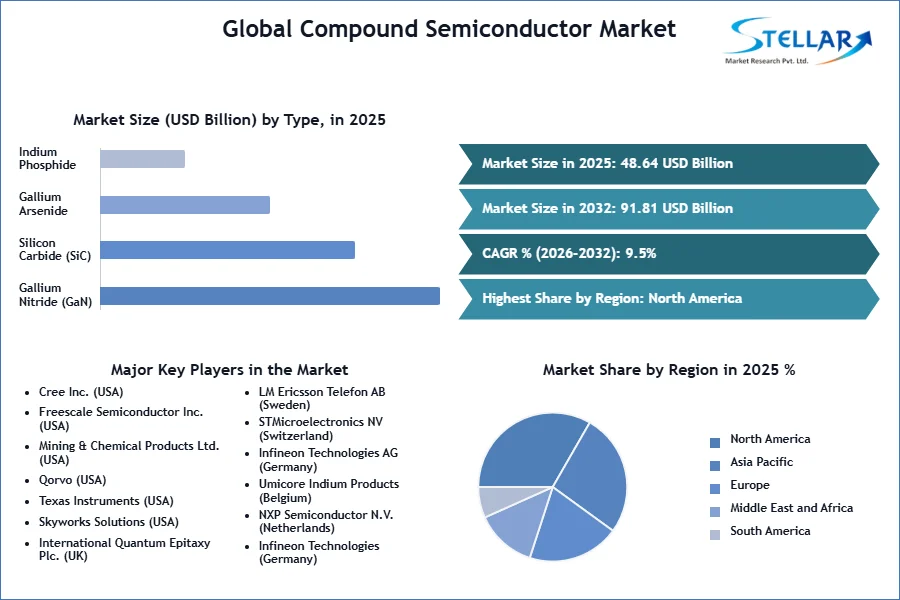
Compound semiconductors offer superior electrical performance, faster switching speeds, higher energy efficiency, and better thermal conductivity than conventional silicon semiconductors. According to Stellar Market Research, the global Compound Semiconductor Market was valued at USD 48.64 billion in 2025 and is expected to grow at a CAGR of 9.5% during the forecast period, driven by increasing demand across telecommunications, automotive, aerospace, industrial automation, and consumer electronics.
What are Compound Semiconductors?
Compound semiconductors are semiconductor materials made by combining two or more elements from different groups of the periodic table rather than using pure silicon.
Common compound semiconductor materials include:
- Gallium Nitride (GaN)
- Silicon Carbide (SiC)
- Gallium Arsenide (GaAs)
- Indium Phosphide (InP)
- Gallium Phosphide (GaP)
These materials provide exceptional performance in high-frequency, high-temperature, and high-power applications, making them ideal for modern electronic systems.
Key Factors Driving the Compound Semiconductor Market
1. Growing Adoption of Electric Vehicles
The rapid expansion of the electric vehicle industry is one of the strongest growth drivers for compound semiconductors.
Silicon Carbide (SiC) and Gallium Nitride (GaN) devices improve:
- Battery efficiency
- Fast charging
- Power conversion
- Thermal management
- Driving range
Automakers are increasingly integrating these materials into electric powertrains and charging infrastructure to improve vehicle performance.
2. Expansion of 5G Networks
The deployment of 5G communication infrastructure requires semiconductors capable of operating at extremely high frequencies with minimal energy loss.
Compound semiconductors support:
- RF amplifiers
- Base stations
- Satellite communication
- High-speed wireless networking
Their excellent electron mobility enables faster and more reliable data transmission.
3. Increasing Demand for Energy-Efficient Electronics
Energy efficiency has become a major priority across industries.
Compound semiconductors reduce power losses in:
- Power supplies
- Industrial equipment
- Renewable energy systems
- Consumer electronics
Their ability to operate at higher temperatures also reduces cooling requirements, improving overall system efficiency.
4. Growth in Renewable Energy Infrastructure
Solar power systems, wind energy installations, and battery storage solutions require efficient power conversion technologies.
Compound semiconductor devices improve inverter performance and energy management, making them increasingly important in renewable energy applications.
𝐃𝐨𝐰𝐧𝐥𝐨𝐚𝐝 𝐅𝐫𝐞𝐞 𝐏𝐃𝐅 𝐁𝐫𝐨𝐜𝐡𝐮𝐫𝐞: https://www.stellarmr.com/report/req_sample/Compound-Semiconductor-Market/2246
Major Types of Compound Semiconductor Materials
Gallium Nitride (GaN)
GaN is widely used for high-frequency and high-power applications because of its superior switching speed and efficiency.
Major applications include:
- 5G infrastructure
- Fast chargers
- Power electronics
- Data centers
- Radar systems
Silicon Carbide (SiC)
Silicon Carbide offers outstanding thermal conductivity and high-voltage performance.
It is commonly used in:
- Electric vehicles
- Solar inverters
- Industrial motor drives
- Smart grid systems
Its ability to reduce energy losses makes it one of the fastest-growing semiconductor materials.
Gallium Arsenide (GaAs)
GaAs is known for excellent electron mobility and is widely used in:
- Smartphones
- RF devices
- Satellite communication
- Optical communication
- Military electronics
Indium Phosphide (InP)
Indium Phosphide supports ultra-high-speed optical communication and photonic applications.
It is increasingly used in:
- Fiber optic networks
- Data centers
- High-speed communication systems
Applications Across Industries
Consumer Electronics
Compound semiconductors improve the performance of smartphones, laptops, gaming systems, and wearable devices by enabling faster charging and higher processing efficiency.
Automotive Industry
Electric and hybrid vehicles rely on compound semiconductors for efficient power management, battery charging, and advanced driver assistance systems (ADAS).
Telecommunications
Telecom companies use compound semiconductor devices in:
- 5G base stations
- Wireless communication equipment
- Optical networking
- Satellite communication
Aerospace and Defense
Military radar systems, electronic warfare equipment, satellite technologies, and secure communication systems depend on high-performance compound semiconductor components.
Industrial Automation
Factories increasingly adopt compound semiconductors in robotics, industrial drives, and automation systems to improve operational efficiency.
Emerging Technology Trends
Wide Bandgap Semiconductor Adoption
Wide bandgap materials such as SiC and GaN are replacing conventional silicon devices in many power electronics applications because they offer higher efficiency and improved thermal performance.
Artificial Intelligence and Edge Computing
AI servers and edge computing infrastructure require high-performance chips capable of handling massive computing workloads with minimal energy consumption.
Compound semiconductors help meet these performance requirements.
Miniaturization of Electronic Devices
As electronic devices become smaller and more powerful, manufacturers are increasingly adopting compound semiconductor technologies that deliver higher performance in compact designs.
Challenges Facing the Market
Despite strong growth potential, several challenges remain.
High Manufacturing Costs
Compound semiconductor materials are generally more expensive to manufacture than traditional silicon devices due to complex fabrication processes.
Limited Manufacturing Capacity
The production of high-quality wafers and advanced semiconductor devices requires specialized facilities and significant capital investment.
Technical Integration Challenges
Integrating compound semiconductor technologies into existing manufacturing ecosystems requires specialized expertise and advanced design capabilities.
𝐃𝐨𝐰𝐧𝐥𝐨𝐚𝐝 𝐅𝐫𝐞𝐞 𝐏𝐃𝐅 𝐁𝐫𝐨𝐜𝐡𝐮𝐫𝐞: https://www.stellarmr.com/report/req_sample/Compound-Semiconductor-Market/2246
Future Opportunities
The Compound Semiconductor Market is expected to benefit from several long-term growth opportunities:
- Expansion of electric vehicle production
- Global deployment of 5G and future 6G networks
- Growth of AI and high-performance computing
- Increasing investment in renewable energy
- Development of advanced aerospace technologies
- Rising adoption of smart industrial automation
- Expansion of data centers and cloud computing infrastructure
Asia-Pacific is expected to remain the largest regional market due to its strong semiconductor manufacturing ecosystem, growing electronics production, and increasing investments in automotive and telecommunications industries.
Conclusion
The Compound Semiconductor Market is becoming a cornerstone of next-generation electronics by enabling faster, more efficient, and higher-performing devices across multiple industries. Rising demand for electric vehicles, 5G communication, renewable energy systems, and AI-driven technologies is accelerating the adoption of advanced semiconductor materials such as GaN, SiC, and GaAs.
As research, manufacturing capacity, and technological innovation continue to advance, compound semiconductors are expected to play a critical role in shaping the future of global electronics and digital infrastructure.
