Key Highlights
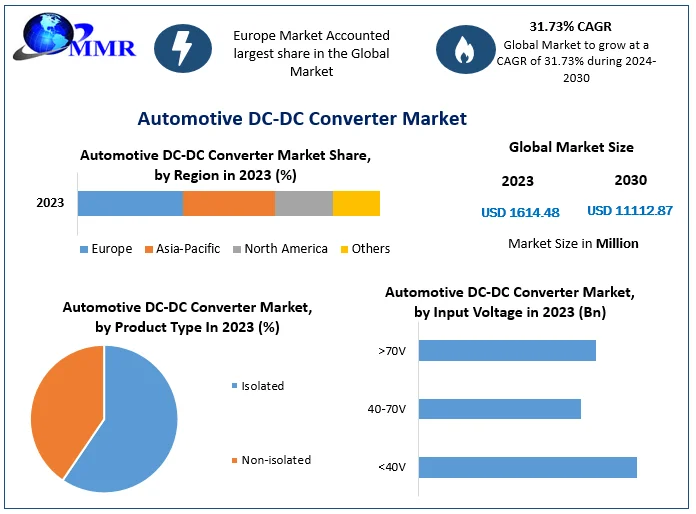
The global Automotive DC-DC Converter Market size achieved a valuation of USD 1,614.48 million in 2023 and is projected to expand to USD 11,112.87 million by 2030.
The market exhibits an accelerated growth path, sustaining a compounded annual growth rate (CAGR) of 31.73% during the forecast period from 2024 to 2030.
Battery Electric Vehicles (BEVs) represent the dominant propulsion architecture segment, accounting for two-thirds of new global electric car registrations.
Non-isolated DC-DC converters emerge as the fastest-growing configuration due to continuous component miniaturization and smaller structural footprints compared to isolated platforms.
China holds the leading market share in EV deployment, generating more than 3.5 million unit sales in 2023 alone, representing 50% of global light-duty electric vehicle trade flows.
Why This Matters Now
Automotive OEMs, Tier-1 suppliers, and power electronics manufacturers face an immediate, high-stakes transition as electric vehicle architecture permanently moves toward advanced high-voltage battery rails. Legacy internal combustion systems are rapidly giving way to high-power, multi-voltage vehicle networks that require absolute precision in managing power at the point of load. Manufacturers that fail to rapidly deploy highly efficient, miniaturized converter platforms will find themselves locked out of major upcoming commercial passenger vehicle architectures. The massive industry expansion to an USD 11,112.87 million valuation by 2030 creates a highly competitive window where component weight, spatial efficiency, and thermal stability dictate long-term sourcing victories.
Market Overview
The global automotive DC-DC converter market comprises highly specialized electronic control units designed to convert primary source voltages from one distinct operational level to another across automotive input voltage rails. These power electronics demand advanced input and load output simulations to guarantee the stability, power efficiency, and long-term functional integrity of onboard vehicle subsystems. Modern electric drivetrains generate hundreds of volts of Direct Current (DC), necessitating higher power DC-DC converters that routinely exceed operational thresholds of 200 W. As electronic component density multiplies across braking, steering, comfort, and safety systems, specialized converters are mandatory to insulate and transform voltage outputs reliably.
Key Trends Driving Growth
Rapidly declining battery and electric vehicle assembly costs are fueling unprecedented consumer demand for electric mobility options globally. In response to this consumer shift, public and private capital allocations are expanding regional charging infrastructure networks, which directly removes historical purchasing barriers and accelerates vehicle procurement. This ongoing transition to high-voltage electrified platforms acts as the primary engine for advanced power conversion systems capable of handling extreme voltage variations.
Simultaneously, aggressive carbon emission regulations and government efforts to build greener municipal environments are accelerating the deployment of specialized engine start-stop technologies. By automatically shutting off internal combustion during temporary vehicle standstills and regulating voltage during restarts, these systems heavily rely on embedded DC-DC conversion blocks to prevent power dips across secondary cabin electronics. Consequently, the rising inclusion of highly advanced, low-emissions control modules throughout light and heavy vehicles drives systemic market growth.
Segment Insights
Battery Electric Vehicles (BEVs) [Dominant Segment]: This propulsion type segment commands the absolute majority of global market volume. Delivering high-voltage DC outputs that must be stepped down to run low-voltage auxiliary vehicle subsystems, BEVs represent two-thirds of the total global electric car stock, securing long-term dominant demand.
Non-Isolated DC-DC Converters [Fastest-Growing Segment]: Driven by intense industry-wide product development focusing on component miniaturization, non-isolated topologies represent the fastest-increasing configuration. These components are significantly smaller in size compared to isolated alternatives, allowing OEMs to reduce vehicle weight and lower total manufacturing costs.
Regional Growth Story
China commands the dominant position in the global market landscape, establishing itself as the primary vehicle manufacturing and deployment hub. In 2023, Chinese domestic production and demand accounted for 50% of the world’s total electric light-duty vehicle sales and an overwhelming 92% of the global electric heavy-duty vehicle market share. This high-density manufacturing landscape provides domestic power electronics producers with massive economies of scale.
North America occupies a powerful market position, driven by intensive tier-1 investment strategies and extensive research and development spending. Major global automotive manufacturers—including Ford, Tesla, and Honda—are investing heavily across the United States to expand local passenger vehicle electrification networks and establish resilient component manufacturing facilities. Meanwhile, Western Europe, anchored by German manufacturing networks, maintains steady high-volume procurement as strict regional carbon targets force the complete phase-out of traditional internal combustion architectures.
Competitive Landscape
The competitive matrix of the global automotive DC-DC converter market is highly dynamic and increasingly consolidated around a select tier of dominant technological innovators. Top-tier manufacturers are executing aggressive product deployment strategies that prioritize miniaturization, high power efficiency, and advanced thermal management to capture long-term supply agreements. Pricing power in this space belongs exclusively to companies that can deliver compact, highly reliable units capable of operating under extreme automotive temperature variations.
Furthermore, historical consolidation patterns through strategic mergers and acquisitions continue to reshape vendor relations, as larger corporations absorb niche component providers to quickly broaden their power electronics portfolios. Emerging market entrants face intense engineering moats due to the rigorous safety certifications and custom programmable DC power testing matrices required by major automotive brands.
Recent Developments
Global manufacturing specialists including BorgWarner Inc., Skyworks Solutions Inc., and Semiconductor Components Industries continue to scale up high-power, low-footprint component manufacturing lines tailored for commercial electric platforms.
Advanced power conversion innovators such as Synqor Inc., Crane Aerospace and Electronics, Vicor Corporation, VPT Power Inc., and Microsemi Corporation have advanced their research layouts, focusing on high-efficiency non-isolated architectures.
Top-tier global automotive OEMs including Tesla, Ford, and Honda have systematically expanded their long-term supply agreements with specialized component makers to secure high-volume DC-DC converter pipelines for upcoming vehicle models.
Industrial automated testing operations have integrated highly programmable DC power sources to validate broad input voltage operating ranges across automated multi-voltage assembly lines.
Strategic Implications
For power electronic design engineers and Tier-1 automotive integrators, the massive push toward component miniaturization requires an immediate move away from heavy, legacy isolated architectures wherever design regulations permit. Minimizing component packaging size while maximizing total electrical throughput allows suppliers to offer immediate weight-saving advantages to volume-focused automotive manufacturers.
Furthermore, to combat ongoing global semiconductor supply chain vulnerabilities and ensure uninterrupted production capacity, converter manufacturers must build resilient, diversified raw material sourcing networks. Suppliers must also align their development tracks directly with the rapid shift toward heavy-duty vehicle electrification, where higher-power handling capabilities beyond the standard 200 W threshold represent an increasingly lucrative commercial opportunity.
Future Outlook
The ultimate divide in the global automotive landscape will separate the advanced power electronic innovators who successfully master lightweight, highly efficient multi-voltage integration from legacy component suppliers who remain dependent on bulky, low-efficiency conversion platforms.
Analyst Perspective
“The automotive industry is adapting rapidly to a fast-changing competitive landscape defined by expanding electronic content inside modern passenger cars,” states Dharati Raut, Research Analyst at Maximize Market Research. “As global BEV registrations scale up and vehicle electrical rails multiply in complexity, the engineering focus must center completely on the miniaturization and efficiency of DC-DC converters to secure next-generation automotive platform placements.”
About Maximize Market Research
Maximize Market Research Pvt. Ltd. (MMR) is a global market research and consulting company that provides reliable, data-focused, and practical business insights. The firm serves a wide range of industries, including healthcare, pharmaceuticals, technology, automotive, electronics, chemicals, personal care, and consumer goods. Through market forecasts, competitive analysis, strategic consulting, and industry impact assessments, MMR helps organizations understand changing market conditions, identify growth opportunities, and make informed business decisions for long-term success.
2nd Floor, Navale IT Park Phase 3
Pune Banglore Highway, Narhe
Pune, Maharashtra 411041, India
+91 9607365656
sales@maximizemarketresearch.com
