The Service Robotics Market is experiencing rapid global expansion as robots increasingly move beyond industrial settings into everyday environments. Service robots are designed to assist humans by performing useful tasks in sectors such as healthcare, hospitality, logistics, retail, and domestic applications.
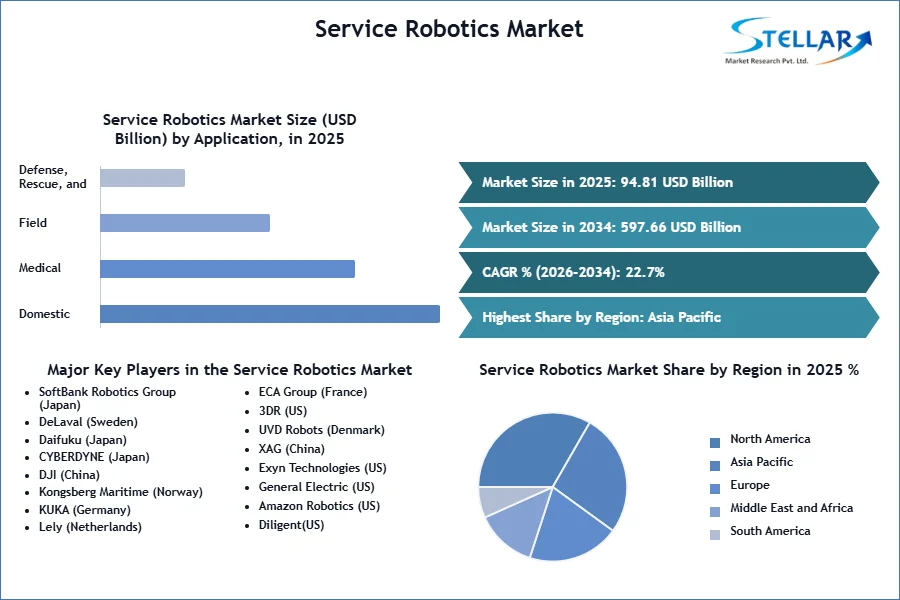
Service Robotics Market size was valued at USD 94.81 Billion in 2025 and the total Service Robotics revenue is expected to grow at 22.7% through 2026 to 2034, reaching nearly USD 597.66 Billion.
With advancements in artificial intelligence (AI), machine learning, and sensor technologies, service robots are becoming more intelligent, autonomous, and capable of delivering enhanced efficiency and convenience.
A Market Driven by Automation and Human Assistance
A defining trend in the service robotics market is the growing demand for automation in service-oriented tasks. Organizations are leveraging robots to improve productivity, reduce labor costs, and enhance customer experience.
Service robots are transforming industries by enabling safer, faster, and more efficient operations.
Key Market Insights
- Service robots are widely used across multiple industries.
- Professional service robots dominate market share.
- Healthcare and logistics are key application areas.
- AI and machine learning enhance robot capabilities.
- Domestic robots are gaining popularity.
- Asia-Pacific leads the global market.
- Human-robot collaboration is increasing.
𝐃𝐨𝐰𝐧𝐥𝐨𝐚𝐝 𝐅𝐫𝐞𝐞 𝐏𝐃𝐅 𝐁𝐫𝐨𝐜𝐡𝐮𝐫𝐞: https://www.stellarmr.com/report/req_sample/Service-Robotics-Market/431
Market Drivers Accelerating Growth
1. Rising Demand for Automation
Businesses are adopting robots to improve operational efficiency.
2. Labor Shortages and Cost Pressures
Service robots help address workforce challenges.
3. Advancements in AI and Robotics Technologies
Improved intelligence and autonomy are driving adoption.
Market Challenges and Restraints
1. High Initial Investment Costs
Advanced robotic systems can be expensive.
2. Technical Complexity and Integration Issues
Implementation may require specialized expertise.
Technology and Innovation Trends
Innovation in the service robotics market is driven by advancements in AI, computer vision, natural language processing, and sensor technologies. Robots are becoming more adaptive and capable of interacting with humans in natural ways.
Autonomous navigation systems are enabling robots to operate in dynamic environments. Cloud robotics and edge computing are enhancing data processing and real-time decision-making.
Collaborative robots (cobots) are working alongside humans to improve productivity and safety. Robotics-as-a-Service (RaaS) models are making service robots more accessible to businesses.
Miniaturization and energy efficiency are also expanding applications in domestic and healthcare settings.
Visual Snapshot: Service Robotics in Action
Regional Insights: Asia-Pacific Leads, Global Adoption Expands
Asia-Pacific dominates the service robotics market, driven by strong manufacturing capabilities, rapid technological adoption, and increasing investments in countries like China, Japan, and South Korea.
North America is a significant market, focusing on innovation, healthcare robotics, and advanced applications.
Europe is also expanding, particularly in industrial automation and service applications.
Emerging markets are gradually adopting service robotics to improve efficiency and service delivery.
Recent Industry Developments
- iRobot (2025): Expanded home robotics solutions.
- SoftBank Robotics (2024): Advanced humanoid service robots.
- ABB (2025): Developed collaborative robotic systems.
- Boston Dynamics (2024): Enhanced autonomous robot capabilities.
- International Federation of Robotics (2025): Highlighted global robotics trends.
Competitive Landscape
The service robotics market is highly competitive, with global technology companies, robotics manufacturers, and startups driving innovation. Companies are focusing on AI integration, user-friendly design, and scalability to strengthen their market position.
Strategic partnerships and R&D investments are key to maintaining competitiveness.
Analyst Perspective
A senior market analyst notes:
“The service robotics market is transforming how services are delivered. Intelligent automation will define the future of human-robot interaction.”
Future Outlook
The Service Robotics Market is expected to witness strong growth in the coming years, supported by increasing adoption across industries, advancements in AI and robotics technologies, and rising demand for automation.
The expansion of RaaS models, integration with IoT and cloud platforms, and development of cost-effective solutions will further enhance market potential.
As industries continue to embrace automation, service robots will play a central role in improving efficiency, safety, and customer experience.
Overall, the market presents significant opportunities for technology providers, businesses, and investors aiming to shape the future of intelligent service solutions.
