Key Highlights
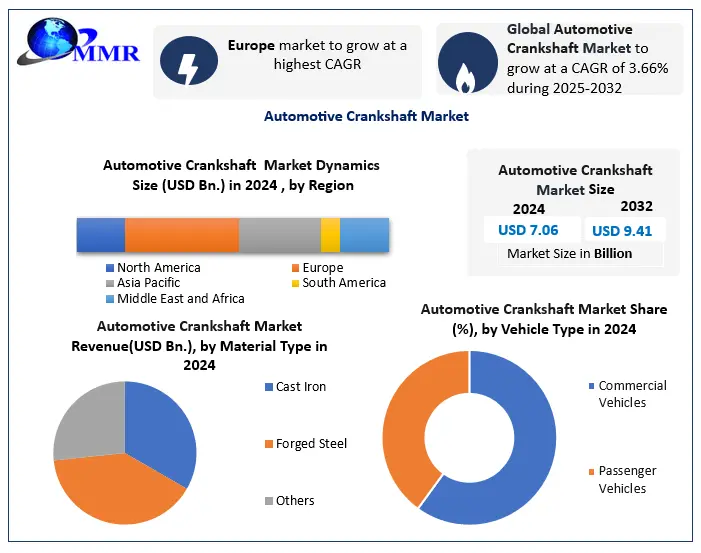
The global automotive crankshaft market size achieved an institutional valuation of USD 7.06 billion in 2024 and is projected to scale to USD 9.41 billion by 2032.
The sector operates on a resilient growth path, sustaining a compounded annual growth rate (CAGR) of 3.66% during the forecast matrix spanning 2025 to 2032.
The commercial vehicle segment stands as the dominant driver of market volume, generating long-term demand via heavy-duty thickness and structural tolerance mandates.
Forged steel architectures represent the fastest-growing material segment, rapidly outpacing legacy cast iron setups due to extreme durability, shock tolerance, and corrosion resistance.
The Asia-Pacific region maintains the largest regional production capacity and consumption footprint, anchored by highly cost-effective manufacturing setups in primary industrial hubs.
Why This Matters Now
Automotive OEMs, Tier-1 forging suppliers, and powertrain engineers face a high-urgency window to optimize mechanical production lines as global emission regulations compress development cycles for internal combustion and hybrid architectures. Fleet operators demand immediate improvements in vehicle uptime and fuel efficiency, meaning that baseline engine components must deliver tighter dimensional tolerances and reduced weight without sacrificing structural integrity. Component manufacturers that fail to transition production from cheap cast iron platforms to highly durable forged steel and billet setups face swift exclusion from next-generation commercial vehicle platforms. With the industry expanding systematically toward a USD 9.41 billion cap by 2032, long-term procurement victories belong exclusively to vendors who can balance extreme metallurgical strength with advanced weight-reduction strategies.
Market Overview
The global automotive crankshaft market comprises the structural engineering, forging, casting, and precision-machining of core internal combustion engine assets designed to transform linear piston movement into rotational kinetic energy. These heavy-duty engine blocks are positioned at the base of the engine assembly, managing immense mechanical stress and continuous thermal shock during standard operation. In terms of design variations, the market operates on a clear functional split between flat-plane and cross-plane designs. Flat-plane configurations feature lower mass and excellent high-RPM attributes tailored for sports applications, whereas cross-plane architectures leverage zig-zag pin offsets to deliver smooth operations across passenger and commercial vehicles.
Key Trends Driving Growth
Accelerating global infrastructure modernizations and expanding heavy logistics networks are generating continuous, multi-regional demand for heavy commercial vehicles and high-capacity freight transit. Because commercial platforms run extended duty cycles under maximum load conditions, engine components demand maximum structural thickness and heightened fatigue resistance, creating an isolated, high-volume baseline for crankshaft producers.
Concurrently, a broad industry shift toward optimized hybrid powertrains is changing traditional engine design rules. Hybrid vehicles require internal combustion setups that shut down and restart repeatedly during standard operation, exposing the crankshaft assembly to continuous rotational variations and elevated thermal cycles. To survive these demanding operational profiles, component makers are forcing widespread integration of high-strength steel alloys, specialized surface treatments, and advanced metallurgical coatings to maximize part longevity.
Segment Insights
Commercial Vehicles [Dominant Segment]: This application classification commands the absolute majority of global market revenue. The continuous operational demands of heavy commercial transport require crankshaft architectures with increased thickness, highly optimized weight distribution, and rigid mechanical performance criteria to prevent catastrophic field failures.
Forged Steel [Fastest-Growing Segment]: Due to strict reliability requirements across high-load and premium engine blocks, forged steel represents the fastest-increasing material configuration. Forged steel provides superior fatigue life, excellent shock absorption, and high corrosion resistance compared to price-sensitive legacy cast configurations.
Regional Growth Story
The Asia-Pacific region commands the dominant position in the global automotive crankshaft market landscape, serving as both a massive automotive manufacturing center and the primary source of volume demand. Within this regional market, cost-effective cast iron crankshafts remain a preferred, highly practical choice for highly price-sensitive entry-level passenger vehicles and agricultural equipment. This structural demand provides regional manufacturing facilities with consistent, high-volume production baselines.
Simultaneously, key manufacturing hubs across China, India, and Japan are steadily upgrading their domestic metalworking facilities to support advanced precision forging. Western Europe, anchored by precision premium automotive networks in Germany, maintains highly targeted procurement paths focused on luxury cross-plane setups and high-performance billet steel configurations. North America follows a similar high-value development pattern, driven by heavy domestic commercial truck demands and intensive Tier-1 engineering investments.
Competitive Landscape
The competitive matrix of the global automotive crankshaft market is highly consolidated, defined by deep capital investments in heavy-duty automated pressing lines and advanced computer numerical control (CNC) finishing systems. Sourcing power belongs exclusively to tier-1 suppliers who can deliver zero-defect manufacturing batches with microscopic dimensional tolerances. Major industry participants maintain their dominant positions by forming direct, multi-year supply integrations with top-tier commercial truck and passenger vehicle OEMs, creating high barriers to entry for new component vendors. Niche machining firms and independent component developers are adjusting by focusing heavily on specialized billet steel and custom composite prototyping to capture high-margin, low-volume motorsport and experimental hybrid performance contracts.
Recent Developments
Global powertrain component specialists and high-tier precision forging operations continue to expand their manufacturing footprints, targeting advanced steel alloy formulations to reduce overall rotating mass.
Leading metalworking facilities have deployed high-efficiency CNC machining blocks to enforce tighter dimensional tolerances, meeting the strict requirements of downsized, high-compression engines.
Advanced material developers are testing billet steel variants and unique surface treatments to prevent mechanical wear during repeated start-stop cycles in next-generation hybrid configurations.
Sourcing structures have shifted toward localized forging facilities in the Asia-Pacific region to insulate major automotive brands against long-term ocean shipping delays and volatile international raw material pricing.
Strategic Implications
For industrial design engineers and Tier-1 automotive suppliers, the permanent shift toward weight optimization means that material science is now a core competitive front. Component makers must consistently invest in advanced fatigue analysis software and precision surface hardening methods to thin out non-critical crankshaft dimensions without compromising total load capacity.
Furthermore, to hedge against volatile steel prices and fluctuating global raw material access, manufacturers must build flexible, multi-layered metal sourcing networks. Suppliers must also align their long-term factory space with the expanding hybrid market, modifying automated testing cells to handle the distinct performance variations required by high-compression, multi-energy powertrains.
Future Outlook
The ultimate line of separation in the global powertrain sector will isolate advanced precision forge operations that successfully commercialize ultra-lightweight, high-fatigue alloys from legacy casting foundries stuck producing heavy, low-efficiency component blocks.
Analyst Perspective
“The global automotive crankshaft market is navigating a complex evolutionary shift where core mechanical durability must combine seamlessly with advanced lightweight design,” says Dharati Raut, Research Analyst at Maximize Market Research. “As commercial transport needs expand alongside complex hybrid powertrains, the engineering focus must center entirely on forged steel innovations and tighter structural tolerances to maintain long-term relevance in a changing automotive architecture.”
About Maximize Market Research
Maximize Market Research Pvt. Ltd. (MMR) is a global market research and consulting company that provides reliable, data-focused, and practical business insights. The firm serves a wide range of industries, including healthcare, pharmaceuticals, technology, automotive, electronics, chemicals, personal care, and consumer goods. Through market forecasts, competitive analysis, strategic consulting, and industry impact assessments, MMR helps organizations understand changing market conditions, identify growth opportunities, and make informed business decisions for long-term success.
2nd Floor, Navale IT Park Phase 3
Pune Banglore Highway, Narhe
Pune, Maharashtra 411041, India
+91 9607365656
sales@maximizemarketresearch.com
