Key Highlights
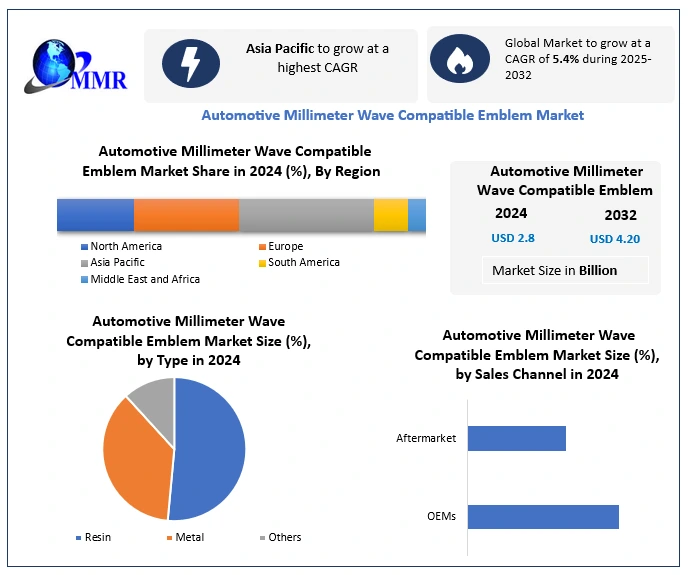
Market Valuation: Global market valued at USD 2.8 Billion in 2024, projected to hit USD 4.20 Billion by 2032.
Growth Trajectory: Consistent 5.4% CAGR over the 2025–2032 forecast period.
Material Shift: Resin-based emblems command the market due to superior radar wave permeability and design versatility.
ADAS Dominance: Passenger vehicles represent the primary growth driver, necessitated by standardized safety mandates and consumer demand for autonomous features.
Regional Dynamics: Asia Pacific leads current market share; North America and Europe are emerging as high-growth hubs due to regulatory phase-outs of legacy 24-GHz radar bands.
Why This Matters Now
OEMs and Tier-1 suppliers face a critical juncture: the front-facing vehicle emblem is no longer a branding afterthought but a functional, mission-critical component of the Advanced Driver-Assistance Systems (ADAS) sensor suite. As manufacturers aggressively integrate radar-based safety features—ranging from adaptive cruise control to automatic emergency braking—the demand for radar-transparent, interference-free exterior materials has become an urgent supply chain priority. Failing to secure the right material partnerships today threatens vehicle launch timelines and safety compliance certifications.
Market Overview
The Automotive Millimeter Wave Compatible Emblem Market serves as the physical interface between critical vehicle safety sensors and the external environment. These components must balance aesthetic branding with precise material science to ensure radar waves propagate without attenuation or scattering. In 2024, the market was valued at USD 2.8 Billion. As ADAS adoption moves from luxury flagship models to the mid-market and entry-level segments, the global market is on a firm path to reach USD 4.20 Billion by 2032.
Key Trends Driving Growth
The primary catalyst for this expansion is the global push toward “vision-zero” safety standards. Regulatory frameworks are mandating advanced collision avoidance systems, which rely heavily on millimeter-wave radar. Furthermore, the industry-wide shift from legacy 24-GHz radar frequencies to higher, more efficient millimeter-wave bands necessitates a redesign of front-end components. This technical migration forces a replacement cycle across the global fleet, turning standard emblems into specialized electronic shielding components.
Segment Insights
Dominant Segment (Material): Resin. Resin-based emblems hold the largest market share. The material offers the optimal balance of dielectric properties required for radar signal transmission, alongside weight reduction and durability.
Dominant Segment (Vehicle): Passenger Vehicles. This segment leads due to the high density of ADAS integration in consumer-facing passenger cars compared to commercial transport fleets.
Fastest-Growing Segment: While established, the Aftermarket channel is expected to see increased activity as older vehicles require sensor-compatible replacements to maintain safety system integrity.
Regional Growth Story
Asia Pacific currently dictates the market pace, driven by a high volume of vehicle production and rapid ADAS integration in emerging manufacturing hubs. However, the regulatory landscape in North America and Europe is tilting the balance. Stringent government phase-outs of the 24-GHz frequency band are compelling manufacturers to adopt newer standards, creating a massive replacement and upgrade demand for radar-compatible components in these regions.
Competitive Landscape
The market is characterized by high-stakes partnerships between automotive Tier-1 suppliers and material science firms. Key players, including Toyoda Gosei, Shinko Nameplate, Zanini Auto Grup, and Shimadzu Corporation, are prioritizing sensor-friendly manufacturing processes. Competitive positioning is no longer based on branding prowess but on the precision of radar transmission benchmarks. Companies that can scale resin-molding capacities while meeting the strict dielectric requirements of radar OEMs are securing long-term contracts.
Recent Developments
Capacity Expansion: Leading suppliers are rapidly scaling resin-molding lines to meet the sudden surge in demand for radar-transparent, high-durability surfaces.
Technological Alignment: Suppliers are shifting portfolios to align with the higher frequency requirements of next-generation radar systems.
Strategic Partnerships: Increased collaboration between sensor manufacturers and emblem producers to test signal interference in real-time.
Market Consolidation: A noticeable move by Tier-1 suppliers to integrate emblem production directly into their ADAS sensor service offerings to provide “total front-end solutions” to OEMs.
Strategic Implications
For OEMs, the strategy must pivot toward long-term supplier integration. Purchasing emblems as commodity parts is a liability; they are now sensor-critical infrastructure. For investors, the focus should remain on those manufacturers capable of managing the intersection of high-precision materials and automotive assembly speed. The transition to radar-based safety is not cyclical—it is structural. Suppliers that fail to achieve high-frequency compatibility will be locked out of the next generation of platform architecture.
Future Outlook
As autonomous driving capabilities advance, the emblem will transition from a passive radio-transparent cover to a multi-functional hub for LiDAR, radar, and heating elements to combat sensor icing. Companies that master the integration of these multiple systems behind a single, aesthetically pleasing emblem will lead the next decade of exterior automotive design, while those relying on legacy fabrication methods will see their market relevance diminish rapidly.
Analyst Perspective
“The shift in the automotive millimeter wave compatible emblem market is emblematic of the broader transition toward sensor-centric vehicle architecture,” states Tejaswini Kakade, Market Analyst. “We are seeing a move where material science is just as critical as software development. As safety mandates become more stringent globally, the ability to manufacture cost-effective, high-performance, radar-compatible components will become a cornerstone of OEM competitive advantage.”
About Maximize Market Research
Maximize Market Research Pvt. Ltd. (MMR) is a global market research and consulting company that provides reliable, data-focused, and practical business insights. The firm serves a wide range of industries, including healthcare, pharmaceuticals, technology, automotive, electronics, chemicals, personal care, and consumer goods. Through market forecasts, competitive analysis, strategic consulting, and industry impact assessments, MMR helps organizations understand changing market conditions, identify growth opportunities, and make informed business decisions for long-term success.
2nd Floor, Navale IT Park Phase 3
Pune Banglore Highway, Narhe
Pune, Maharashtra 411041, India
+91 9607365656
sales@maximizemarketresearch.com
