Key Highlights
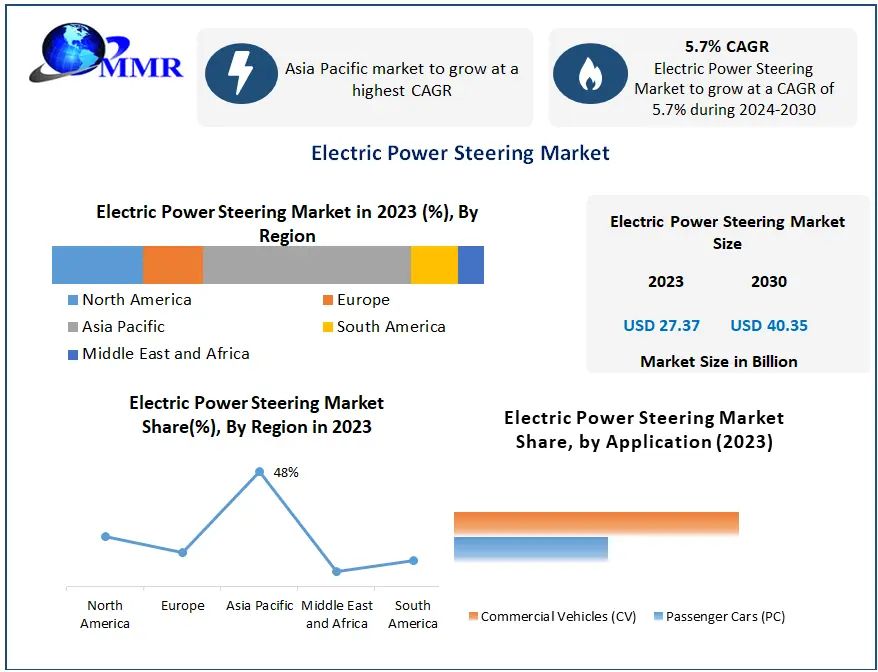
The global Electric Power Steering Market size was valued at USD 27.37 billion in 2023 and is projected to expand to USD 40.35 billion by 2030.
The industrial sector maintains a steady growth timeline, advancing at a compounded annual growth rate (CAGR) of 5.7% from 2024 to 2030.
The rack assist type (REPS) steering system held the maximum market share in 2023, managing heavy front-axle loads inside large trucks and sport utility vehicles.
The commercial vehicle segment is expected to rise at the fastest rate over the forecast matrix, outpacing legacy manual and hydraulic frameworks.
The Asia-Pacific region dominated the global marketplace with a commanding 48% share in 2023, anchored by localized industrial expansions in China and India.
Why This Matters Now
Automotive OEMs, Tier-1 system providers, and autonomous mobility strategists must instantly upgrade their steering component portfolios as strict international fuel efficiency parameters render legacy hydraulic pumps obsolete. Traditional hydraulic systems place a continuous parasitic drag on the vehicle’s engine, whereas electric architectures draw power only when actively requested by driver input. Component manufacturers that delay transitioning production lines to highly responsive, digitally managed steering configurations face immediate exclusion from upcoming electric vehicle platforms. With the global marketplace scaling systematically toward a USD 40.35 billion valuation by 2030, long-term procurement victories belong exclusively to vendors who can deliver high-level redundant control units capable of supporting SAE Level 4 autonomy.
Market Overview
The global electric power steering market comprises the specialized manufacturing, electronic control engineering, and precision assembly of steering columns that utilize electric motors to regulate and support vehicle directional changes. These advanced control arrays eliminate the need for traditional hydraulic pumps, fluid hoses, drive belts, and pulleys, which fundamentally decreases total vehicle weight and streamlines engine packaging space. The technology serves as a critical bridge for autonomous safety, enabling software-driven advanced driver assist systems (ADAS) to perform lane-keep maneuvers and automated emergency steering without human physical intervention. As global middle-class populations expand and vehicle ownership intensifies, this software-controlled configuration is shifting from premium luxury tiers into high-volume global passenger vehicle baselines.
Key Trends Driving Growth
Accelerating global populations and rising purchasing power across major developing economies are generating consistent consumer demand for both luxury and non-premium passenger vehicles. To capture this expanding volume, automotive manufacturers are leveraging electric steering configurations to optimize cabin packaging space while providing a satisfying, responsive driving experience. The removal of heavy fluid networks allows engineers to lighten front-axle assemblies, which directly aids compliance with strict regional fuel-economy benchmarks.
Simultaneously, government efforts to enforce strict vehicle efficiency targets are acting as major catalysts for the industry. Rigid regulatory directives—such as the Safer Affordable Fuel-Efficient (SAFE) Vehicles Rule introduced by the National Highway Traffic Safety Administration (NHTSA) and the Environmental Protection Agency (EPA)—require automakers to systematically eliminate mechanical power drains. Because EPS platforms draw current only during active steering adjustments, their deployment delivers an immediate boost to vehicle fuel efficiency, forcing rapid adoption across all major production classes.
Segment Insights
Rack Assist Type (REPS) [Dominant Segment]: This specialized mechanism captured the maximum market share in 2023. Engineered to withstand heavy front-axle loading profiles while optimizing packaging space, REPS architectures serve as the primary steering solution for mid-sized trucks, full-size transport platforms, and premium sport utility vehicles.
Commercial Vehicles [Fastest-Growing Segment]: Driven by intense corporate logistics expansions and fleet modernizations, the commercial vehicle application segment is projected to grow at the highest velocity. Freight managers are rapidly retiring legacy mechanical steering networks to lower long-term maintenance overhead and reduce driver fatigue during long-haul transit cycles.
Regional Growth Story
The Asia-Pacific region commands the dominant position in the global electric power steering market landscape, controlling a powerful 48% market share in 2023. This regional leadership is supported by a highly developed automotive manufacturing core, booming domestic consumer purchasing patterns, and deep manufacturing investments across China and India. The rapid localized rollout of high-volume manufacturing facilities allows regional component suppliers to achieve exceptional economies of scale.
Concurrently, Western Europe, anchored by precision premium automotive networks in Germany, maintains an essential role in technology validation. High-end brands like Mercedes, Audi, and BMW are actively serving as primary deployment partners for early steer-by-wire adaptations, reinforcing European technology leadership. North America follows a parallel high-value development trajectory, driven by consumer demand for full-sized pickup trucks utilizing heavy-duty REPS setups and extensive tier-1 supplier investments across domestic automotive corridors.
Competitive Landscape
The competitive matrix of the global electric power steering market is characterized by a concentrated group of high-capacity technology providers who hold extensive electronic control and mechanical patents. Sourcing power belongs to suppliers who can successfully master real-time software adjustability, such as advanced Proportional-Integral-Derivative (PID) control methods that optimize steering stability and sensitivity across varying operational environments. Key players are aggressively competing via long-term, high-volume production contracts with major automotive groups, creating high entry barriers for newer component vendors. Niche software developers and independent electronic control unit (ECU) makers are adjusting by forming collaborative research partnerships with larger tier-1 suppliers to integrate redundant backup systems for upcoming semi-autonomous vehicle lines.
Recent Developments
Leading global industrial and automotive supplier Schaeffler has aggressively scaled up field testing for its advanced steer-by-wire “Space Drive” technology platform, deploying the system onto highly competitive DTM racing grids inside specialized Mercedes-AMG and BMW M6 GT3 vehicles to prove real-world durability.
High-tier tier-1 manufacturing specialists—including JTEKT Corporation, DENSO Corporation, and Mitsubishi Electric Corporation—continue to expand their electronic power steering assembly lines to fulfill high-volume electric vehicle contracts.
Advanced component developers—such as NSK Ltd., Hitachi Automotive Systems, and Renesas Electronics—have accelerated the integration of flexible PID control algorithms into their latest ECU modules to dramatically improve steering response speed.
European technology leaders, led by ZF Friedrichshafen AG, have expanded their domestic manufacturing footprint for collapsible steering columns, integrating advanced driver assist sensors directly into the base hardware structure.
Strategic Implications
For electronic control architects and Tier-1 automotive integrators, the widespread implementation of automated driving modes requires an immediate engineering shift toward dual-redundant safety setups. Hardware configurations must contain auxiliary microcontrollers and backup power routes to ensure full steering control remains functional up to SAE Level 4 autonomy in the event of a primary electrical failure.
Furthermore, to insulate production capacity from ongoing semiconductor supply shortages and volatile raw material pricing, steering manufacturers must build highly diversified regional supply channels. Suppliers must also align their engineering programs with the rapid transition toward collapsible steering architectures. Creating modular, energy-absorbing column setups that mesh perfectly with modern ADAS frameworks will allow component providers to secure next-generation platform placements with volume-focused passenger vehicle OEMs.
Future Outlook
The ultimate line of separation in the global automotive component landscape will isolate advanced electronic power electronic innovators who master seamless steer-by-wire software integrations from legacy mechanical hardware suppliers stuck producing unnetworked, fluid-dependent steering components.
Analyst Perspective
“The global electric power steering market is undergoing a structural evolution where basic mechanical driver assistance is transforming into a fully digital, highly intelligent vehicle control node,” says Dharati Raut, Research Analyst at Maximize Market Research. “As steer-by-wire technology moves from the racetrack to commercial passenger lines, the ability to deliver real-time PID tuning and absolute electrical redundancy will dictate which tier-1 suppliers command the future of autonomous mobility.”
About Maximize Market Research
Maximize Market Research Pvt. Ltd. (MMR) is a global market research and consulting company that provides reliable, data-focused, and practical business insights. The firm serves a wide range of industries, including healthcare, pharmaceuticals, technology, automotive, electronics, chemicals, personal care, and consumer goods. Through market forecasts, competitive analysis, strategic consulting, and industry impact assessments, MMR helps organizations understand changing market conditions, identify growth opportunities, and make informed business decisions for long-term success.
2nd Floor, Navale IT Park Phase 3
Pune Banglore Highway, Narhe
Pune, Maharashtra 411041, India
+91 9607365656
sales@maximizemarketresearch.com
