Key Highlights
The Brazil automotive market maintains its structural position as the eighth largest vehicular production and sales arena in the world.
The regulatory environment transitioned away from the expired Innovar program to the active Rota 2030 directive, targeting localized powertrain innovation.
Passenger vehicle sales proved resilient during established baseline baselines, recording registrations just under 2.5 million units in a single annual cycle.
Heavy structural shifts altered the competitive field, highlighted by the strategic complete manufacturing exit of Ford Motor Co. across regional facilities.
Regional trade flows indicate integrated Latin American volume adjustments, with light vehicle output trends directly linked with cross-border assembly chains in Argentina.
Why This Matters Now
Global automotive executives, Tier-1 material suppliers, and mobility investors must instantly adjust their industrial footprints in South America as regional regulatory mandates rewrite the terms of localized market access. The historical reliance on traditional combustion engineering is giving way to localized electrification goals enforced by the strict Rota 2030 framework, which rewards energy-efficient component integration. Component suppliers that delay modifying their manufacturing tools to match the specialized tooling shifts required by remaining volume brands face rapid exclusion from future global platforms. The structural transformation of this major emerging economy creates a narrow competitive window where manufacturing footprint optimization, idle capacity control, and regulatory alignment dictate survival.
Market Overview
The Brazil automotive market comprises the heavy manufacturing, localized assembly, tool casting, and cross-border distribution of passenger cars and commercial vehicles. These industrial operations function as the primary economic foundation for the broader Latin American transportation space, directly managing trade lines that move vehicle components through deep regional supply networks. The market features a standard classification split between passenger platforms and heavy commercial transport units, both operating under rigid regional safety and efficiency rules. As corporate managers address persistent manufacturing space variations, the regional ecosystem is moving away from high-volume domestic saturation strategies toward highly targeted platform exports.
Key Trends Driving Growth
The formal introduction of the new state regulatory order known as Rota 2030 acts as the primary engine for advanced vehicle design transformations across the nation. Following the expiration of the legacy Innovar program, this comprehensive industrial policy was specially meant to drive the industry to accelerate its growth in the production of hybrid and electric vehicles. To capture the fiscal benefits built into this framework, remaining automakers must systematically optimize internal combustion efficiency and invest heavily in localized alternative propulsion architectures. This corporate policy adjustment ensures a steady, mandatory flow of engineering capital into modern electronic controls and advanced valvetrain modules.
Concurrently, systemic manufacturing adjustments and the necessity to absorb persistent idle capacity act as a major catalyst for corporate realignment. Regional assembly operations frequently deal with sudden volume drops and changing domestic registration rates, forcing factory managers to consolidate production lines onto fewer, highly flexible global vehicle platforms. By shifting focus toward multi-energy architectures that can seamlessly integrate traditional biofuels with emerging electric powertrains, local subsidiaries are building operational resilience against shifting consumer purchasing patterns.
Segment Insights
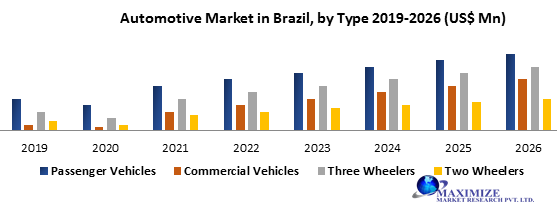
Passenger Vehicles [Dominant Segment]: This classification commands the absolute majority of global market volume inside the country, historically recording transactions just under 2.5 million units during high-growth cycles to anchor local component manufacturing plants.
Commercial Vehicles [Critical Logistics Hub]: Within the broad distribution setup, commercial truck and utility platforms represent a vital, highly integrated segment that coordinates cargo trade links connecting Brazil and Argentina.
Hybrid & Electric Systems [Fastest-Growing Trend]: Driven directly by the proactive guidelines built into the Rota 2030 mandate, electrified alternative-fuel platforms represent the fastest-increasing engineering focus across local R&D hubs.
Regional Growth Story
The domestic manufacturing landscape centers heavily around established industrial clusters that supply light vehicles across the broader Latin American trade bloc. The volume trajectory of local assembly plants remains closely bound to synchronized demand patterns in neighboring Argentina, ensuring that shifting international trade relations immediately affect factory shift schedules. During structural corrections, integrated volume output across Latin America can contract by hundreds of thousands of units, requiring corporate offices to aggressively manage regional capacity distribution.
Concurrently, international manufacturing centers—including the United States, Germany, China, Japan, South Korea, and India—serve as the primary benchmarks for local technology validation. Local planners are studying the rapid EV adoption rates and advanced component sourcing strategies deployed in these leading hubs to shape domestic supply lines. The primary goal remains the deployment of advanced global platforms inside localized facilities without incurring excessive capital setup costs.
Competitive Landscape
The competitive matrix of the Brazil automotive market is undergoing a profound structural rebalancing, characterized by intense platform consolidation and high-profile retreats by legacy multi-national icons. Sourcing power belongs exclusively to remaining volume producers who can navigate complex local manufacturing regulations while sustaining aggressive cost efficiency goals. The departure of Ford Motor Co., which brought its more than 100-year history in the nation to a close, underscores the severe financial penalties imposed on brands that fail to control persistent idle capacity and adjust to volatile local currency variations. Consequently, remaining industry participants—including Volkswagen, Fiat, Toyota, Nissan, and BYD—are aggressively competing to absorb displaced market share by expanding their localized component lines and securing multi-year distribution deals.
Recent Developments
Ford Motor Co. executed a complete withdrawal from local assembly operations, closing all its plants in Brazil due to persistent idle capacity, high structural losses, and shifts in global currency values.
Emerging electric mobility pioneer BYD expanded its localized presence, introducing advanced alternative powertrain options to align with state electrification targets.
Top-tier manufacturing giants—including Volkswagen, Toyota, Nissan, and Fiat—restructured their assembly layouts to support the transition from the legacy Innovar program to the active Rota 2030 framework.
Major industrial heavy vehicle providers—such as MAN SE, Mercedes-Benz, and Mitsubishi—optimized their commercial truck operations to absorb changing demand dynamics across Latin American shipping lines.
Global brand managers—including Renault, Honda, Hyundai, Kia, and Volvo—broadened their localized engineering spending to incorporate flexible alternative-fuel systems into volume platforms.
Strategic Implications
For industrial design engineers and Tier-1 component providers, the strict transition toward the Rota 2030 framework requires an immediate operational focus on hybrid vehicle component optimization. Developing lightweight engine parts and modular electronic setups that fit within multi-energy platforms allows suppliers to offer immediate compliance advantages to remaining volume OEMs.
Furthermore, to hedge against high manufacturing space volatility and sudden shifts in regional trade flows, component fabricators must focus on flexible production configurations that can shift output easily between domestic lines and export orders. Suppliers must also align their development tracks with the specialized needs of remaining global brands, modifying automated quality arrays to easily certify components under the strict energy efficiency metrics enforced by domestic trade authorities.
Future Outlook
The ultimate line of separation in the South American transportation sector will isolate forward-thinking manufacturing conglomerates who successfully master flexible hybrid platform localization under Rota 2030 mandates from legacy brand managers unable to reduce persistent idle capacity across under-utilized regional facilities.
Analyst Perspective
“The Brazil automotive market is navigating a complex structural transition where historic manufacturing traditions are colliding directly with the modern demands of global platform consolidation,” states Dharati Raut, Research Analyst at Maximize Market Research. “As the regulatory framework shifts permanently toward alternative propulsion targets under the Rota 2030 mandate, the engineering capability to reduce factory idle capacity and deliver localized hybrid systems will determine which automakers sustain long-term relevance.“
About Maximize Market Research
Maximize Market Research Pvt. Ltd. (MMR) is a global market research and consulting company that provides reliable, data-focused, and practical business insights. The firm serves a wide range of industries, including healthcare, pharmaceuticals, technology, automotive, electronics, chemicals, personal care, and consumer goods. Through market forecasts, competitive analysis, strategic consulting, and industry impact assessments, MMR helps organizations understand changing market conditions, identify growth opportunities, and make informed business decisions for long-term success.
2nd Floor, Navale IT Park Phase 3
Pune Banglore Highway, Narhe
Pune, Maharashtra 411041, India
+91 9607365656
sales@maximizemarketresearch.com
