Key Highlights
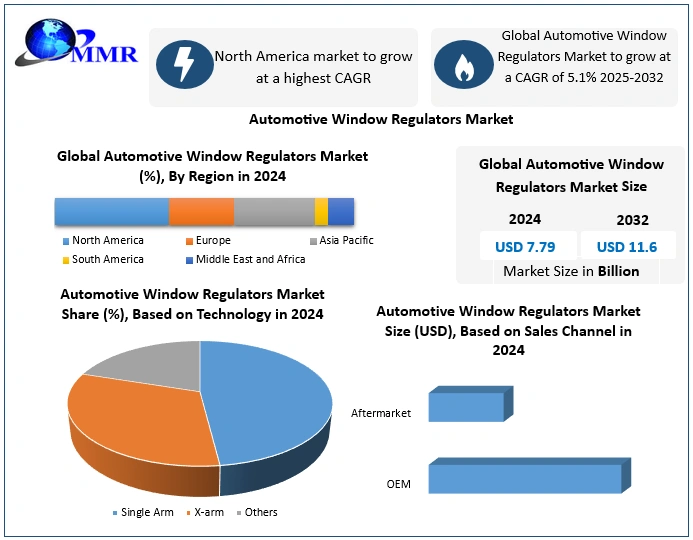
The global automotive window regulators market was valued at USD 7.79 billion in 2024 and is projected to reach USD 11.6 billion by 2032, expanding at a compound annual growth rate (CAGR) of 5.1%.
Electric vehicle (EV) lightweighting initiatives are driving a systemic transition from heavy steel single-arm regulators to advanced plastic and hybrid cable-type mechanisms.
The Original Equipment Manufacturer (OEM) sales channel remains the dominant market force, underpinned by long-term production contracts and assembly line integration.
North America continues to hold the dominant regional position, while the Asia-Pacific region represents a high-growth hub fueled by rising vehicle sales and local manufacturing capacity.
Integrated smart technologies, including anti-pinch sensors and child-lock automation, are shifting consumer demand from basic mechanical operators to intelligent cabin access systems.
Why This Matters Now
The automotive cockpit is undergoing its most radical redesign in a century, turning simple mechanical closures into sophisticated structural and electronic interfaces. For original equipment manufacturers (OEMs) and Tier-1 suppliers, the window regulator is no longer just a commodity hardware piece but a crucial target for weight savings and intelligent software integration. As automotive players spend billions to squeeze out every possible kilometer of range from high-voltage battery packs, reducing the mass of internal door hardware has emerged as a low-hanging fruit.
At the same time, the rise of software-defined vehicles (SDVs) is pushing mechanical window regulators to become fully integrated nodes within the vehicle’s electronic architecture. Centralized locking, over-the-air (OTA) updates, smart climate sync, and automated obstacle detection demand a new breed of power regulators equipped with digital control units. Failing to adapt to this mechatronic transition means facing commoditization, while companies that successfully combine lightweight physical components with advanced electronic controls stand to capture premium margins on upcoming vehicle platforms.
Market Overview
Valued at USD 7.79 billion in 2024, the global Automotive window regulators market is on a steady upward trajectory, forecasted to reach USD 11.6 billion by 2032 at a CAGR of 5.1%. This growth is directly linked to global automotive assembly rates and the rising penetration of power windows across light and heavy commercial vehicle fleets. The transition from manual crank systems to electric and automatic window operators has completed its sweep of premium segments and is now standardizing across entry-level models in emerging economies.
As shown in the technical diagram above, a standard geared-arm window regulator relies on a compact window motor, gear drive, and geared arm to lift and lower the glass-holding bracket. This mechanical assembly must deliver high torque while maintaining structural integrity within the cramped inner cavity of the vehicle door. The continuous demand for lower cabin noise and vibration has forced suppliers to refine these mechanisms, leading to tighter tolerances and more durable materials.
Key Trends Driving Growth
Weight reduction remains the most critical engineering challenge of the modern electric vehicle era. Every gram saved in the door structural module directly translates into reduced battery load, allowing automakers to either extend driving range or reduce the size and cost of the battery pack itself. Traditional single-arm window regulators, while incredibly reliable, have historically relied on heavy steel stampings that add unnecessary mass to the vehicle frame. Consequently, Tier-1 suppliers are re-engineering these assemblies to use carbon-fiber-reinforced plastics and high-strength hybrid materials to achieve weight savings of up to 30% without sacrificing rigidity.
Beyond weight, the market is heavily influenced by the rise of active passenger safety regulations and automated vehicle ingress/egress. Modern safety standards require vehicles to feature highly responsive anti-pinch systems that stop and reverse window travel instantly upon detecting an obstruction. This has transformed the simple electric window motor into an intelligent mechatronic unit featuring integrated hall sensors and microcontrollers. These systems must communicate seamlessly with the vehicle’s central electronic architecture, linking window control to safety features like crash-detection unlocking and automatic emergency ventilation.
Segment Insights
To understand how the market is shifting under these technological forces, we must look at how specific segments are performing:
Vehicle Type: Passenger Cars remain the dominant vehicle segment due to sheer global production volume and the rapid standard adoption of four-door power window setups. Light Commercial Vehicles (LCVs) represent the fastest-growing segment, propelled by the electrification of urban delivery fleets and a focus on driver comfort features.
Technology: The single arm segment is the Dominant Segment by technology, continuing its steady growth due to its established reliability and easy installation. Meanwhile, other modern mechatronic designs represent the Fastest-Growing Segment, driven by their superior spatial efficiency inside thin-profile door structures.
Sales Channel: The OEM segment is the Dominant Segment, capturing the vast majority of the market through direct assembly line integration and long-term supply contracts. The Aftermarket segment acts as the Fastest-Growing Segment in secondary markets, sustained by the rising average age of the global vehicle fleet and replacement demands.
Material: Metal is the Dominant Segment owing to its structural integrity, while Plastic and Hybrid materials are the Fastest-Growing Segment as manufacturers seek aggressive lightweighting.
Mechanism: Cable-Type Window Regulators represent the Dominant Segment due to their light footprint and flexible routing capabilities within the door panel. Scissor-Type mechanisms remain the Fastest-Growing Segment in specialized vehicle categories where maximum mechanical lift force is required.
Regional Growth Story
North America held the dominant market position in 2024 and is projected to maintain this leadership through 2032. The regional market is characterized by high consumer demand for premium sports utility vehicles (SUVs) and full-size pickup trucks, both of which utilize complex, heavy-duty window regulator assemblies. High safety standards and rapid electric vehicle development in the United States and Canada have pushed local suppliers to adopt smart, sensor-driven regulators much faster than in other regions.
Meanwhile, the Asia-Pacific region is emerging as the manufacturing powerhouse of this market, driven by expanding automotive production in China, India, and Japan. Rising disposable income across these developing economies has boosted vehicle sales, while localized supply chains allow manufacturers to produce components at highly competitive prices. In Europe, stringent passenger safety regulations and a massive push toward vehicle decarbonization are fueling the growth of advanced lightweight and smart hybrid regulator systems.
Competitive Landscape
The competitive environment is shifting from traditional mechanical fabrication to specialized electronics manufacturing. Companies like Brose Fahrzeugteile, Valeo, and Grupo Antolin are no longer competing solely on metal-stamping efficiency. Instead, they are positioning themselves as complete door module specialists, integrating the window regulator, latching systems, speakers, wiring harnesses, and control units into a single pre-assembled unit. This modular strategy allows OEMs to simplify their assembly lines, reducing production time and lowering overhead costs.
Furthermore, suppliers are expanding their manufacturing footprints closer to major EV production centers to offset logistics costs and protect against supply chain disruptions. Key players like Hi-Lex Corporation, Shiroki Corporation, and Shanghai SIIC Transportation Electric are investing heavily in automated production processes. This shift highlights a broader market theme: the future belongs to suppliers who can produce high-precision mechatronic components at scale, while keeping material costs and carbon emissions low.
Recent Developments
Tier-1 manufacturers are partnering with sensor specialists to incorporate high-sensitivity anti-pinch technology directly into the window regulator’s brush or brushless DC motor assembly.
The industry is seeing a shift toward plastic-intensive hybrid window regulators that utilize fiberglass and polyamides to cut component weight by up to 35% compared to steel.
Major players have introduced integrated door modules that combine the window regulator with side-impact structural members, optimizing both interior door space and crash safety.
Leading brands are restructuring their manufacturing lines to run on renewable energy, helping vehicle manufacturers meet strict scope 3 emission goals.
Strategic Implications
For automotive OEMs, the window regulator is transition ground for vehicle interior optimization. Thinner, more compact window regulator designs allow designers to carve out more cabin space or pack in more acoustic insulation and side-impact safety structures. Automakers must work closely with Tier-1 suppliers early in the vehicle development cycle to co-design door modules that balance lightweighting targets with structural safety requirements.
For suppliers, the rise of the software-defined vehicle means software capabilities are becoming a key differentiator. A window regulator is no longer a silent mechanical component; it must interact with vehicle-wide software architectures, supporting over-the-air updates for pinch detection and diagnostics. Suppliers that invest in internal software and sensor capabilities will capture high-margin contracts, while those stuck in traditional metal fabrication will face intense pricing pressure.
Future Outlook
Looking forward, the global automotive window regulators market will continue to reflect broader changes in vehicle design and power systems. The move toward autonomous vehicles, shared mobility models, and luxury electric vehicles will require highly durable window mechanisms capable of surviving intense, high-frequency use cycles. Innovations in sound damping and smart glass integration will also demand regulators that operate almost silently, blending seamlessly into quiet EV cabins.
Ultimately, the market will separate into two distinct groups of players. Those who treat window regulators as simple mechanical hardware will face shrinking margins, while those who transform them into smart, lightweight, and software-connected door systems will lead the next generation of automotive design.
Analyst Perspective
“The humble window regulator has evolved from a basic mechanical lever into a highly sophisticated, weight-critical mechatronic node,” says Tejaswini Kakade, Lead Analyst at Maximize Market Research.
About Maximize Market Research
Maximize Market Research Pvt. Ltd. (MMR) is a global market research and consulting company that provides reliable, data-focused, and practical business insights. The firm serves a wide range of industries, including healthcare, pharmaceuticals, technology, automotive, electronics, chemicals, personal care, and consumer goods. Through market forecasts, competitive analysis, strategic consulting, and industry impact assessments, MMR helps organizations understand changing market conditions, identify growth opportunities, and make informed business decisions for long-term success.
2nd Floor, Navale IT Park Phase 3
Pune Banglore Highway, Narhe
Pune, Maharashtra 411041, India
+91 9607365656
sales@maximizemarketresearch.com
