Key Highlights
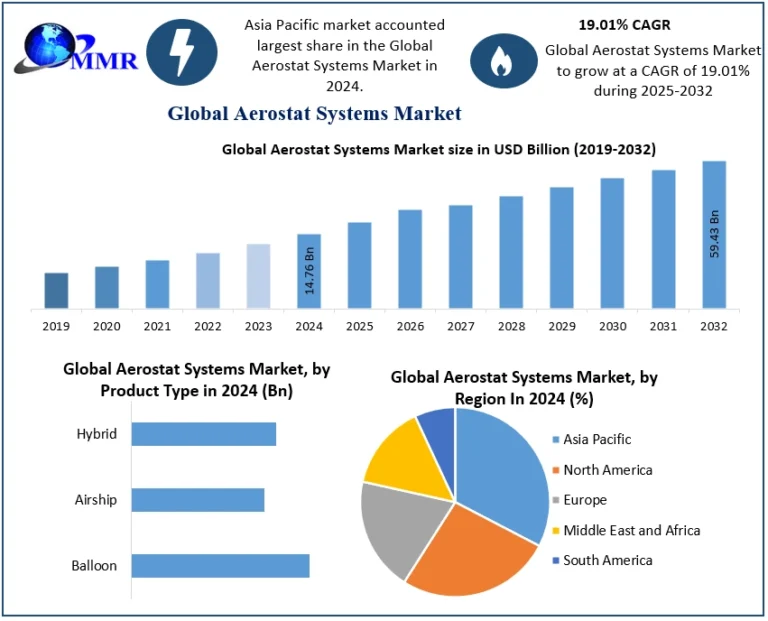
- Global market valued at USD 14.76 billion in 2024.
- Market projected to reach USD 59.43 billion by 2032.
- CAGR estimated at 19.01% during 2025–2032.
- Asia Pacific remains the largest regional market.
- Airships dominate product demand because of higher payload capacity and operational endurance.
- Military surveillance remains the largest application area.
- Border security modernization continues to drive procurement.
- Advanced sensor integration is expanding operational capabilities.
- Government investments remain the primary source of market demand.
- High acquisition costs and regulatory approvals continue to limit commercial adoption.
Why This Matters Now
Governments are increasing spending on persistent surveillance as geopolitical tensions, border disputes, and asymmetric security threats intensify. Conventional surveillance aircraft face higher operating costs and shorter mission endurance, creating demand for aerostat systems capable of continuous monitoring. At the same time, advances in lightweight materials, helium retention technologies, and multi-sensor payload integration are making aerostats more reliable and cost-effective. For manufacturers, this creates long-term opportunities in defense modernization, communications infrastructure, and intelligence operations.
Market Overview
The Aerostat Systems Market covers tethered balloons, powered airships, and hybrid lighter-than-air platforms used for surveillance, communication relay, border monitoring, disaster management, and military intelligence. Unlike conventional aircraft, aerostats remain airborne for extended periods while consuming significantly less energy, making them attractive for persistent observation missions.
Demand is largely generated by defense organizations seeking affordable surveillance platforms capable of carrying electro-optical, infrared, radar, acoustic, and communication payloads. Rising military modernization programs, growing border security investments, and increasing intelligence requirements continue to strengthen procurement activity.
Supply-side growth is supported by innovations in hull materials that improve structural strength, environmental resistance, and helium retention. These improvements reduce maintenance costs while extending operational life, improving lifecycle economics for defense agencies.
However, procurement remains highly dependent on government budgets. Large capital investments, lengthy procurement cycles, and regulatory approvals continue to slow commercialization, particularly outside defense applications.
Key Trends Driving Growth
Next-Generation Airship Development
Manufacturers are developing larger airships capable of transporting cargo while simultaneously performing surveillance missions. This expands the commercial potential of aerostat technology beyond traditional military applications.
Multi-Sensor Intelligence Platforms
Modern aerostats increasingly integrate EO/IR cameras, radar systems, communication repeaters, and acoustic sensors into a single platform. This improves battlefield awareness while reducing the need for multiple surveillance assets.
Defense Modernization Programs
Governments continue investing in persistent intelligence capabilities to strengthen border surveillance, maritime security, and critical infrastructure protection. Aerostats offer longer operational endurance than many conventional airborne platforms.
Material Innovation
Improved envelope materials provide greater durability, lower helium leakage, and higher resistance to harsh environmental conditions. These advancements reduce operating costs while improving mission reliability.
Expanding Global Defense Cooperation
Defense partnerships across Europe, Asia, and the Middle East are increasing procurement opportunities for aerostat manufacturers as allied nations prioritize intelligence-sharing capabilities and integrated surveillance networks.
Explore detailed analysis, insights, and growth opportunities
Segment Insights
Dominant Segment: Airship
The Airship segment holds the largest market share throughout the forecast period.
Unlike tethered balloons, powered airships provide mobility while maintaining long-duration flight capability. They can transport heavier payloads, support multiple sensor packages, and maintain surveillance even during adverse weather conditions.
For defense organizations, this translates into greater operational flexibility, fewer mission interruptions, and improved intelligence collection. Manufacturers focusing on advanced airship technologies are therefore positioned to capture higher-value defense contracts.
Fastest-Growing Segment: Powered Propulsion Systems
Powered aerostat systems are expected to experience the fastest growth.
Powered platforms provide maneuverability, expanded mission coverage, and improved operational efficiency compared with passive systems. Military operators increasingly prefer powered airships for intelligence, surveillance, reconnaissance (ISR), and logistics support.
Growing investments in autonomous navigation and propulsion efficiency further strengthen demand.
Additional Key Segments
Balloon Systems
Tethered balloons continue serving fixed surveillance missions including border monitoring, military bases, and critical infrastructure protection. Their relatively low operating costs make them attractive for continuous observation.
Hybrid Aerostats
Hybrid platforms combine buoyant lift with aerodynamic performance, improving payload flexibility while expanding operational applications beyond traditional surveillance.
By Class
Large-sized aerostats continue attracting investment due to higher payload capacity and longer endurance, while compact systems gain adoption in tactical military operations requiring rapid deployment.
The growing diversity of operational requirements ensures demand across all platform categories rather than a single standardized solution.
Regional Growth Story
Asia Pacific
Asia Pacific remains the largest regional market.
Growing geopolitical tensions, expanding border security programs, and military modernization initiatives continue driving procurement across India, China, Japan, South Korea, and Southeast Asia.
India is expected to record the fastest regional growth as defense modernization programs accelerate investments in surveillance infrastructure and intelligence capabilities.
North America
North America maintains strong technological leadership through advanced aerospace manufacturers and extensive defense spending.
Continuous investments in surveillance modernization, homeland security, and advanced ISR capabilities support sustained demand for next-generation aerostat platforms.
Europe
European demand is supported by defense cooperation initiatives and growing investments in border monitoring and critical infrastructure protection.
Manufacturers increasingly focus on interoperable surveillance solutions capable of supporting multinational security operations.
Middle East & Africa
Regional demand continues expanding due to border security requirements, energy infrastructure protection, and increasing investment in defense surveillance systems.
Persistent monitoring capabilities remain particularly valuable across remote desert environments.
South America
Although relatively smaller, the market benefits from increasing requirements for border surveillance, anti-smuggling operations, and disaster response capabilities.
Government modernization programs could gradually expand procurement opportunities over the coming years.
Competitive Landscape
The Aerostat Systems Market remains highly specialized, with competition centered on engineering expertise, defense relationships, payload integration capabilities, and long-term government contracts rather than price alone.
Lockheed Martin Corporation, Raytheon Company, and Israel Aerospace Industries Ltd leverage established defense portfolios to secure large surveillance programs while integrating aerostats into broader intelligence ecosystems.
Specialized manufacturers including TCOM, L.P, ILC Dover, Hybrid Air Vehicles Limited, and Worldwide Aeros Corporation differentiate through lighter-than-air engineering, advanced envelope materials, and customized mission platforms.
Companies such as Raven Industries, Lindstrand Technologies Limited, Cameron Balloons, and Aerostar International focus on specialized surveillance and commercial applications, broadening the industry’s technology base.
As governments prioritize long-term surveillance capability over short-term procurement costs, vendors with integrated sensor ecosystems, proven operational reliability, and global defense partnerships are expected to strengthen competitive positioning.
Recent Developments
- Lockheed Martin introduced a large next-generation airship designed for high-altitude surveillance operations.
- Aeros International continued development of a heavy-lift cargo airship under a Pentagon-supported program capable of transporting approximately 66 tons.
- Defense organizations across Europe, Asia, and the Middle East expanded deployment of advanced aerostat surveillance platforms.
- Continued improvements in hull materials enhanced durability, environmental resistance, and helium retention, improving operational efficiency.
Future Outlook
Companies that combine advanced surveillance payload integration, durable lighter-than-air technologies, and long-term defense partnerships will capture the strongest opportunities as governments prioritize persistent intelligence capabilities despite high procurement costs.
Analyst Perspective – Rucha Deshpande
The Aerostat Systems Market is transitioning from a niche military surveillance segment into a strategic intelligence platform supporting border security, communications, and next-generation defense operations. Future market leadership will depend less on platform size and more on integrated sensor capabilities, autonomous operation, and lifecycle cost efficiency. Vendors that align with government modernization programs while investing in advanced materials and multi-mission functionality are likely to establish sustainable competitive advantages in the decade ahead.
About Maximize Market Research
Maximize Market Research Pvt. Ltd. (MMR) is a global market research and consulting company that provides reliable, data-focused, and practical business insights. The firm serves a wide range of industries, including healthcare, pharmaceuticals, technology, automotive, electronics, chemicals, personal care, and consumer goods. Through market forecasts, competitive analysis, strategic consulting, and industry impact assessments, MMR helps organizations understand changing market conditions, identify growth opportunities, and make informed business decisions for long-term success.
Contact Us :
2nd Floor, Navale IT Park Phase 3
Pune Banglore Highway, Narhe
Pune, Maharashtra 411041, India
+91 9607365656
sales@maximizemarketresearch.com
