Key Highlights
The differential lock market maintains a core industrial footprint across global passenger and heavy commercial automotive sectors.
Technical application shifts show rising integration of electronic locking frameworks over legacy mechanical locking structures.
Passenger vehicle and sports utility platforms stand as a primary volume driver for standard factory axle lines.
Heavy commercial transport networks generate continuous procurement streams for highly durable, high-torque differential designs.
Global manufacturing operations focus on reducing internal gear mass while maintaining structural load fatigue life under extreme conditions.
Why This Matters Now
Automotive OEMs, Tier-1 drivetrain specialists, and mobility strategists face immediate operational urgency as modern vehicle architectures undergo a fundamental redesign of traditional layout spaces. The historical reliance on loose, unmonitored mechanical axle locking is giving way to fast, integrated electronic traction matrices that react instantly to changing surface parameters. Component suppliers that delay modifying their automated gear cutting and tool casting arrays to match the compact dimensions required by modern multi-energy architectures face rapid commercial exclusion from next-generation sourcing platforms. The ongoing reconfiguration of global vehicle chassis creates a narrow competitive window where manufacturing layout flexibility, lightweight metallurgical engineering, and strict raw material inventory control dictate corporate margins.
Market Overview
The global differential lock market encompasses the precision engineering, chemical metal treating, structural gear casting, and automated assembly of traction control mechanisms. These critical drivetrain elements lock internal vehicle axles together to force identical wheel rotation speeds, ensuring absolute power delivery when singular wheels lose contact stability on soft or uneven surfaces. The product scope covers standard mechanical designs, automatic locking structures, and advanced electronic lockers managed by central vehicle diagnostic units. As vehicle weight reduction rules tighten across major economic hubs, these heavy metal components are moving from large, multi-piece configurations into unified, micro-lightweight hub architectures.
Key Trends Driving Growth
Accelerating multi-regional consumer spending on highly capable sports utility vehicles and premium crossover platforms acts as the primary engine for continuous hardware utilization. Millions of buyers select all-wheel-drive variations for daily transit and weekend travel, generating a steady, high-volume manufacturing baseline for volume automakers. This consistent behavioral pattern guarantees a long-term, predictable contract pipeline for tier-1 gear and axle manufacturing clusters worldwide.
Simultaneously, the widespread structural expansion of regional commercial freight infrastructure and heavy logistics networks acts as a core catalyst for technological variation. Freight fleets operate under severe payload metrics and volatile environmental constraints that accelerate the wear-and-tear cycles of standard open differential assemblies. Because integrated locking setups insulate primary drive pins from sudden shock loads and minimize tire slippage, their installation allows fleet operators to lower total maintenance downtime while satisfying rigid corporate vehicle utilization quotas.
Segment Insights
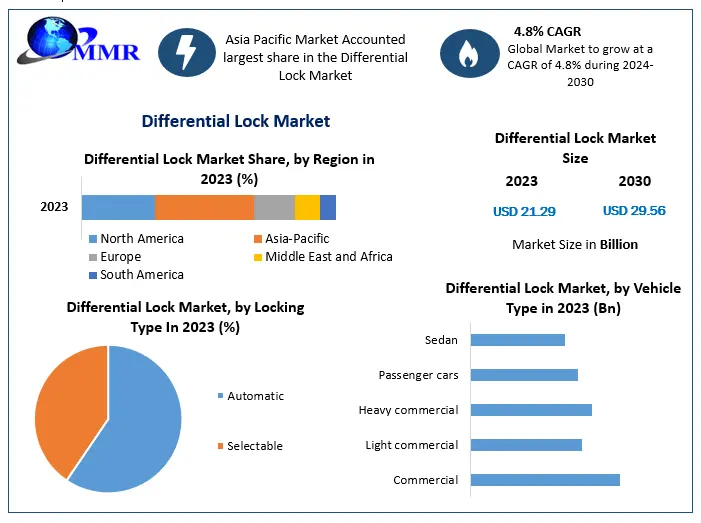
Passenger Vehicles [Dominant Segment]: This vehicular application classification commands a substantial share of global contract volume, supported directly by mass-market vehicle assembly metrics across major international automotive production hubs.
Electronic Locking Systems [Fastest-Growing Trend]: Driven directly by the rapid integration of advanced driver assistance systems (ADAS) and digital traction logic, software-controlled electronic locking configurations represent the fastest-increasing engineering focus across localized R&D matrices.
Commercial Vehicles [Critical Logistics Segment]: Within the broad distribution network, heavy multi-axle freight carriers and off-highway construction platforms require high-torque differential blocks, ensuring high-margin specialty orders for material fabricators.
Regional Growth Story
The global manufacturing footprint relies heavily on integrated automotive production networks across established industrial clusters to satisfy volatile regional component demand. International manufacturing hubs—including the United States, Germany, China, Japan, South Korea, and India—serve as the primary benchmarks for component technology validation and high-volume driveline sourcing. Local engineering centers analyze vehicle assembly rates and supply chain bottlenecks inside these primary zones to calibrate localized casting setups and manage capital tooling layouts.
Concurrently, Western European operations maintain highly focused procurement patterns centered on premium luxury platforms requiring high levels of electronic sub-system integration. The regional presence of major vehicle platforms allows domestic tier-1 suppliers to protect pricing power by delivering specialized, zero-defect traction systems that satisfy tough regional safety certifications. Meanwhile, expanding infrastructure investment paths across the Asia-Pacific territory are boosting volume calls for heavy commercial differential assemblies.
Competitive Landscape
The competitive matrix of the global differential lock market is highly dynamic, characterized by a concentrated core of multi-billion-dollar tier-1 driveline developers possessing deep patent protections and extensive gear testing infrastructure. Sourcing power belongs exclusively to component manufacturers who can deliver high-strength, low-weight gear clusters that reduce total vehicle unsprung mass without sacrificing component longevity. Dominant market participants protect their market share by securing direct factory platform supply contracts with volume automotive groups while running synchronized global replacement networks. Smaller regional machine shops and independent gear molders face intense margin pressure due to volatile raw metal costs, forcing them to target custom motorsport niches or specialized agriculture equipment lines to avoid direct price conflicts with volume leaders.
Recent Developments
Drivetrain engineering specialists continue to expand their premium metallurgy centers, focusing on low-friction surface coatings to optimize gear meshing behavior under extreme thermal stress.
High-tier component providers have scaled up their automated forging lines to achieve absolute geometric uniformity across high-volume differential pin orders.
Tier-1 suppliers have systematically shortened their system design timelines, deploying advanced computer modeling to shrink housing dimensions and lower total raw metal consumption.
Global logistics matrices have adjusted to support direct, just-in-time component deliveries from highly automated gear plants to primary vehicle assembly facilities across Europe and North America.
Strategic Implications
For industrial design engineers and Tier-1 component providers, the clear industry movement toward vehicle electronics requires an immediate operational focus on digital integration. Moving away from independent mechanical locking systems allows suppliers to offer immediate weight-reduction and automated traction management benefits to volume-conscious automotive OEMs who must defend tight vehicle efficiency baselines.
Furthermore, to hedge against shifting raw metal access and volatile international steel pricing, component fabricators must focus on flexible automated production blocks that can change output styles without heavy retooling costs. Suppliers must also align their development tracks with upcoming multi-energy platform timelines, ensuring that automated verification cells are configured to check differential lock performance metrics under the instant torque profiles characteristic of modern hybrid configurations.
Future Outlook
The ultimate line of separation in the global drivetrain sector will isolate advanced traction intelligence innovators who master lightweight, digitally integrated electronic locking differentials from legacy metal foundries stuck stamping heavy, unnetworked mechanical gear blocks.
Analyst Perspective
“The global differential lock market is navigating a complex structural transition where core mechanical toughness must align perfectly with real-time electronic control logic,” states Dharati Raut, Research Analyst at Maximize Market Research. “As multi-energy passenger platforms and heavy commercial vehicle networks demand higher traction efficiency, the engineering ability to deliver compact designs and rapid electronic actuation will determine which tier-1 suppliers secure future platform contracts.”
About Maximize Market Research
Maximize Market Research Pvt. Ltd. (MMR) is a global market research and consulting company that provides reliable, data-focused, and practical business insights. The firm serves a wide range of industries, including healthcare, pharmaceuticals, technology, automotive, electronics, chemicals, personal care, and consumer goods. Through market forecasts, competitive analysis, strategic consulting, and industry impact assessments, MMR helps organizations understand changing market conditions, identify growth opportunities, and make informed business decisions for long-term success.
2nd Floor, Navale IT Park Phase 3
Pune Banglore Highway, Narhe
Pune, Maharashtra 411041, India
+91 9607365656
sales@maximizemarketresearch.com
