Key Highlights
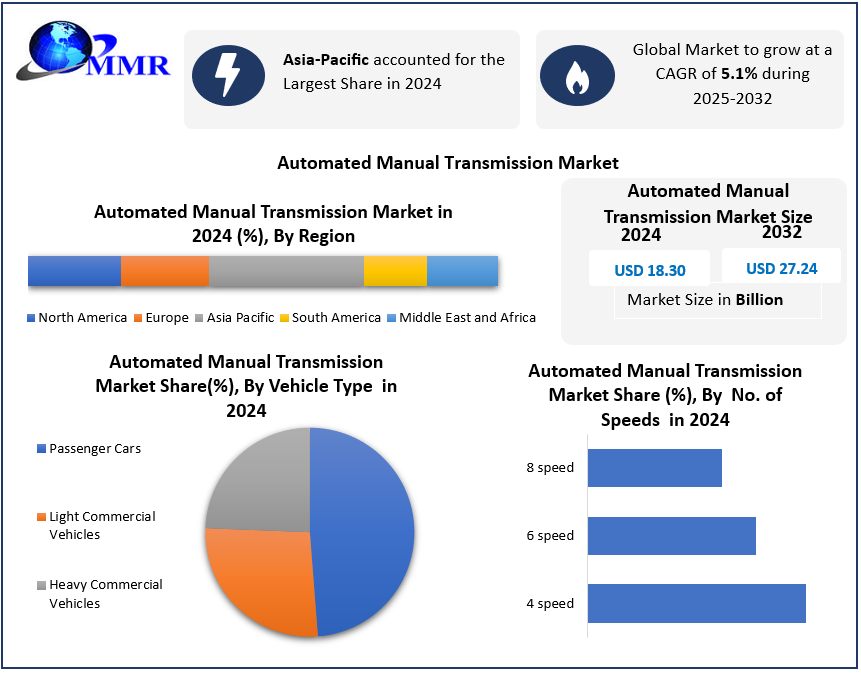
The global Automated Manual Transmission (AMT) market size achieved a baseline valuation of USD 18.30 billion in 2024 and is projected to expand to USD 27.24 billion by 2032.
The processing sector maintains a highly resilient growth velocity, advancing at a compounded annual growth rate (CAGR) of 5.1% throughout the forecast timeline spanning 2025 to 2032.
Mid-range and low-end passenger cars represent the dominant vehicle application segment due to aggressive pricing parameters and critical urbanization limits.
Hybrid vehicle integration emerges as the fastest-growing technology trend, optimizing energy distribution across multi-source propulsion systems.
The Asia-Pacific region holds the highest geographic market footprint, driven by massive cost-effective vehicle production clusters across China, India, and Japan.
Why This Matters Now
Automotive OEMs, Tier-1 transmission specialists, and fleet operations managers face immediate procurement urgency as expanding metropolitan centers exacerbate peak-hour gridlock, crushing driver retention and increasing fuel waste. Traditional manual layouts impose high physical stress during continuous stop-and-go driving, forcing automakers to rapidly deploy affordable automated shifting platforms to secure mass-market buyers. Component fabricators that delay upgrading automated clutch assembly setups from sluggish hydraulic setups toward rapid electronic actuators face rapid commercial exclusion by volume vehicle brands. With the global marketplace expanding toward a USD 27.24 billion valuation by 2032, long-term sourcing victories belong to organizations that improve driver comfort while maintaining mechanical fuel economy advantages.
Market Overview
The global automated manual transmission (AMT) market encompasses the structural engineering, software mapping, actuator casting, and electronic optimization of vehicle gearboxes that automate gear changes without a manual clutch pedal. These systems utilize electronic control units (ECUs) and high-speed actuators to manage the regular manual gearbox internals, delivering the ease of a conventional automatic at a fraction of the manufacturing cost. The application matrix covers entry-level passenger cars, city transit buses, and heavy-duty logistics truck platforms operating under tight margin limits. As the international automotive supply chain adapts, these gearboxes are evolving into active electronic nodes capable of intelligent shift forecasting through advanced internal algorithms.
Key Trends Driving Growth
Accelerating vehicle assembly numbers in price-sensitive emerging markets acts as the primary engine for high-volume AMT platform consumption. Severe city traffic gridlock requires the integration of automatic options containing specialized features like “creep mode,” which permits hands-free low-speed vehicle creeping during rush hour. Because AMT gearboxes balance automatic convenience with lower upfront manufacturing costs and superior power transmission over torque-converter setups, they remain highly popular in mid-range automotive platforms.
Simultaneously, the strategic transition toward vehicle electrification and hybridization acts as a major catalyst for structural variation. Automotive designers are embedding customized AMT layouts into modern hybrid cars to smoothly blend internal combustion torque with immediate electric motor power. This multi-energy drivetrain integration protects component suppliers from sudden regulatory bans on standalone fossil-fuel engines while opening new avenues in low-emission shipping fleets.
Segment Insights
Mid-Range and Low-End Vehicles [Dominant Segment]: This vehicle classification holds the absolute majority of global market volume, driven by consumers who demand two-pedal driving convenience without paying the price premium attached to complex torque-converter or continuous variable transmissions.
Hybridization Integration [Fastest-Growing Trend]: Driven by strict state emission ceilings, alternative hybrid transmission setups represent the fastest-increasing technology focus, leveraging specialized software code to control power handoffs between electric and thermal energy units.
Actuator & Electronic Controls [High-Value Component Node]: High-speed electronic shift actuators and control units form a critical component tier, directly deciding overall vehicle shift smoothness and eliminating legacy gear change delays.
Regional Growth Story
The Asia-Pacific region commands the dominant position in the global automated manual transmission market landscape, holding the highest geographic market footprint and tracking to lead volume metrics through 2032. This market concentration is supported by massive manufacturing clusters producing cost-effective compact cars across India, China, and Japan, where local government industrial support lowers factory export hurdles. The dense population distribution and severe traffic congestion characteristic of major Asian metropolises create a continuous domestic demand pipeline for automated vehicle options.
Concurrently, North America maintains highly focused procurement patterns centered on commercial trucking applications, where heavy component operators like Eaton and Allison Transmission deliver heavy-duty automated systems. Europe follows a parallel high-value trajectory, serving as a primary innovation zone for premium software refinement and advanced automated valvetrain testing led by groups like ZF Friedrichshafen and Schaeffler.
Competitive Landscape
The competitive matrix of the global automated manual transmission market is highly dynamic and increasingly shaped by advanced electronic actuation engineering and custom gear-mapping software. Sourcing power belongs to component manufacturers who can deliver high-smoothness gear shift loops that eliminate the “shift shock” typically associated with older mechanical setups. Top-tier manufacturing giants protect their market moats by locking down exclusive long-term supply integration deals with major passenger vehicle groups while funding automated production expansions to lower piece-rate pricing. Smaller independent machine houses and regional gearbox molders face intense margin competition, forcing them to focus on custom commercial tractor variants or local aftersales repair partnerships to survive direct competition with global volume leaders.
Recent Developments
Global drivetrain innovators—including ZF Friedrichshafen AG, Schaeffler AG, and Eaton Corporation—continue to expand their automated portfolios, refining electro-mechanical actuators to achieve smooth shift quality.
High-tier Asian transmission specialists—such as Aisin Corporation and JATCO Ltd—have scaled up their automated lines to satisfy rising demand for fuel-efficient sub-compact passenger cars.
Major vehicle builders like Maruti Suzuki India Ltd. have systematically expanded their domestic AMT model lineups, locking in high-volume production schedules to meet urban demand spikes.
Technology companies like Ricardo have advanced their software control testing, deploying predictive algorithms that adjust shift schedules based on real-time traffic telematics.
Strategic Implications
For transmission development teams and Tier-1 component providers, the strong market movement toward hybrid vehicle optimization requires an immediate shift toward high-speed electro-mechanical actuators. Improving shift smoothness through rapid software adjustments allows suppliers to offer clear drivability advantages to volume-conscious automotive OEMs who must satisfy demanding modern consumers.
Furthermore, to hedge against shifting raw metal access and volatile semiconductor availability for ECUs, gearbox manufacturers must build highly diversified component networks. Suppliers must also align their forward capacity plans with the fast-expanding Asia-Pacific market, setting up optimized regional production networks to easily feed the massive passenger vehicle and commercial truck production lines expanding across the territory.
Future Outlook
The ultimate line of separation in the vehicle transmission space will isolate advanced electro-mechanical powertrain innovators who successfully master smooth, hybrid-integrated AMT systems from legacy component fabricators stuck stamping unoptimized, high-wear manual gearbox elements.
Analyst Perspective
“The global automated manual transmission market is navigating a critical transition phase where baseline mechanical durability must integrate perfectly with advanced electronic actuation and alternative hybrid platforms,” states Dharati Raut, Research Analyst at Maximize Market Research. “As city traffic density climbs globally and automakers seek affordable methods to lower fleet fuel consumption, the engineering capability to deliver smooth, cost-effective AMT systems will dictate future B2B sourcing victories.”
About Maximize Market Research
Maximize Market Research Pvt. Ltd. (MMR) is a global market research and consulting company that provides reliable, data-focused, and practical business insights. The firm serves a wide range of industries, including healthcare, pharmaceuticals, technology, automotive, electronics, chemicals, personal care, and consumer goods. Through market forecasts, competitive analysis, strategic consulting, and industry impact assessments, MMR helps organizations understand changing market conditions, identify growth opportunities, and make informed business decisions for long-term success.
2nd Floor, Navale IT Park Phase 3
Pune Banglore Highway, Narhe
Pune, Maharashtra 411041, India
+91 9607365656
sales@maximizemarketresearch.com
