Key Highlights
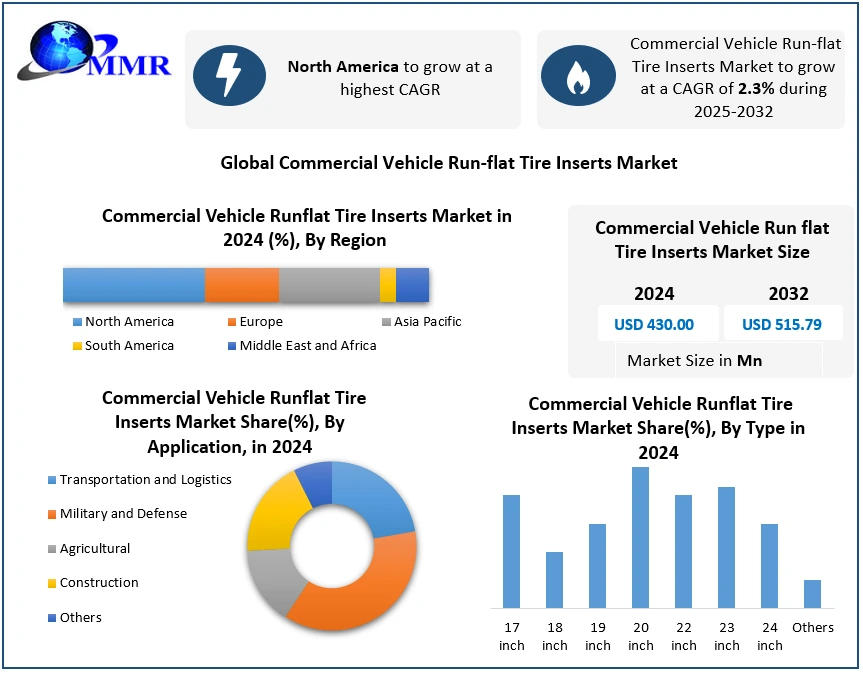
- Commercial Vehicle Run-flat Tire Inserts Market valued at USD 430.00 million in 2024
- Market projected to reach USD 515.79 million by 2032
- Forecast CAGR stands at 2.3%
- Fleet reliability and operational continuity remain primary investment drivers
- Defense and specialized commercial vehicles continue to support demand
- OEM and aftermarket opportunities are expanding alongside vehicle safety requirements
Why This Matters Now
Transportation companies are under pressure to improve fleet utilization while reducing unplanned maintenance events. Logistics operators face tighter delivery schedules, rising operating costs, and increasing customer expectations for uninterrupted service.
Run-flat tire inserts directly address these challenges by allowing vehicles to continue operating after tire damage, reducing roadside disruptions and improving mission readiness. For defense fleets, emergency services, mining vehicles, and specialized commercial operations, the technology delivers operational continuity where vehicle immobilization is unacceptable.
The business implication extends beyond safety. Fleet owners increasingly evaluate technologies based on total operating cost, vehicle availability, and risk reduction. Run-flat systems contribute across all three performance metrics.
Market Overview
The Commercial Vehicle Run-flat Tire Inserts Market occupies a specialized position within the broader commercial vehicle components industry. Unlike traditional tire technologies focused primarily on durability, run-flat inserts provide continued vehicle mobility following tire puncture or pressure loss.
Demand is supported by commercial transportation, military applications, construction equipment, mining operations, emergency response vehicles, and other specialized mobility segments where operational downtime has significant financial or operational consequences.
Vehicle manufacturers are simultaneously integrating higher safety standards while fleet operators continue investing in technologies that improve reliability across increasingly demanding operating environments. These parallel trends are strengthening long-term demand fundamentals.
Although market expansion remains measured, value creation increasingly depends on technological differentiation, product durability, compatibility with modern vehicle platforms, and lifecycle performance rather than production scale alone.
Key Trends Driving Growth
Vehicle uptime has become one of the strongest competitive differentiators across commercial transportation. Logistics providers, public transportation agencies, and industrial fleets continue prioritizing technologies that minimize disruptions throughout vehicle service life.
Safety regulations are also influencing purchasing decisions. Fleet managers increasingly evaluate components that improve operational security while reducing accident risks associated with sudden tire failures.
The growing complexity of commercial transportation networks further supports demand. Longer delivery routes, remote operating environments, and expanding infrastructure projects increase the importance of technologies capable of maintaining mobility despite unexpected tire damage.
Aftermarket demand continues to create additional opportunities as fleet operators retrofit existing vehicles instead of replacing entire fleets. This expands the addressable market beyond new vehicle production and creates recurring revenue opportunities for suppliers.
OEM collaboration is becoming increasingly important. Vehicle manufacturers continue evaluating integrated mobility solutions that enhance vehicle reliability without compromising overall performance characteristics.
Supply chain resilience also remains a strategic consideration. Manufacturers continue emphasizing production efficiency, material quality, and manufacturing consistency to meet customer expectations for long service life and predictable performance.
Segment Insights
The supplied report excerpt does not provide segment-level leadership or fastest-growing segment information. Accordingly, unavailable data has been omitted.
- Dominant Segment: Not specified in the supplied report.
- Fastest-Growing Segment: Not specified in the supplied report.
- Demand remains supported by commercial applications requiring uninterrupted vehicle mobility.
- Fleet operators continue emphasizing operational reliability and lifecycle performance when evaluating run-flat technologies.
Regional Growth Story
Commercial vehicle manufacturing hubs continue shaping demand across global markets. Countries with extensive logistics infrastructure, industrial transportation networks, and defense modernization programs remain important contributors to market development.
North America maintains strong demand driven by commercial freight transportation, public safety fleets, and defense applications. Fleet operators increasingly evaluate technologies that reduce downtime while improving operational resilience.
Europe benefits from advanced commercial vehicle manufacturing capabilities alongside stringent vehicle safety expectations. Commercial fleet modernization continues supporting investments in higher-performance mobility solutions.
Asia-Pacific remains a strategically important manufacturing region as commercial vehicle production expands across major industrial economies. Infrastructure development, industrial logistics, and increasing commercial transportation activity continue creating long-term opportunities for specialized vehicle technologies.
The report does not specify regional market leadership or comparative market shares; therefore, detailed regional rankings have been omitted.
Competitive Landscape
Competition increasingly centers on engineering capability rather than production volume alone. Suppliers capable of delivering durable, lightweight, and application-specific run-flat systems are positioned to strengthen relationships with OEMs and specialized fleet operators.
Technology leadership increasingly depends on continuous product development, manufacturing quality, and compatibility with diverse commercial vehicle platforms. As fleet customers prioritize lifecycle value, suppliers with proven field performance gain pricing advantages and stronger customer retention.
OEM partnerships remain strategically significant because factory integration improves product adoption while expanding long-term supply agreements. Companies securing these relationships can strengthen recurring revenue streams and improve competitive positioning.
The report emphasizes market competition but does not specify acquisitions, partnerships, investments, or company-specific strategic developments. Consequently, no unsupported competitive events have been included.
Recent Developments
- The Commercial Vehicle Run-flat Tire Inserts Market was valued at USD 430.00 million in 2024.
- Market value is projected to reach USD 515.79 million by 2032.
- Forecast growth rate stands at 2.3% during the forecast period.
- The supplied report excerpt does not disclose additional recent corporate developments, acquisitions, partnerships, or capacity expansions.
Strategic Implications
For OEMs, integrating run-flat technologies strengthens product differentiation while supporting higher vehicle safety standards. Manufacturers capable of offering enhanced mobility solutions can improve their competitive positioning in specialized commercial vehicle segments.
Tier-1 suppliers should continue investing in product engineering, materials innovation, and manufacturing efficiency. As fleet customers increasingly evaluate total ownership costs, suppliers demonstrating superior durability and operational performance gain stronger negotiating leverage.
Fleet operators benefit through reduced operational interruptions, lower recovery costs, and improved vehicle utilization. These improvements become increasingly valuable as logistics networks grow more time-sensitive and customer service expectations continue rising.
Investors should recognize that this market prioritizes profitability, technology specialization, and recurring replacement demand over rapid volume expansion. Stable demand fundamentals create opportunities for companies focused on high-value engineering solutions.
Future Outlook
Commercial vehicle mobility will increasingly prioritize resilience alongside efficiency. As transportation networks become more complex and fleet utilization intensifies, technologies that prevent costly operational interruptions will continue gaining strategic importance. Companies that combine engineering innovation with long-term OEM relationships will define the next phase of competitive leadership, while those competing primarily on price risk losing strategic relevance.
Analyst Perspective
“Commercial vehicle operators continue prioritizing technologies that improve operational continuity, vehicle safety, and lifecycle efficiency. Run-flat tire inserts remain an important solution for fleets seeking greater reliability across demanding operating environments while supporting long-term mobility requirements,” says Tejaswini Kakade, Analyst, Maximize Market Research.
About Maximize Market Research
Maximize Market Research Pvt. Ltd. (MMR) is a global market research and consulting company that provides reliable, data-focused, and practical business insights. The firm serves a wide range of industries, including healthcare, pharmaceuticals, technology, automotive, electronics, chemicals, personal care, and consumer goods. Through market forecasts, competitive analysis, strategic consulting, and industry impact assessments, MMR helps organizations understand changing market conditions, identify growth opportunities, and make informed business decisions for long-term success.
2nd Floor, Navale IT Park Phase 3
Pune Banglore Highway, Narhe
Pune, Maharashtra 411041, India
+91 9607365656
sales@maximizemarketresearch.com
