Key Highlights
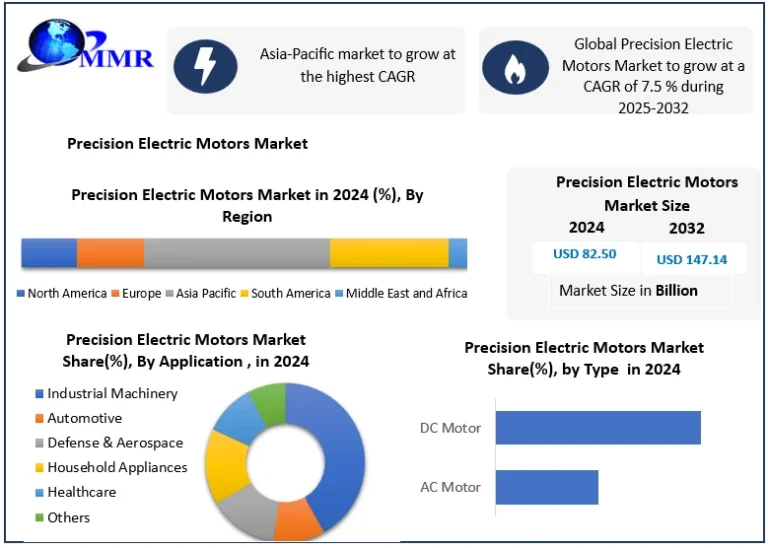
- Precision Electric Motors Market was valued at USD 82.50 billion in 2024 and is projected to reach USD 147.14 billion by 2032, growing at a 7.5% CAGR.
- Industrial machinery remains the largest application segment, supported by factory automation and precision manufacturing.
- Automotive demand is expanding as EV manufacturers adopt high-efficiency brushless motor technologies.
- Asia-Pacific continues to strengthen its position as a global manufacturing hub for precision electric motors.
- Leading manufacturers are competing through technology development, product efficiency, and industrial automation capabilities.
Why This Matters Now
Automotive manufacturers are redesigning powertrains while factories accelerate automation investments. Both transitions depend on precision electric motors capable of delivering higher efficiency, tighter motion control, and greater reliability.
That convergence creates a larger strategic opportunity than simple component demand. Suppliers that improve motor efficiency, manufacturing scale, and application-specific performance will be positioned to capture business from OEMs, industrial equipment manufacturers, robotics companies, and emerging electric mobility platforms.
Market Overview
The Precision Electric Motors Market is entering a phase where industrial modernization and transportation electrification reinforce one another. According to Maximize Market Research, the market reached USD 82.50 billion in 2024 and is expected to climb to USD 147.14 billion by 2032, representing a 7.5% compound annual growth rate.
Industrial users continue to invest in robotics, CNC equipment, automated assembly lines, and material handling systems that require highly accurate motion control. Every production upgrade increases demand for motors capable of delivering repeatable performance while reducing operating costs.
Automotive manufacturers are creating another growth engine. Electric vehicle production requires compact, energy-efficient motors across propulsion systems and numerous auxiliary applications. The report identifies automotive as a strong-growth application supported by expanding EV production and increasing use of brushless motor technologies.
For investors, the market signals durable demand driven by manufacturing investment rather than a single product cycle. For suppliers, technology differentiation increasingly determines pricing power.
Key Trends Driving Growth
Industrial automation continues to reshape purchasing priorities. Manufacturers seek higher productivity, reduced downtime, and improved precision, making advanced electric motors central to smart factory investments. The expansion of Industry 4.0 initiatives strengthens demand across industrial machinery applications.
Electric vehicle adoption is creating additional opportunities for precision motor suppliers. Automotive manufacturers increasingly integrate brushless motors because they offer improved energy efficiency and torque characteristics. That transition aligns motor innovation directly with vehicle efficiency targets.
Continuous improvements in DC motor technology are lowering costs while increasing operational efficiency. These advances expand commercial viability across industrial equipment, household appliances, healthcare devices, and transportation systems.
The report does not provide verified information regarding semiconductor dependencies, raw material sourcing, charging infrastructure investments, hydrogen fuel-cell deployment, autonomous driving development, pricing trends, fleet electrification, aftermarket activity, or international trade flows. Those topics are therefore omitted.
Segment Insights
- Dominant Application Segment: Industrial Machinery leads the market, supported by increasing automation, robotics deployment, CNC machining, and precision engineering requirements across manufacturing facilities.
- Fastest-Growing Application: Automotive benefits from rising electric vehicle production and broader adoption of brushless motors that improve efficiency and torque performance.
- End-Use Industry Leader: Textiles and Utilities represent the leading end-use category, driven by automated production systems requiring highly accurate motor control.
- Technology Trend: Ongoing innovation in DC motor technology continues to improve efficiency while reducing ownership costs across multiple industries.
Regional Growth Story
Asia-Pacific remains central to global precision motor manufacturing. China, Japan, India, South Korea, and ASEAN countries combine extensive manufacturing capacity with expanding automation investments, supporting sustained demand across industrial and automotive applications.
North America continues to benefit from advanced manufacturing modernization and investments by automation specialists serving industrial equipment producers. The presence of established motion-control suppliers supports continued innovation across multiple end markets.
Europe maintains strong demand through Germany and other manufacturing economies where industrial automation, machine tools, and precision engineering remain strategic priorities. Automotive manufacturing also continues to support precision motor deployment across production systems and vehicle applications.
The report identifies regional coverage across North America, Europe, Asia-Pacific, South America, and the Middle East & Africa but does not quantify country-specific EV adoption rates, infrastructure spending, or production capacity expansions.
Competitive Landscape
Competition increasingly centers on technology leadership rather than manufacturing volume alone.
Major companies including Siemens, Bosch Rexroth, Nidec, Johnson Electric, ABB, Rockwell Automation, Allied Motion Technologies, Franklin Electric, Maxon Motor, SEW-Eurodrive, Faulhaber, Oriental Motor, Toshiba Industrial Products and Systems, Wolong Electric Group, Schneider Electric, and WEG compete across industrial automation, precision engineering, and advanced motion-control applications.
Manufacturers capable of delivering higher efficiency, improved reliability, compact designs, and application-specific customization strengthen relationships with OEM customers seeking long-term productivity improvements. As automation investments accelerate, technology differentiation becomes increasingly important for maintaining premium pricing and expanding market share.
The report includes competitive benchmarking along with merger and acquisition coverage, but it does not disclose specific acquisition, partnership, platform launch, or capacity expansion details. Those developments are therefore not interpreted beyond the report’s published information.
Recent Developments
- Continued innovation in DC motor technology is improving operational efficiency while reducing costs.
- Industrial automation investments continue supporting higher deployment of precision motors across manufacturing environments.
- Automotive manufacturers continue increasing adoption of brushless motor technologies within electric vehicle applications.
Strategic Implications
Precision electric motors are becoming strategic enablers of manufacturing competitiveness. Industrial equipment producers require greater accuracy and automation while vehicle manufacturers pursue higher efficiency across electric platforms.
For Tier-1 suppliers, investment priorities increasingly shift toward motor efficiency, intelligent motion control, and scalable manufacturing capabilities. OEM procurement strategies are likely to reward suppliers capable of delivering consistent quality, engineering flexibility, and application-specific performance rather than competing solely on cost.
Investors should monitor companies expanding technology portfolios aligned with industrial automation and electric mobility, where long-term demand drivers appear structurally stronger than traditional replacement cycles.
Future Outlook
The Precision Electric Motors Market is positioned for sustained expansion as industrial automation and vehicle electrification continue to increase demand for efficient, high-performance motion systems; companies that combine advanced engineering with scalable production will define the industry’s next generation of market leaders.
Analyst Perspective
“Industrial automation and the growing adoption of electric vehicles are expanding the need for precision electric motors that deliver greater efficiency, reliability, and performance across multiple industries. Manufacturers that continue advancing motor technologies are well positioned to capture long-term opportunities created by these structural shifts.” — Tejaswini Kakade, Analyst
About Maximize Market Research
Maximize Market Research Pvt. Ltd. (MMR) is a global market research and consulting company that provides reliable, data-focused, and practical business insights. The firm serves a wide range of industries, including healthcare, pharmaceuticals, technology, automotive, electronics, chemicals, personal care, and consumer goods. Through market forecasts, competitive analysis, strategic consulting, and industry impact assessments, MMR helps organizations understand changing market conditions, identify growth opportunities, and make informed business decisions for long-term success.
2nd Floor, Navale IT Park Phase 3
Pune Banglore Highway, Narhe
Pune, Maharashtra 411041, India
+91 9607365656
sales@maximizemarketresearch.com
