Key Highlights
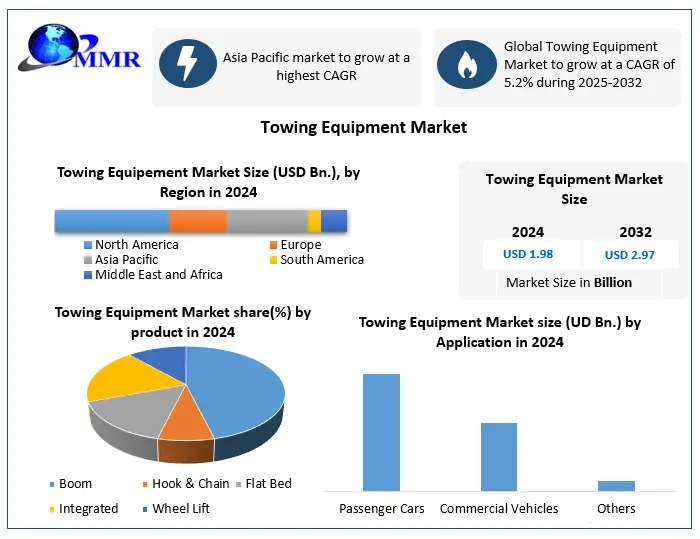
The global Towing Equipment Market size achieved an institutional valuation of USD 1.98 billion in 2024 and is projected to expand to USD 2.97 billion by 2032.
The sector operates on a resilient growth timeline, sustaining a compounded annual growth rate (CAGR) of 5.2% across the forecast period from 2025 to 2032.
Tow bars represent the dominant hardware configuration, maintaining high-volume installation metrics across commercial and utility passenger lines.
The commercial transportation segment stands out as the primary application driver, sustained by dense global freight shipping schedules.
The Asia-Pacific region commands a leading geographic production footprint, supported by massive automotive assembly hubs across major manufacturing corridors.
Why This Matters Now
Logistics executives, Tier-1 chassis engineers, and fleet operations managers face immediate procurement urgency as expanding international trade links strain existing light and heavy transport networks. High-density cargo distribution structures impose continuous stress on mechanical coupling systems, requiring immediate capital allocation toward high-fatigue-resistant hardware to prevent severe road accidents. Operating teams can no longer accept the unscheduled vehicle down-time linked with legacy, uncertified hitches when handling tight global supply chains. Component fabricators that delay moving production from low-margin standard steel brackets toward high-tensile, lightweight alloy towing assemblies face immediate commercial exclusion by volume vehicle brands. With the global marketplace expanding toward a USD 2.97 billion endpoint by 2032, long-term sourcing victories belong to organizations that successfully match structural towing capacity with rigid vehicle weight-reduction criteria.
Market Overview
The global towing equipment market encompasses the specialized structural engineering, chemical metallurgical treating, automated forging, and multi-stage verification testing of coupling hardware designed to link trailing units to prime movers. These vital mechanical components dictate total vehicle towing capacities, maximum tongue weight boundaries, and overall highway safety margins under varying loading distributions. The hardware category covers robust tow bars, ball mounts, fifth-wheel hitches, pintle hooks, and specialized recovery couplers. As global vehicle engineering rules restrict gross weights to maximize efficiency, these structural steel elements are evolving into advanced, low-mass configurations optimized for maximum tensile strength.
Key Trends Driving Growth
Accelerating global vehicle production counts combined with strict regional transport safety codes serve as the primary engine for continuous towing hardware adoption. Transportation safety authorities are enforcing aggressive cargo restraint guidelines that require transport operators to utilize certified, high-strength couplers that eliminate decoupling hazards during high-speed transit. Because a uniform, industrial-grade tow hitch provides verified structural load pathways between trailers and vehicle frames, its installation is expanding rapidly across new commercial fleets.
Simultaneously, the widespread structural expansion of e-commerce logistics channels and local last-mile distribution networks acts as a core catalyst for technology variation. Delivery networks operate under continuous shift schedules that require frequent vehicle reconfigurations, demanding modular, quick-change hitches to speed up loading tasks. This continuous utilization establishes a highly predictable replacement parts pipeline for component fabricators worldwide, shielding them against broader light-vehicle production drops.
Segment Insights
Tow Bars [Dominant Segment]: This hardware configuration holds the dominant share of the global marketplace. Preferred for standard commercial trucks and utility utility vehicles, tow bars offer a cost-effective, highly reliable connection method that distributes tongue weight safely into vehicle frames.
Commercial Transportation [Dominant Application Segment]: Within the broad vehicular application structure, heavy multi-axle cargo trucks, urban delivery vans, and industrial freight platforms represent the absolute majority of total market volume.
High-Tensile Alloy Hitches [Fastest-Growing Trend]: Driven directly by the urgent corporate push to eliminate dead weight from vehicle frames, specialized light-alloy towing variants represent the fastest-increasing engineering focus across major production plants.
Regional Growth Story
The Asia-Pacific region commands a dominant position in the global towing equipment market landscape, establishing itself as a vital manufacturing cluster through the forecast timeline. This geographic leadership is heavily supported by the massive vehicle assembly networks expanding across China, India, Japan, and South Korea, where heavy industrial logistics centers rely on millions of material moving assets. The high density of local component manufacturing plants gives domestic suppliers exceptional production scale advantages.
Concurrently, North America occupies a powerful high-value market position, driven by deep consumer demand for full-size light trucks and heavy fifth-wheel recreational systems. Regional sourcing networks focus heavily on integrating smart coupling verification setups into automated commercial vehicle lines. Western Europe follows a parallel premium development path, supported by tough regional road safety audits and widespread vehicle modification habits across Germany and the UK.
Competitive Landscape
The competitive matrix of the global towing equipment market is characterized by a concentrated core of high-capacity technology providers who leverage deep metal treatment patents and high delivery precision to secure volume contracts. Pricing power belongs exclusively to tier-1 manufacturing groups who can deliver specialized, zero-defect coupling frames that simplify vehicle installation metrics. Dominant market participants protect their market share by locking down direct factory original equipment (OE) supply agreements with major truck builders while simultaneously running extensive international aftersales replacement channels. Smaller regional machine shops and independent component fabricators face intense margin competition due to volatile raw metal costs, forcing them to focus on custom agricultural setups or local distribution deals to survive direct competition with global volume leaders.
Recent Developments
Market leaders—including Horizon Global Corporation, Curt Manufacturing, and B&W Trailer Hitches—continue to scale up their structural forging lines to fulfill high-volume transport contracts.
Top-tier component providers—such as Brink Group, Bosal, and Westfalia-Automotive—have advanced their research investments, focusing on hidden, retractable tow bars to maintain optimal vehicle aerodynamics.
High-volume suppliers have systematically shortened their system design timelines, deploying advanced computer modeling to shrink coupling dimensions and lower total raw metal consumption.
Sourcing networks have integrated advanced anti-corrosion chemical dip treatments to satisfy the extended durability lifespans demanded by multi-national logistics fleets.
Strategic Implications
For structural chassis engineers and Tier-1 component providers, the clear industry movement toward vehicle optimization requires an immediate focus on lightweight high-tensile alloy compositions. Eliminating unnecessary mass from the coupling frame allows component makers to offer clear fuel-saving and battery-range advantages to volume-conscious automotive OEMs who must defend strict fleet emission averages.
Furthermore, to hedge against shifting raw metal access and volatile international steel pricing, towing equipment manufacturers must build highly resilient multi-sourced steel and alloy component pipelines. Suppliers must also align their forward capacity plans with the fast-expanding Asia-Pacific market, setting up optimized regional production networks to easily feed the massive passenger vehicle and commercial truck production lines expanding across the territory.
Future Outlook
The ultimate line of separation in the vehicle coupling sector will isolate advanced metallurgical engineering innovators who master ultra-lightweight, high-fatigue-resistant alloy towing systems from legacy metal shops stuck fabricating heavy, static steel hitch blocks.
Analyst Perspective
“The global towing equipment market is navigating a structural transition where traditional mechanical mass must transform into intelligent, lightweight coupling efficiency,” states Dharati Raut, Research Analyst at Maximize Market Research. “As commercial freight volumes climb globally and automotive platforms penalize heavy accessory designs, the engineering focus must lock onto advanced high-tensile alloy innovations to secure future platform contracts.”
About Maximize Market Research
Maximize Market Research Pvt. Ltd. (MMR) is a global market research and consulting company that provides reliable, data-focused, and practical business insights. The firm serves a wide range of industries, including healthcare, pharmaceuticals, technology, automotive, electronics, chemicals, personal care, and consumer goods. Through market forecasts, competitive analysis, strategic consulting, and industry impact assessments, MMR helps organizations understand changing market conditions, identify growth opportunities, and make informed business decisions for long-term success.
2nd Floor, Navale IT Park Phase 3
Pune Banglore Highway, Narhe
Pune, Maharashtra 411041, India
+91 9607365656
sales@maximizemarketresearch.com
