Key Highlights
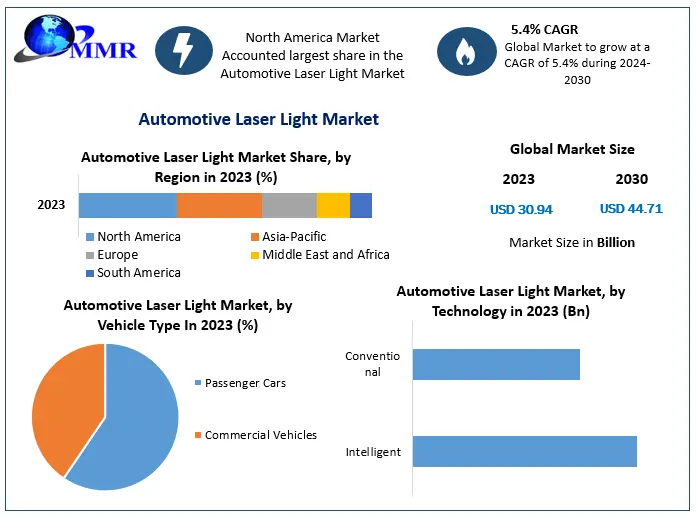
- Automotive Laser Light Market valued at USD 30.94 billion in 2023.
- Market projected to reach USD 44.71 billion by 2030.
- Forecast CAGR stands at 5.4% during 2024–2030.
- Europe remains the leading regional market.
- Premium passenger vehicles continue to drive OEM adoption.
- Electric vehicle manufacturers increasingly evaluate laser lighting because of lower power consumption.
- Aftermarket demand is expanding alongside vehicle customization trends.
- Strategic collaborations between automakers and lighting suppliers are accelerating innovation.
Why This Matters Now
Automakers are entering a new phase of competition where lighting technology influences both vehicle performance and brand positioning. OEMs, Tier-1 suppliers, investors, and mobility strategists now view advanced lighting as part of the broader shift toward intelligent, energy-efficient vehicles rather than a styling upgrade.
Laser lighting offers greater illumination while consuming less electrical power than conventional alternatives. As vehicle electrification advances and premium buyers demand more sophisticated safety features, manufacturers are expanding investments in advanced lighting systems to strengthen product differentiation and improve driving performance.
Market Overview
The Automotive Laser Light Market was valued at USD 30.94 billion in 2023 and is expected to reach USD 44.71 billion by 2030, growing at a 5.4% CAGR during the forecast period.
Automotive lighting has progressed rapidly from incandescent bulbs to HID, Xenon, LED and now laser-based systems. Laser headlights deliver stronger illumination with lower energy consumption, making them increasingly attractive for premium vehicles and electric mobility platforms. The technology remains in the early stages of commercial deployment, with penetration concentrated in flagship vehicle models where manufacturers can justify higher system costs through premium positioning.
For suppliers, the market represents a transition from component competition toward integrated lighting systems. Companies capable of combining optics, electronics and intelligent lighting software stand to gain stronger relationships with global OEMs.
Key Trends Driving Growth
Vehicle electrification continues to strengthen the business case for laser lighting. Electric vehicles operate within tight energy budgets, making lower-power lighting technologies increasingly valuable. Reduced energy consumption can improve overall vehicle efficiency while supporting longer driving range.
Premium vehicle manufacturers remain the first adopters of laser lighting technology. Rather than competing solely on horsepower or infotainment, luxury brands increasingly differentiate through advanced safety systems and high-performance illumination. This strategy allows OEMs to command premium pricing while reinforcing technological leadership.
The aftermarket is also emerging as an additional growth opportunity. Rising consumer interest in vehicle customization is creating demand for advanced lighting upgrades beyond factory installations. Although OEM installations remain dominant, aftermarket channels broaden revenue opportunities for lighting suppliers.
Technology partnerships are becoming equally important. The report highlights collaboration between Volkswagen and Hella in developing IQ.LIGHT LED Matrix Headlamps, illustrating how automakers increasingly rely on specialist lighting suppliers to accelerate innovation cycles. Such partnerships strengthen supplier positioning while helping OEMs shorten development timelines.
Segment Insights
- Dominant Segment: The report segments the market by Vehicle Type (Passenger Cars and Commercial Vehicles), Technology (Intelligent and Conventional), and Product Type. The report does not identify a dominant segment within these categories.
- Fastest-Growing Segment: Not specified in the report.
- Electric vehicle manufacturers are increasingly evaluating laser lighting because the technology requires less electricity than conventional LED systems, creating long-term opportunities as EV production expands.
- Aftermarket demand is expected to benefit from growing vehicle customization activities, complementing OEM installations.
Regional Growth Story
Europe leads the Automotive Laser Light Market thanks to its concentration of established automotive lighting manufacturers, including major suppliers such as OSRAM GmbH and Valeo S.A. Strong demand for luxury vehicles provides an ideal environment for introducing advanced lighting technologies that command higher margins.
North America also benefits from growing luxury vehicle demand, supporting gradual adoption of laser lighting systems. Installation rates are expected to strengthen over time as premium vehicle sales expand and technology costs gradually improve.
Asia-Pacific presents a different growth profile. The report indicates that adoption has been relatively slower because a larger share of vehicle demand remains concentrated in lower-priced models with fewer premium features. However, expanding investment by major companies across emerging markets is expected to generate future opportunities as advanced lighting becomes more commercially accessible.
South America and other developing regions are expected to follow adoption trends established in mature automotive markets. As premium technologies become more affordable, these regions could represent the next phase of market expansion.
Competitive Landscape
Competition increasingly revolves around technology leadership rather than production scale alone.
Lighting specialists are investing in advanced optical systems while collaborating closely with global vehicle manufacturers. These relationships enable suppliers to become strategic development partners instead of commodity component vendors.
Manufacturers are focusing on intelligent lighting architectures that improve visibility, enhance vehicle safety and support premium vehicle positioning. Companies capable of delivering complete lighting systems—including hardware, optics and electronic control technologies—are likely to strengthen pricing power as OEMs seek integrated solutions.
The industry’s organized structure also creates higher barriers to entry. Complex system engineering, expensive raw materials and significant research investments limit participation to established automotive suppliers with advanced manufacturing capabilities.
Recent Developments
- Volkswagen and Hella collaborated to develop IQ.LIGHT LED Matrix Headlights, demonstrating growing strategic partnerships between automakers and lighting specialists.
- Premium vehicle manufacturers continue introducing advanced lighting systems as factory-installed features on flagship models.
- Vehicle customization trends are supporting expanding aftermarket opportunities for advanced automotive lighting solutions.
- Electric vehicle manufacturers are showing greater interest in laser lighting because of lower energy consumption compared with conventional alternatives.
Strategic Implications
For OEMs, laser lighting has become part of broader vehicle technology strategies that combine efficiency, safety and premium differentiation.
Tier-1 suppliers have an opportunity to deepen long-term relationships by delivering integrated lighting platforms rather than standalone components. Investors should monitor companies capable of scaling production while maintaining technological leadership in advanced optics and intelligent lighting electronics.
The report does not provide specific information regarding semiconductor dependencies, manufacturing capacity expansion, trade flows, pricing trends, fleet electrification programs, hydrogen mobility, autonomous driving investments, connectivity platforms, emission regulations, charging infrastructure investments or raw material supply chain developments. These topics are therefore omitted.
Future Outlook
The next phase of competition will reward manufacturers that integrate energy-efficient laser lighting into premium mobility platforms while building strategic supplier partnerships; companies that delay adoption risk losing differentiation in an increasingly technology-driven automotive market.
Analyst Perspective
“Automotive laser lighting is moving beyond premium styling toward becoming an efficiency and performance technology that aligns with future vehicle development priorities. As OEMs pursue advanced lighting solutions alongside vehicle electrification, strategic collaboration across the automotive value chain will remain a defining competitive advantage.” — Tejaswini Kakade
About Maximize Market Research
Maximize Market Research Pvt. Ltd. (MMR) is a global market research and consulting company that provides reliable, data-focused, and practical business insights. The firm serves a wide range of industries, including healthcare, pharmaceuticals, technology, automotive, electronics, chemicals, personal care, and consumer goods. Through market forecasts, competitive analysis, strategic consulting, and industry impact assessments, MMR helps organizations understand changing market conditions, identify growth opportunities, and make informed business decisions for long-term success.
2nd Floor, Navale IT Park Phase 3
Pune Banglore Highway, Narhe
Pune, Maharashtra 411041, India
+91 9607365656
sales@maximizemarketresearch.com
