Key Highlights
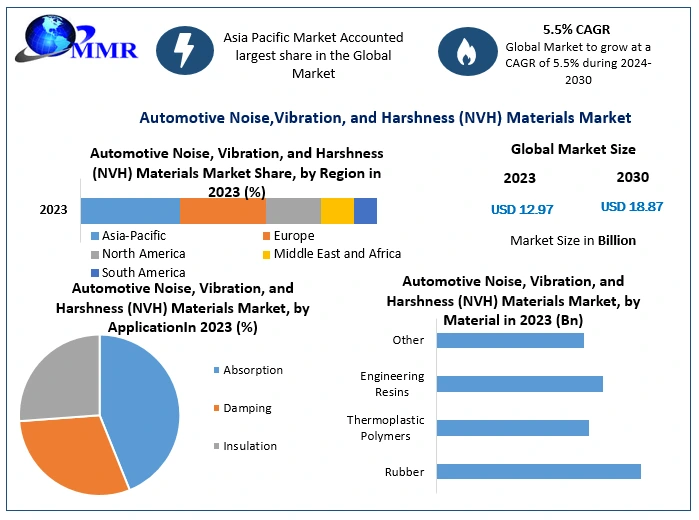
- Automotive Noise, Vibration, and Harshness (NVH) Materials Market stood at USD 12.97 billion in 2023.
- Market revenue is forecast to reach USD 18.87 billion by 2030 at a 5.5% CAGR.
- Rising electric vehicle adoption is creating new demand for advanced acoustic and vibration management.
- Lightweight materials are becoming central to balancing efficiency with cabin comfort.
- North America remains the leading regional market.
- Autonomous mobility and shared transportation concepts are expanding long-term NVH requirements.
Why This Matters Now
Automakers are entering a phase where vehicle refinement has become a competitive differentiator rather than a premium feature. As electric powertrains eliminate engine noise, customers increasingly notice road, wind, and structural sounds that previously remained masked.
That changes procurement priorities across OEMs, Tier-1 suppliers, investors, and material manufacturers. Companies that develop lighter, more effective acoustic solutions can improve vehicle range, passenger comfort, warranty performance, and brand perception simultaneously. The market’s projected expansion from USD 12.97 billion in 2023 to USD 18.87 billion by 2030 demonstrates that NVH engineering is becoming an essential investment rather than a secondary design consideration.
Market Overview
The Automotive Noise, Vibration, and Harshness (NVH) Materials Market reduce unwanted sound transmission and structural vibration throughout a vehicle. They include insulation, damping, and absorption solutions integrated into floors, doors, dashboards, body panels, and glazing systems.
Automotive manufacturers are increasing investment because customer expectations continue to shift toward quieter cabins, improved ride quality, and premium driving experiences. Regulatory attention on warranty claims associated with noise and vibration is also encouraging manufacturers to strengthen vehicle refinement throughout development cycles.
Electrification adds another layer of complexity. Internal combustion engines naturally mask several frequencies. Electric drivetrains remove that masking effect, exposing rolling, aerodynamic, and structural noise that requires more sophisticated NVH engineering. The result is stronger demand for innovative lightweight materials capable of improving comfort without reducing driving range.
Key Trends Driving Growth
Electric vehicles are redefining acoustic engineering. Battery-powered vehicles require quieter cabins because electric motors generate substantially less mechanical noise than conventional engines. That makes previously unnoticed sounds immediately apparent to passengers, increasing demand for advanced insulation and damping materials.
Lightweight material innovation represents another major shift. Manufacturers are adopting advanced glazing, foam laminates, and engineered materials capable of reducing weight while maintaining or improving vibration control. According to the report, lightweight glazing solutions can reduce weight by approximately 30% to 40% without compromising NVH performance, supporting both efficiency and passenger comfort.
Future mobility concepts are expanding the role of NVH technologies. Autonomous driving and shared mobility place greater emphasis on passenger experience because occupants increasingly treat vehicles as workspaces or relaxation environments rather than purely transportation assets. Quieter interiors therefore become a commercial advantage.
Powertrain downsizing also influences demand. Smaller turbocharged engines introduce different vibration characteristics, encouraging manufacturers to integrate additional NVH materials that maintain refinement despite compact engine architectures. However, additional material weight remains an engineering trade-off that suppliers continue to address through advanced material science.
Segment Insights
- Dominant Application: The report segments the market into Absorption, Damping, and Insulation applications but does not identify the dominant segment.
- Fastest-Growing Application: Not specified in the report.
- Material Segments: Rubber, Thermoplastic Polymers, Engineering Resins, and Others.
- End-Use Industries: Automotive, Aerospace, Consumer Goods, Power Tools, and Others.
- EV Opportunity: Electric vehicle manufacturers increasingly require lightweight acoustic materials that preserve battery range while improving cabin refinement.
Regional Growth Story
North America is expected to maintain the largest market share throughout the forecast period. The region benefits from established automotive manufacturing, continuous vehicle technology investments, and strong customer demand for comfort-oriented vehicles.
Europe continues to emphasize quieter and more efficient vehicle platforms as manufacturers respond to evolving mobility expectations and engineering innovation. Germany remains particularly important because of its concentration of premium automotive manufacturers.
Asia-Pacific represents a significant manufacturing base, supported by China, Japan, South Korea, and India. Rising vehicle production, expanding EV adoption, and growing consumer demand for higher-quality interiors create long-term opportunities for NVH material suppliers across the region. The report identifies these countries among its major regional markets but does not provide country-level market shares or growth rankings.
Competitive Landscape
The competitive environment increasingly rewards suppliers capable of combining lightweight construction with superior acoustic performance. Material innovation now influences OEM sourcing decisions as much as traditional cost considerations.
Research and development spending has become a strategic differentiator. Manufacturers are investing in advanced foam laminates, engineered polymers, and acoustic glazing technologies that improve vibration damping while minimizing additional vehicle mass. These investments strengthen supplier positioning as automakers accelerate electrification programs.
The report emphasizes broader technology advancement rather than detailing acquisitions, partnerships, manufacturing expansions, semiconductor dependencies, pricing trends, trade flows, or competitive transactions. Those developments are therefore not reported.
Recent Developments
- Rising electric vehicle sales continue to increase demand for advanced NVH solutions.
- Lightweight glazing technologies demonstrate significant weight reduction while maintaining acoustic performance.
- Foam laminates are seeing wider application across floor insulation, door insulation, floor lining, and vehicle cushioning.
- Autonomous mobility concepts are expanding future requirements for quieter passenger cabins.
Strategic Implications
OEMs now face competing objectives: reducing vehicle weight, extending EV driving range, improving passenger comfort, and controlling manufacturing costs. NVH material suppliers capable of delivering all four advantages simultaneously will strengthen long-term relationships with global vehicle manufacturers.
Tier-1 suppliers also gain opportunities by integrating advanced acoustic solutions earlier in vehicle development programs. Investors should monitor companies developing lightweight damping materials and advanced insulation technologies, as these segments align closely with electrification and premium vehicle trends.
Fleet operators benefit as quieter cabins improve passenger satisfaction in shared mobility and commercial transportation applications, potentially enhancing fleet utilization and customer retention.
Future Outlook
The Automotive Noise, Vibration, and Harshness (NVH) Materials Market is transitioning from traditional comfort engineering toward strategic vehicle differentiation. Electrification, lightweight construction, and autonomous mobility will continue increasing demand for sophisticated acoustic solutions across global automotive manufacturing.
Manufacturers that combine material innovation with lightweight engineering will be best positioned to capture long-term growth, while companies relying on conventional insulation technologies risk losing relevance as vehicle architectures evolve.
The next generation of automotive leaders will compete as much on silence and refinement as on power, efficiency, and software capability.
Analyst Perspective
“The growing transition toward electric mobility and lightweight vehicle engineering is accelerating demand for advanced NVH materials that enhance passenger comfort while supporting vehicle efficiency. Companies that innovate in acoustic performance without adding significant weight will shape the market’s next phase of growth.” — Tejaswini Kakade
About Maximize Market Research
Maximize Market Research Pvt. Ltd. (MMR) is a global market research and consulting company that provides reliable, data-focused, and practical business insights. The firm serves a wide range of industries, including healthcare, pharmaceuticals, technology, automotive, electronics, chemicals, personal care, and consumer goods. Through market forecasts, competitive analysis, strategic consulting, and industry impact assessments, MMR helps organizations understand changing market conditions, identify growth opportunities, and make informed business decisions for long-term success.
2nd Floor, Navale IT Park Phase 3
Pune Banglore Highway, Narhe
Pune, Maharashtra 411041, India
+91 9607365656
sales@maximizemarketresearch.com
