Key Highlights
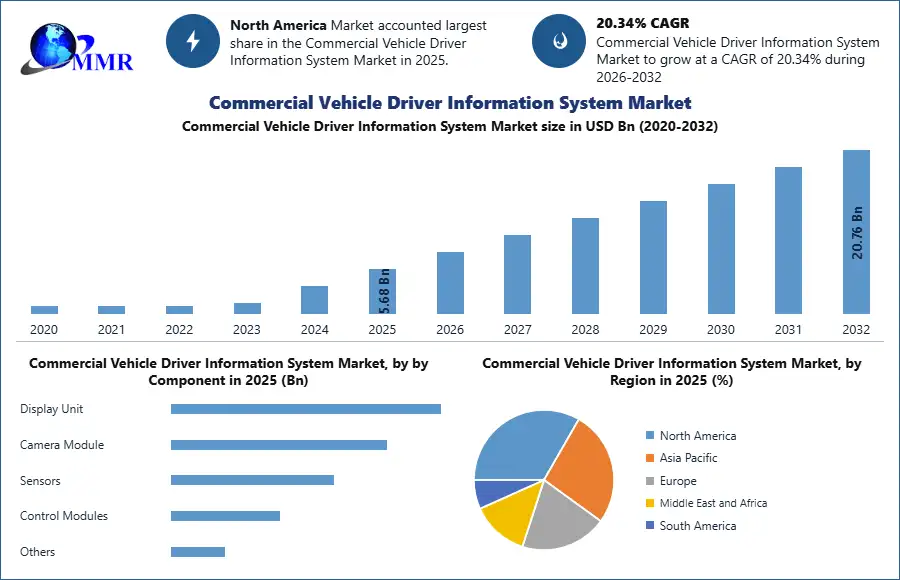
- The Commercial Vehicle Driver Information System Market was valued at USD 5.68 Billion in 2025, highlighting the increasing role of digital technologies in commercial transportation.
- The market is projected to reach USD 20.76 Billion by 2032, creating substantial opportunities for OEMs, Tier-1 suppliers, software companies, and fleet technology providers.
- The market is expected to expand at a 20.34% CAGR from 2025 to 2032, signaling rapid adoption of connected commercial vehicle ecosystems.
- Software-defined vehicles, telematics, and intelligent driver interfaces are becoming essential fleet management tools.
- Fleet electrification, ADAS integration, and predictive analytics continue reshaping commercial vehicle operations.
Why This Matters Now
Commercial transportation is no longer defined solely by engines, payload capacity, or operating costs. Digital intelligence has become a strategic asset, transforming commercial vehicles into connected platforms capable of improving safety, productivity, regulatory compliance, and fleet profitability.
The Commercial Vehicle Driver Information System Market was valued at USD 5.68 Billion in 2025. That valuation demonstrates growing investment in digital commercial vehicle technologies and encourages manufacturers to accelerate software integration, intelligent driver interfaces, and connected mobility solutions. The market is expected to reach USD 20.76 Billion by 2032, growing at a 20.34% CAGR, indicating that digital transformation is becoming a core competitive differentiator across commercial transportation.
Market Overview
Driver information systems have evolved far beyond conventional instrument clusters. Modern commercial vehicles increasingly function as intelligent mobility platforms that integrate telematics, vehicle diagnostics, navigation, predictive maintenance, driver assistance, and real-time fleet analytics into unified digital ecosystems.
Fleet operators are responding to increasing operational complexity. Rising fuel costs, stricter regulatory requirements, driver shortages, sustainability targets, and customer expectations require greater visibility across every vehicle operating within commercial fleets.
OEMs increasingly view digital cockpit technologies as essential competitive differentiators. Connected displays, cloud integration, intelligent notifications, vehicle health monitoring, and software-enabled fleet services are becoming standard capabilities rather than premium features.
The transition toward software-defined commercial vehicles also changes supplier priorities. Electronics, semiconductors, sensors, digital displays, software platforms, cybersecurity, and cloud connectivity are becoming as strategically important as traditional mechanical systems.
Key Trends Driving Growth
Fleet digitization continues accelerating across logistics, construction, mining, municipal transportation, and long-haul trucking. Organizations increasingly invest in driver information systems that improve operational efficiency while reducing maintenance costs and safety risks.
Software-defined vehicle architecture is transforming commercial transportation. Modern driver information systems integrate multiple vehicle functions into centralized digital interfaces capable of supporting over-the-air software updates, predictive diagnostics, and continuous feature improvements throughout vehicle lifecycles.
ADAS integration continues strengthening market demand. Commercial operators increasingly value technologies that improve driver awareness, reduce accident risk, and enhance regulatory compliance through intelligent monitoring and real-time alerts.
Fleet electrification is also expanding technology requirements. Electric commercial vehicles require sophisticated energy management systems capable of displaying battery performance, charging status, regenerative braking information, and route optimization for maximum operational efficiency.
Semiconductor technology remains fundamental to digital vehicle development. High-performance processors, graphics systems, sensors, and communication modules enable increasingly sophisticated driver information platforms while supporting future autonomous driving capabilities.
Cloud connectivity and telematics continue improving fleet visibility. Real-time diagnostics, predictive maintenance, remote monitoring, and intelligent fleet analytics allow operators to optimize asset utilization while minimizing vehicle downtime.
Segment Insights
- Dominant Segment: Information not available in the supplied source.
- Fastest-Growing Segment: Information not available in the supplied source.
- Connected driver interfaces continue evolving into comprehensive fleet intelligence platforms.
- ADAS integration and real-time vehicle diagnostics remain major product development priorities.
- Commercial vehicle manufacturers increasingly combine software, connectivity, and digital safety systems into unified cockpit architectures.
Regional Growth Story
The United States continues leading connected commercial vehicle adoption through advanced fleet management technologies, logistics modernization, and strong investment in digital transportation infrastructure.
Germany remains at the forefront of commercial vehicle engineering, integrating intelligent software platforms, connected mobility, and advanced driver assistance technologies into next-generation commercial vehicles.
China continues expanding commercial transportation digitization alongside large-scale manufacturing, intelligent logistics development, and connected vehicle investment. Manufacturing scale and rapid technology adoption strengthen its strategic market position.
Japan and South Korea remain leaders in automotive electronics, semiconductor innovation, digital displays, and intelligent vehicle technologies. Their expertise supports continued advancement in commercial vehicle information systems.
India’s commercial transportation sector continues modernizing through digital fleet management, logistics optimization, and expanding infrastructure investment, creating long-term opportunities for connected commercial vehicle technologies.
Regional competitiveness increasingly depends on software capability, semiconductor availability, telecommunications infrastructure, and digital ecosystem development rather than vehicle manufacturing volume alone.
Competitive Landscape
Competition in the Commercial Vehicle Driver Information System Market increasingly revolves around software leadership rather than hardware capability alone. OEMs compete by delivering integrated digital ecosystems that improve fleet productivity while strengthening vehicle intelligence.
Tier-1 suppliers are expanding beyond traditional automotive electronics into cloud software, digital interfaces, cybersecurity, telematics, artificial intelligence, and predictive analytics. These capabilities strengthen supplier relevance as vehicles become increasingly software-defined.
Semiconductor providers have become strategically critical. High-performance processors enable advanced graphical interfaces, ADAS functionality, autonomous-ready architectures, and real-time fleet intelligence, making semiconductor availability an important competitive factor.
Technology partnerships are becoming increasingly valuable. Collaboration between automotive manufacturers, software developers, telecommunications providers, cloud companies, and mobility platform operators accelerates innovation while reducing development complexity.
Pricing power increasingly depends on recurring software value rather than one-time hardware sales. Subscription-based fleet services, predictive maintenance platforms, remote diagnostics, and digital mobility ecosystems generate long-term customer relationships beyond vehicle delivery.
Recent Developments
- OEMs continue expanding software-defined commercial vehicle strategies.
- Fleet operators are increasing adoption of connected driver information systems.
- ADAS integration remains a major investment priority across commercial transportation.
- Cloud-based fleet management and telematics platforms continue expanding.
- Semiconductor innovation is supporting increasingly sophisticated digital cockpit technologies.
Strategic Implications
The Commercial Vehicle Driver Information System Market reflects the broader digital transformation of commercial transportation. Vehicles are increasingly becoming intelligent business assets capable of generating operational data throughout their entire service lifecycle.
Fleet operators benefit through improved driver productivity, enhanced safety, predictive maintenance, regulatory compliance, and lower operating costs. Digital visibility increasingly influences profitability as much as traditional vehicle performance.
OEMs must evolve from hardware manufacturers into software-enabled mobility providers capable of delivering integrated digital ecosystems. Suppliers similarly benefit by expanding into cloud services, artificial intelligence, connectivity platforms, cybersecurity, and advanced vehicle software.
Investors increasingly evaluate commercial vehicle technology companies based on software capability, recurring digital revenue, semiconductor partnerships, and ecosystem integration rather than conventional component manufacturing alone.
Future Outlook
The Commercial Vehicle Driver Information System Market is entering a decisive growth phase where software-defined vehicles, connected fleet ecosystems, artificial intelligence, and intelligent mobility platforms collectively redefine commercial transportation. The market’s expansion from USD 5.68 Billion in 2025 to an expected USD 20.76 Billion by 2032, supported by a 20.34% CAGR, demonstrates that digital intelligence has become central to commercial vehicle competitiveness.
The industry’s future leaders will be those that transform commercial vehicles into continuously connected, software-driven mobility platforms that generate operational value throughout every mile of operation, while companies focused solely on hardware will steadily lose strategic influence in the next generation of commercial transportation.
Analyst Perspective
“The Commercial Vehicle Driver Information System Market demonstrates how software, connectivity, and intelligent vehicle technologies are becoming fundamental components of commercial transportation. Companies that combine advanced digital platforms with scalable automotive engineering will be best positioned to lead the next generation of connected commercial mobility.” — Tejaswini Kakade, Analyst
About Maximize Market Research
Maximize Market Research Pvt. Ltd. (MMR) is a global market research and consulting company that provides reliable, data-focused, and practical business insights. The firm serves a wide range of industries, including healthcare, pharmaceuticals, technology, automotive, electronics, chemicals, personal care, and consumer goods. Through market forecasts, competitive analysis, strategic consulting, and industry impact assessments, MMR helps organizations understand changing market conditions, identify growth opportunities, and make informed business decisions for long-term success.
2nd Floor, Navale IT Park Phase 3
Pune Banglore Highway, Narhe
Pune, Maharashtra 411041, India
+91 9607365656
sales@maximizemarketresearch.com
