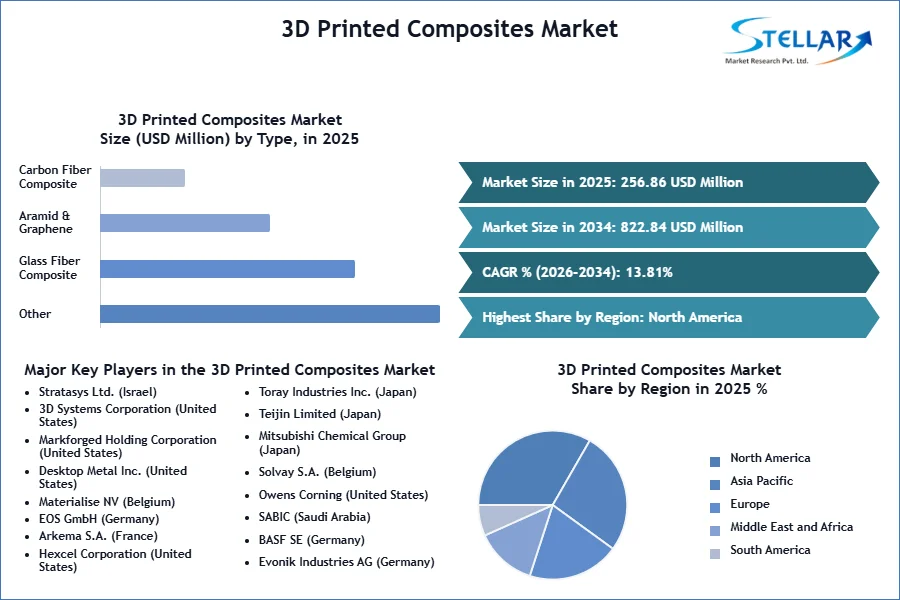
The 3D Printed Composites Market has emerged as a transformative segment within additive manufacturing by combining advanced polymers, metals, ceramics, and reinforcing materials such as carbon fiber, glass fiber, and aramid fiber. These composite materials enable manufacturers to produce complex geometries with superior mechanical strength, reduced weight, and enhanced design flexibility while minimizing material waste and production costs.
Growing demand for customized products, rapid prototyping, lightweight engineering solutions, and sustainable manufacturing practices is driving market expansion. Continuous advancements in 3D printing technologies, composite materials, and digital design software are further accelerating industry adoption.
Increasing Demand for Lightweight Components Drives Market Growth
One of the primary drivers of the 3D Printed Composites Market is the growing need for lightweight yet durable components across multiple industries. Composite materials offer excellent strength-to-weight ratios, making them ideal for applications where performance and efficiency are critical.
3D printed composites are widely used in:
Aerospace components
Automotive parts
Medical implants
Industrial tooling
Construction elements
Consumer products
Robotics components
Defense equipment
These applications improve product performance while reducing material usage and manufacturing complexity.
𝐃𝐨𝐰𝐧𝐥𝐨𝐚𝐝 𝐅𝐫𝐞𝐞 𝐏𝐃𝐅 𝐁𝐫𝐨𝐜𝐡𝐮𝐫𝐞: https://www.stellarmr.com/report/req_sample/3D-Printed-Composites-Market/1452
Aerospace and Automotive Industries Fuel Adoption
The aerospace and automotive sectors are among the largest adopters of composite additive manufacturing due to the need for lightweight, high-strength components that improve fuel efficiency and operational performance.
Key applications include:
Structural aircraft components
Interior cabin parts
Lightweight vehicle components
Performance prototypes
Customized tooling
Engine-related parts
Drone structures
Electric vehicle components
These industries benefit from shorter production cycles and greater design flexibility.
Material Innovation Expands Performance Capabilities
Continuous advancements in composite materials are enabling manufacturers to develop parts with enhanced mechanical, thermal, and chemical properties.
Major material innovations include:
Carbon fiber-reinforced polymers
Glass fiber composites
Kevlar-reinforced materials
Ceramic matrix composites
Metal-polymer hybrid composites
High-temperature engineering thermoplastics
Continuous fiber reinforcement
Bio-based composite materials
These materials deliver improved durability, stiffness, and dimensional stability for demanding applications.
𝐃𝐨𝐰𝐧𝐥𝐨𝐚𝐝 𝐅𝐫𝐞𝐞 𝐏𝐃𝐅 𝐁𝐫𝐨𝐜𝐡𝐮𝐫𝐞: https://www.stellarmr.com/report/req_sample/3D-Printed-Composites-Market/1452
Digital Manufacturing Enhances Production Efficiency
The integration of digital technologies is transforming additive manufacturing workflows and improving production quality.
Emerging technologies include:
AI-assisted design optimization
Generative design software
Digital twins
Automated print monitoring
Predictive maintenance
Cloud-based manufacturing platforms
Real-time process analytics
Smart factory integration
These technologies reduce production errors, optimize material usage, and improve manufacturing efficiency.
Sustainability Supports Market Expansion
Manufacturers are increasingly leveraging 3D printed composites to reduce environmental impact through efficient production methods and material optimization.
Key sustainability initiatives include:
Reduced material waste
Lightweight product design
Recyclable composite materials
Bio-based feedstocks
Energy-efficient manufacturing
On-demand production
Localized manufacturing
Circular economy practices
These initiatives help organizations lower production costs while supporting environmental goals.
Regional Market Insights
North America
North America leads the 3D Printed Composites Market, supported by strong aerospace and defense industries, advanced manufacturing capabilities, significant investments in additive manufacturing technologies, and expanding healthcare applications.
Europe
Europe continues to witness substantial growth due to increasing adoption of Industry 4.0 technologies, strong automotive manufacturing, sustainable production initiatives, and extensive research in advanced materials.
Asia Pacific
Asia Pacific is projected to register the fastest growth, driven by rapid industrialization, expanding electronics and automotive industries, increasing investments in additive manufacturing, and growing demand for high-performance materials across China, Japan, South Korea, India, and Southeast Asia.
Latin America, Middle East, and Africa
These regions are gradually expanding their adoption of additive manufacturing technologies through industrial modernization, infrastructure development, and increasing investments in advanced manufacturing.
Competitive Landscape
The 3D Printed Composites Market is highly competitive, with additive manufacturing companies, advanced material suppliers, industrial equipment manufacturers, and research organizations investing heavily in product innovation.
Major competitive strategies include:
Development of advanced composite materials
Expansion of industrial 3D printing capabilities
Strategic technology partnerships
Research and development investments
Product portfolio diversification
Manufacturing automation
Global market expansion
Sustainable material innovation
Companies continue focusing on improving print quality, production speed, material performance, and cost efficiency.
Emerging Opportunities
Several trends are expected to shape future market growth:
Continuous fiber 3D printing
AI-driven additive manufacturing
Large-format composite printing
Multi-material 3D printing
Sustainable composite materials
Digital inventory manufacturing
Customized medical implants
Smart manufacturing ecosystems
These innovations are expected to expand industrial applications while improving production flexibility and product performance.
Future Outlook
The future of the 3D Printed Composites Market remains highly promising as industries continue embracing digital manufacturing, lightweight engineering, and sustainable production methods. Advances in material science, automation, AI-powered design optimization, and high-speed additive manufacturing will further strengthen market growth.
Manufacturers that prioritize innovation, material development, production scalability, sustainability, and digital transformation will be well positioned to capitalize on the expanding global demand for advanced composite manufacturing solutions.
Conclusion
The 3D Printed Composites Market is transforming modern manufacturing by enabling the production of lightweight, durable, and highly customized components for aerospace, automotive, healthcare, construction, and industrial applications. Rising demand for advanced materials, rapid prototyping, sustainable production, and smart manufacturing technologies is creating significant opportunities across the global industrial landscape.
As additive manufacturing continues to evolve and industries increasingly adopt high-performance composite materials, the 3D Printed Composites Market is expected to witness sustained long-term growth, benefiting material suppliers, equipment manufacturers, industrial producers, research institutions, and investors worldwide.
