Key Highlights
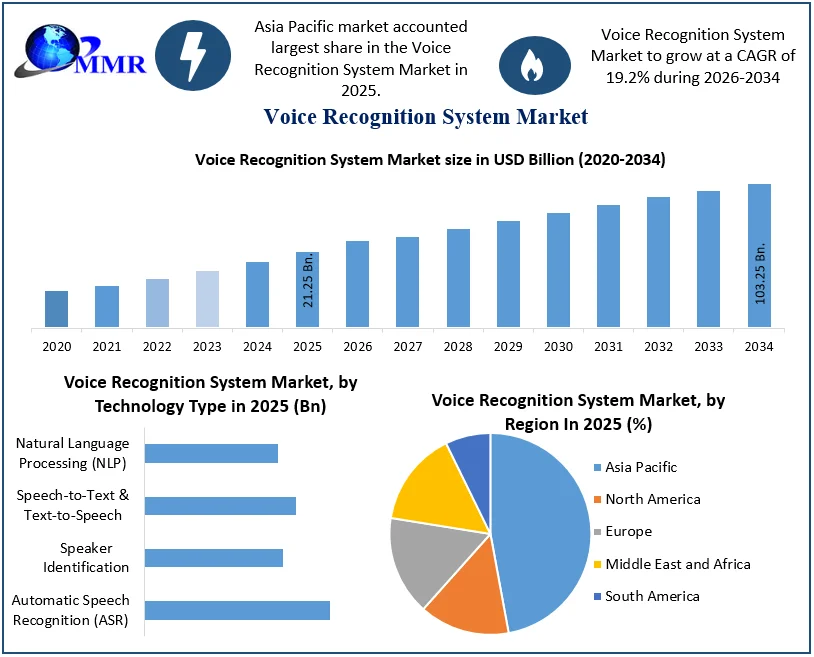
- The Voice Recognition System Market was valued at USD 21.25 Billion in 2025, reflecting rapid adoption of AI-powered human-machine interfaces across industries, including automotive.
- The market is expected to reach USD 103.25 Billion by 2034, creating significant opportunities for OEMs, AI developers, semiconductor suppliers, and connected mobility providers.
- The market is projected to grow at a 19.2% CAGR from 2026 to 2034, signaling accelerated investment in intelligent voice-enabled technologies.
- Voice-enabled digital cockpits are becoming central to software-defined vehicle strategies.
- Artificial intelligence, cloud connectivity, ADAS integration, and connected mobility ecosystems continue driving innovation.
Why This Matters Now
The automotive industry’s next competitive advantage is increasingly determined by how drivers interact with software rather than how they operate mechanical controls. Voice recognition systems are rapidly becoming the primary interface between drivers, connected vehicles, and intelligent mobility ecosystems, supporting safer, hands-free interaction while enhancing the digital driving experience.
The Voice Recognition System Market was valued at USD 21.25 Billion in 2025. That market size reflects rising investment in artificial intelligence and intelligent vehicle interfaces, encouraging OEMs to expand AI-enabled cockpit capabilities across future vehicle platforms. The market is expected to reach USD 103.25 Billion by 2034, growing at a 19.2% CAGR, demonstrating that voice-first interaction is becoming an essential component of next-generation transportation.
Market Overview
Voice recognition technology has evolved from simple command processing into sophisticated artificial intelligence capable of understanding conversational language, contextual intent, and personalized driver preferences. In modern vehicles, voice recognition increasingly serves as the central interface connecting drivers with navigation, entertainment, climate control, communications, vehicle diagnostics, and connected cloud services.
Automotive manufacturers are simultaneously responding to two major industry transformations. Software-defined vehicles continue replacing hardware-centric architectures with digital platforms, while increasingly connected mobility ecosystems demand safer methods of managing complex vehicle functions.
Voice recognition directly addresses these challenges by minimizing driver distraction while improving accessibility, safety, and convenience. Instead of relying on touchscreens or physical controls, drivers increasingly interact naturally with intelligent virtual assistants capable of processing complex requests in real time.
The technology also strengthens broader mobility ecosystems by connecting vehicles to cloud platforms, over-the-air software updates, predictive maintenance systems, navigation services, smart infrastructure, and digital commerce platforms.
Key Trends Driving Growth
Artificial intelligence remains the primary catalyst reshaping voice recognition systems. Advances in natural language processing, machine learning, and contextual understanding allow modern systems to recognize conversational speech with greater accuracy while supporting increasingly personalized driver experiences.
Software-defined vehicles continue accelerating demand for intelligent voice interfaces. Vehicle software increasingly controls navigation, infotainment, diagnostics, energy management, and connected services, making voice interaction a natural gateway to these expanding digital capabilities.
ADAS integration also strengthens adoption. Drivers can access navigation, safety alerts, route information, communication functions, and vehicle controls while maintaining visual focus on the road, improving operational safety alongside user convenience.
Electrification introduces additional opportunities. Battery electric vehicles require continuous interaction with charging information, battery status, energy consumption, regenerative braking settings, and route optimization, making voice assistants valuable tools for managing increasingly complex vehicle systems.
Cloud connectivity continues expanding system intelligence. Connected vehicles increasingly synchronize with smartphones, enterprise fleet platforms, smart homes, and digital ecosystems, allowing voice assistants to deliver contextual information beyond traditional vehicle functions.
Semiconductor innovation remains essential. High-performance processors, AI accelerators, advanced microphones, and digital signal processors enable real-time speech recognition while supporting multilingual capabilities, edge computing, and continuous software improvements.
Segment Insights
- Dominant Segment: Information not available in the supplied source.
- Fastest-Growing Segment: Information not available in the supplied source.
- AI-powered natural language processing continues improving in-vehicle voice experiences.
- Connected digital cockpit integration remains a major development priority.
- Automotive manufacturers increasingly integrate voice recognition with intelligent mobility ecosystems.
Regional Growth Story
The United States remains a global leader in artificial intelligence, cloud computing, software development, and connected mobility innovation. Automotive manufacturers continue integrating advanced voice technologies into premium and mainstream vehicle platforms.
Germany continues strengthening intelligent cockpit development through premium automotive engineering, software-defined vehicle investment, and advanced driver assistance technologies. Voice-enabled interfaces increasingly complement digital cockpit strategies.
China remains one of the fastest-moving connected vehicle markets, combining large-scale EV production with artificial intelligence development and smart mobility initiatives. Strong consumer demand accelerates adoption of intelligent voice-enabled vehicle technologies.
Japan continues leveraging leadership in automotive electronics, robotics, and precision engineering to enhance intelligent human-machine interfaces across future mobility platforms.
South Korea contributes through semiconductor manufacturing, display technologies, AI innovation, and connected electronics, strengthening the global automotive technology supply chain.
India is emerging as a promising market as connected mobility, premium vehicle adoption, digital infrastructure, and AI-powered transportation services continue expanding alongside broader automotive modernization.
Regional competitiveness increasingly depends on artificial intelligence capability, semiconductor availability, cloud infrastructure, software expertise, and connected mobility ecosystems rather than traditional vehicle production capacity alone.
Competitive Landscape
Competition in the Voice Recognition System Market increasingly focuses on software intelligence rather than hardware performance. OEMs now differentiate themselves through seamless AI experiences that integrate voice interaction, connected services, navigation, vehicle controls, and digital ecosystems into unified customer experiences.
Tier-1 suppliers continue expanding beyond conventional automotive electronics into artificial intelligence, cloud services, cybersecurity, embedded software, and natural language processing. These capabilities strengthen supplier relevance as vehicle software becomes increasingly central to competitive positioning.
Semiconductor manufacturers remain critical strategic partners. AI processors, edge computing platforms, digital signal processors, and high-performance computing architectures enable increasingly responsive voice recognition while supporting future autonomous driving applications.
Technology partnerships continue shaping competitive dynamics. Automotive manufacturers increasingly collaborate with AI software developers, cloud providers, telecommunications companies, and semiconductor firms to accelerate intelligent cockpit development while reducing engineering complexity.
Pricing power increasingly depends on software capability and recurring digital services rather than standalone hardware sales. Continuous software enhancements, cloud subscriptions, personalized voice assistants, and connected mobility services generate long-term customer engagement beyond initial vehicle purchases.
Recent Developments
- OEMs continue integrating AI-powered voice assistants into software-defined vehicle platforms.
- Connected vehicle ecosystems increasingly support cloud-based voice services.
- Natural language processing advancements continue improving conversational vehicle interfaces.
- Automotive semiconductor innovation is enabling faster on-device speech recognition.
- Voice recognition technologies are becoming increasingly integrated with ADAS and digital cockpit architectures.
Strategic Implications
The Voice Recognition System Market reflects a broader transformation in automotive user experience where software increasingly defines vehicle value. Voice interfaces enable safer interaction with growing digital functionality while strengthening customer engagement across connected mobility ecosystems.
OEMs benefit through stronger brand differentiation, enhanced user experience, and expanded software monetization opportunities. Suppliers similarly gain from increasing demand for AI platforms, embedded software, cloud connectivity, semiconductors, and digital cockpit technologies.
Investors increasingly evaluate companies based on artificial intelligence capability, software platforms, semiconductor partnerships, cloud ecosystem integration, and recurring software revenue rather than traditional automotive component manufacturing alone.
As autonomous driving technologies continue evolving, voice recognition systems will become increasingly central to vehicle interaction, enabling passengers to communicate naturally with intelligent mobility platforms throughout every journey.
Future Outlook
The Voice Recognition System Market is entering a period where artificial intelligence, software-defined vehicles, connected mobility, and intelligent human-machine interfaces collectively redefine automotive interaction. The market’s expansion from USD 21.25 Billion in 2025 to an expected USD 103.25 Billion by 2034, supported by a 19.2% CAGR, demonstrates that voice intelligence is rapidly becoming a foundational technology across next-generation transportation.
The automotive companies that integrate conversational AI, cloud connectivity, intelligent software, and personalized digital experiences into unified mobility ecosystems will define the future of connected transportation, while manufacturers that treat voice recognition as a standalone feature risk losing relevance in an increasingly AI-driven automotive industry.
Analyst Perspective
“The Voice Recognition System Market demonstrates how artificial intelligence is transforming vehicle interaction from mechanical control to natural conversation. Companies that combine AI innovation, software-defined vehicle architectures, and scalable digital ecosystems will be best positioned to lead the next generation of intelligent mobility.” — Tejaswini Kakade, Analyst
About Maximize Market Research
Maximize Market Research Pvt. Ltd. (MMR) is a global market research and consulting company that provides reliable, data-focused, and practical business insights. The firm serves a wide range of industries, including healthcare, pharmaceuticals, technology, automotive, electronics, chemicals, personal care, and consumer goods. Through market forecasts, competitive analysis, strategic consulting, and industry impact assessments, MMR helps organizations understand changing market conditions, identify growth opportunities, and make informed business decisions for long-term success.
2nd Floor, Navale IT Park Phase 3
Pune Banglore Highway, Narhe
Pune, Maharashtra 411041, India
+91 9607365656
sales@maximizemarketresearch.com
